The right mixer can make a karaoke setup sound clearer, louder, and easier to control. It also determines how smoothly microphones, music sources, speakers, TVs, and recording devices work together.
These 10 options cover simple home karaoke, wireless microphone systems, streaming, recording, and more advanced KTV-style setups. Use the guide below to match features and connections to your room and equipment.
Best 10 Audio Mixer for Karaoke Setup Picks for 2026
Versatile Bluetooth Pick
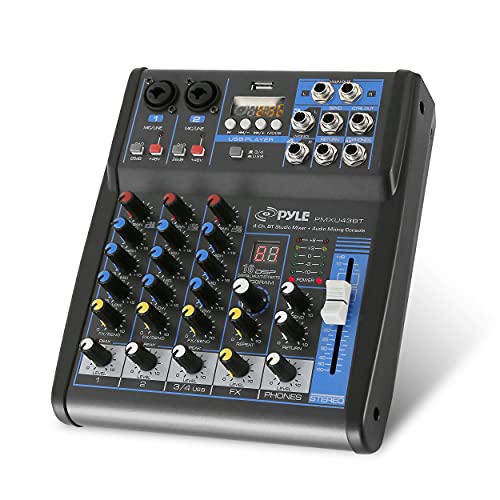
- Bluetooth, USB, flash-drive, and MP3 compatibility
- Four XLR/1/4-inch inputs with 48V phantom power
- 3-band EQ, LED peak indicators, and compact steel chassis
Best For: Home karaoke and small live setups needing wireless music playback
Wireless Mic System Pick
Sound Town SWM16-PRO Karaoke Mixer
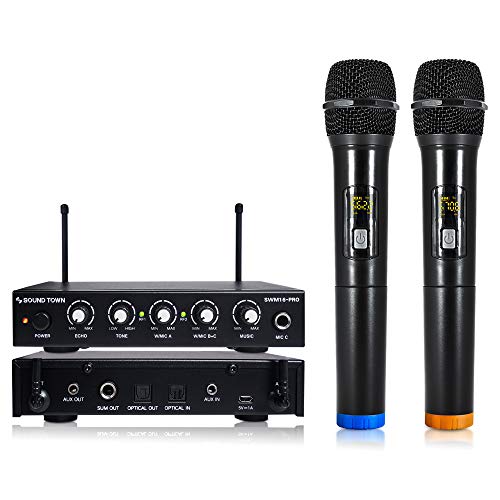
- Two handheld wireless microphones included
- Optical, 3.5mm, and 1/4-inch connection options
- 16 selectable UHF frequencies and vocal effect controls
Best For: TV, soundbar, and home theater karaoke
Clean Analog Choice
Yamaha MG06 6-Input Compact Mixer

- Six analog inputs with XLR outputs
- D-PRE preamps, 3-band EQ, and high-pass filters
- One-knob compressors and rugged metal chassis
Best For: Modular karaoke rigs using separate playback equipment
Feature-Rich Channel Upgrade

- Eight channels with XLR and 1/4-inch input support
- USB, Bluetooth, auxiliary, and recording features
- 3-band EQ, reverb, delay, and headphone monitoring
Best For: Expanded karaoke, streaming, recording, and small live shows
Best Portable Karaoke Kit
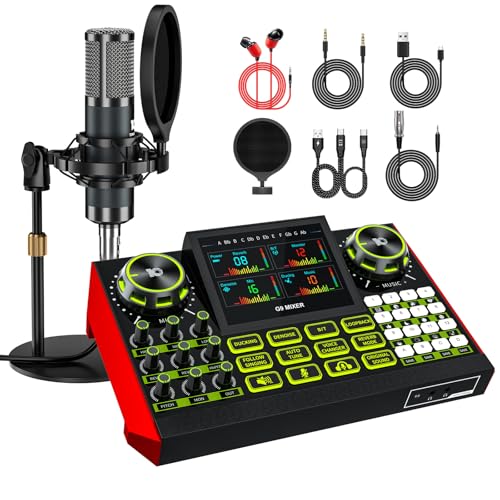
- Includes mixer, condenser microphone, and accessories
- Rechargeable battery with Bluetooth playback
- Noise reduction, vocal effects, and one-to-three-user support
Best For: Portable karaoke, solo singing, and beginner streaming
Best Versatile Mixer

- Three XLR inputs with 48V phantom power
- USB recording, USB playback, and Bluetooth streaming
- EQ, echo, delay, level display, and headphone monitoring
Best For: Home karaoke, multiple microphones, and small events
Best KTV Processor

- Four microphone inputs with vocal adjustments
- Anti-howling function for feedback suppression
- DSP effects, Bluetooth, USB, optical, and remote control
Best For: Dedicated KTV rooms and multi-microphone karaoke
Best for Smart TVs
Wireless TV Karaoke Mixer System
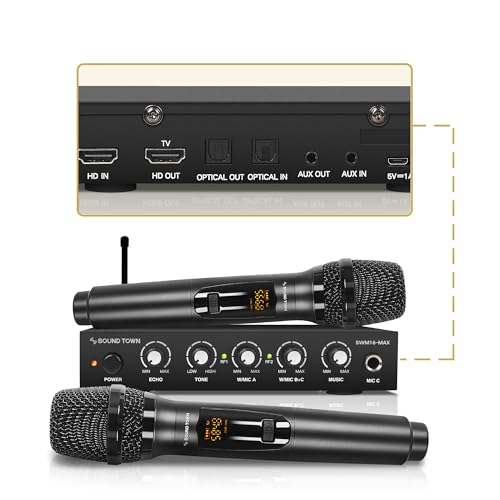
- HDMI ARC and optical audio support
- Includes two metal UHF microphones
- Separate mic volume with shared echo and tone controls
Best For: Living-room karaoke with a smart TV and soundbar
Best for Recording
Pyle 4-Channel Bluetooth Mixer

- USB soundcard for PC or Mac recording
- Bluetooth streaming with 15-foot stated range
- 48V phantom power and multiple microphone/line inputs
Best For: Home karaoke combined with basic recording
Versatile Bluetooth Pick – Pyle PMXU43BT 4-Channel Mixer
If you want an audio mixer for karaoke setup that can handle microphones, backing tracks, and basic recording, the Pyle PMXU43BT offers a flexible feature set in a compact chassis. Bluetooth, USB, flash-drive, and MP3 compatibility make it easy to add music without extra source equipment.
Best For: Home karaoke, small live performances, and users who want wireless music playback with microphone mixing.
Pros:
- Bluetooth streaming works with compatible phones, tablets, and computers.
- Four channels include XLR and unbalanced 1/4-inch inputs, plus 48V phantom power.
- Each channel provides a 3-band EQ, while LED peak indicators help monitor levels.
- Compact steel chassis with sealed rotary controls is designed for regular use.
Cons:
- It has only four channels, which may limit larger karaoke systems.
- Bluetooth, USB, and MP3 features add convenience but may require setup familiarity.
The PMXU43BT is a practical all-in-one choice when karaoke playback flexibility matters as much as microphone control. Its compact size and multi-voltage power supply also suit portable setups.
Wireless Mic System Pick – Sound Town SWM16-PRO Karaoke Mixer
For an audio mixer for karaoke setup built around wireless microphones and a television or soundbar, the Sound Town SWM16-PRO combines a receiver, mixer controls, and two handheld microphones. Optical and analog connections support a range of home entertainment equipment.
Best For: Home karaoke with smart TVs, soundbars, home theaters, and small to medium-sized events.
Pros:
- Includes two handheld wireless microphones and a receiver with mixer functionality.
- Optical, 3.5mm, and 1/4-inch connection options support varied audio systems.
- UHF operation provides 16 selectable frequencies, with eight frequencies per channel.
- Dedicated echo, tone, and volume controls help tailor vocal sound.
Cons:
- It is more specialized for wireless microphone karaoke than for multi-instrument mixing.
- Recommended volume settings require adjustment of the external speakers, microphones, and main mixer volume.
This system is a strong fit when simple wireless singing is the priority. Its optical connectivity is particularly useful for karaoke setups centered on compatible smart TVs, soundbars, or home theater receivers.
Clean Analog Choice – Yamaha MG06 6-Input Compact Mixer
The Yamaha MG06 is a straightforward audio mixer for karaoke setup when you prefer dependable analog control over built-in playback features. Its six inputs, XLR outputs, EQ, high-pass filters, and compact metal chassis provide a focused foundation for microphones and external music sources.
Best For: Users who already have a karaoke player or music source and want a durable, quality-focused analog mixer.
Pros:
- Six-input design provides more connection capacity than a basic four-channel mixer.
- D-PRE preamps are designed for natural bass and smooth high frequencies.
- 3-band EQ and high-pass filters help shape vocals and reduce unwanted noise.
- One-knob compressors can help produce cleaner, more controlled vocals.
Cons:
- No USB connection or built-in Bluetooth playback is included.
- You will need separate equipment for wireless microphones or digital music playback.
The MG06 makes sense for a modular karaoke rig where the source player and microphones are selected separately. It prioritizes solid analog mixing and rugged construction rather than convenience features.
Feature-Rich Channel Upgrade – 8-Channel USB Karaoke Mixer
This 8-channel board is a useful audio mixer for karaoke setup when you need several microphones or sources connected at once. USB, Bluetooth, auxiliary, and XLR connectivity support playback, recording, monitoring, and live sound applications.
Best For: Larger home karaoke systems, streaming, recording, small shows, and users needing multiple input channels.
Pros:
- Eight channels provide room for multiple microphones and other audio devices.
- USB playback and recording work with computers, flash drives, phones, tablets, and other compatible devices.
- Bluetooth enables wireless music streaming, while built-in controls manage playback.
- 3-band EQ, gain, reverb, delay, headphone monitoring, and LED peak indicators offer hands-on control.
Cons:
- The larger control set may be more involved than necessary for simple karaoke.
- It is corded electric and may require additional speakers and microphones.
With eight channels and a broad selection of inputs, this mixer is suited to karaoke systems that may expand into streaming, recording, or small live events. Its effects and monitoring features add flexibility for vocal-focused setups.
Best Portable Karaoke Kit – TENLAMP G9 Mixer Bundle
If you want an audio mixer for karaoke setup that is easy to transport and quick to connect, the TENLAMP G9 bundle is a convenient starting point. It combines a mixer with a 3.5mm condenser microphone, Bluetooth playback, a rechargeable battery, and phone or computer compatibility.
Best For: Solo singers, small group sessions, mobile karaoke, and beginner-friendly streaming setups.
Pros:
- Includes a 3.5mm condenser microphone and essential accessories.
- Rechargeable battery and Bluetooth support make it suitable for portable use.
- Offers noise reduction, reverb, bass, treble, pitch, and 12 sound effects.
- Supports one to three users and works with Windows, Mac, iOS, and Android.
Cons:
- Its two-channel design is less suited to larger karaoke systems.
- Some advanced effects and controls may require setup time for first-time users.
The G9 is a strong fit when portability and all-in-one convenience matter more than extensive channel capacity. Its included microphone and rechargeable design reduce the number of extra components needed for casual karaoke and live content.
Best Versatile Mixer – Aveek 5-Channel Audio Mixer
For a more expandable audio mixer for karaoke setup, the Aveek five-channel console provides multiple microphone and stereo inputs. It also adds Bluetooth playback, USB recording, 48V phantom power, headphone monitoring, and connections for active speakers or a power amplifier.
Best For: Home karaoke systems, multiple microphones, small events, streaming, and users who want recording capability.
Pros:
- Provides three XLR inputs plus 6.35mm and RCA stereo inputs.
- Supports 48V phantom power for compatible condenser microphones.
- Includes USB computer recording, USB drive playback, and Bluetooth streaming.
- Offers two-band EQ, gain controls, echo, delay, LED level monitoring, and headphone monitoring.
Cons:
- Bluetooth, USB, and four/five-channel functions cannot be used simultaneously.
- It requires corded power and is intended for active speakers or a power amplifier.
- The feature set may be more than needed for a simple single-microphone setup.
The Aveek is the practical choice for karaoke users who need several wired inputs and flexible connections. Its recording and monitoring features also make it useful beyond karaoke, although the simultaneous-use limitation should be considered when planning the system.
Best KTV Processor – K-6 Digital Karaoke Mixer
Designed specifically for KTV-style systems, the K-6 is an audio mixer for karaoke setup that emphasizes vocal effects, connectivity, and output flexibility. It combines echo and reverb processing with anti-howling technology, four microphone inputs, Bluetooth, USB, optical, AUX, and a remote control.
Best For: Dedicated home KTV rooms, multi-microphone karaoke, and users seeking extensive vocal and speaker-routing controls.
Pros:
- Provides four microphone inputs across front and rear connections.
- One-button howling prevention helps suppress feedback during singing.
- Supports Bluetooth, USB, AUX, optical, and multiple output configurations.
- Includes DSP effects, echo, reverb adjustments, and a remote control.
Cons:
- Its corded design is less convenient for portable karaoke.
- Fine-tuning some parameters requires adjusting hidden controls with a screwdriver.
- The specialized KTV layout may be excessive for basic casual use.
The K-6 stands out for a permanent karaoke room where microphone control, anti-feedback processing, and multiple audio outputs are priorities. It is less streamlined than a compact mixer, but its dedicated KTV features offer more control for a built-out system.
Best All-in-One Kit – 5-Channel Wireless Karaoke Mixer
If you want an audio mixer for karaoke setup that includes microphones and flexible source connections, this 5-channel system is a practical starting point. It combines two UHF handheld microphones with independent channel controls, Bluetooth playback, RCA/AUX inputs, and a USB audio interface for recording or playback.
Best For: Home karaoke, parties, small performances, and users who want a mixer-and-microphone bundle.
Pros:
- Includes two UHF wireless microphones with a stated reception range of up to 180 feet.
- Offers five channels with volume, echo, equalizer, and gain adjustments.
- Supports Bluetooth, RCA, AUX, USB, and XLR connectivity, plus 48V phantom power.
Cons:
- Bluetooth transmission is limited to a stated maximum of 35 feet.
- The two included microphones share channel 2.
- Microphones use AA batteries and are rated for approximately 4–6 hours of use.
This is a strong value-oriented choice when you need a complete karaoke package rather than a mixer alone. Its broad input selection and per-channel controls also leave room for other playback and recording applications.
Best for Smart TVs – Wireless TV Karaoke Mixer System
This audio mixer for karaoke setup is designed around modern home entertainment equipment. The SWM16-MAX can extract audio through HDMI ARC or optical connections, blend music with vocals, and send the result to a soundbar, receiver, or amplifier.
Best For: Smart TV karaoke setups using a soundbar, AV receiver, or other home audio system.
Pros:
- Provides HDMI ARC, optical Toslink, AUX, Bluetooth, and USB connectivity.
- Includes two metal handheld UHF wireless microphones.
- Offers separate microphone volume controls, shared echo and tone controls, and 16 selectable frequencies.
Cons:
- HDMI cable is not included.
- Echo and tone controls affect both connected microphones together.
- Additional microphones are optional and not included.
The main advantage here is straightforward TV integration: enable ARC, select PCM audio, and route the mixed signal to compatible external speakers. It is less focused on studio-style channel control, but particularly convenient for living-room karaoke.
Best for Recording – Pyle 4-Channel Bluetooth Mixer
For buyers who want an audio mixer for karaoke setup that can also support recording, the Pyle PMXU46BT provides four channels, a USB soundcard, Bluetooth streaming, and microphone inputs with 48V phantom power. Its knobs, LED indicators, and multiple outputs suit hands-on mixing.
Best For: Beginners and home users who want karaoke mixing alongside PC or Mac recording.
Pros:
- USB audio interface supports connection and recording with a PC or Mac.
- Bluetooth accepts wireless playback from phones, tablets, and MP3 players.
- Includes combo microphone/line inputs, headphone output, main outputs, and 48V phantom power.
Cons:
- Bluetooth range is stated as 15 feet.
- It does not include wireless microphones.
- Its four-channel layout provides fewer channels than the five-channel bundle in this roundup.
This mixer is a better fit for a flexible desktop or small recording setup than for someone seeking a ready-to-use karaoke package. Choose it when PC recording, wired microphone connectivity, and manual control matter more than included microphones.
How We Picked the Best Audio Mixer for Karaoke Setup
We focused on the connections and controls that matter most for karaoke: microphone inputs, music playback, speaker compatibility, echo or reverb effects, wireless support, and ease of setup. We also considered whether each mixer suits a basic living-room system, a Smart TV-based setup, live streaming, or more demanding recording and performance use.
Feature claims can vary by configuration, so check the product listing for exact input types, included microphones, output connections, and power requirements before buying. A mixer should complement your existing speakers and source devices rather than force you to replace them.
Quick Comparison
- Best for simple home use: Compact Pyle, Yamaha, and Aveek mixers offer straightforward controls and flexible basic connections.
- Best for wireless karaoke: Sound Town systems and the Pro 5-channel bundle include wireless microphone functionality for fewer cables.
- Best for Smart TV setups: Sound Town models with optical or HDMI audio-return support are designed for modern television connections.
- Best for streaming or recording: Mixers with USB audio interfaces make it easier to connect to a computer.
- Best for effects-focused karaoke: The K-6 digital processor emphasizes echo, reverb, anti-howling, and KTV-style control.
Key Buying Factors for an Audio Mixer for Karaoke Setup
Inputs and Source Connections
Count every microphone and playback source you plan to use at once. XLR inputs suit microphones, while stereo line inputs work for phones, media players, and other consumer devices. Bluetooth and USB can simplify playback, but they should not replace a connection you rely on for low-latency audio.
TV and Speaker Compatibility
Check whether your television uses optical, HDMI audio return, AUX, or another output. Confirm that the mixer’s outputs match your amplifier or powered speakers. Passive speakers generally require a separate amplifier, while powered speakers can connect directly to an appropriate line output.
Microphone and Vocal Controls
Independent microphone volume, tone, echo, and reverb controls make it easier for different singers to sound balanced. Phantom power is useful for compatible condenser microphones, but it is not required for most standard dynamic karaoke microphones.
Wireless, USB, and Effects
Wireless microphones reduce cable clutter, but range, battery life, and interference still matter. USB recording support is useful for streaming or capturing performances. Anti-feedback processing and adjustable digital effects are especially valuable in reflective rooms.
Who Should Buy Which Audio Mixer for Karaoke Setup?
Choose a compact mixer if you want affordable control for one or two microphones, a phone, and powered speakers. Choose a wireless karaoke system if convenience and Smart TV integration are more important than detailed manual mixing. Choose a USB-equipped mixer if you plan to stream, record, or use a computer as part of the setup. Choose a digital KTV processor if vocal effects, anti-howling tools, and dedicated karaoke controls are central to your experience.
Before ordering, verify included accessories, microphone frequencies, output formats, and whether cables or adapters are supplied. The best Audio Mixer for Karaoke Setup is the one that supports your current gear without adding unnecessary complexity.
