Freshly milled grain can bring more flavor, aroma, and control to homemade bread, pasta, and baked goods. The right grain mill depends on how often you bake, which grains you use, and whether you value speed, portability, or hands-on control.
We compare 10 grain mills ranging from compact electric grinders and stand-mixer attachments to manual cast-iron mills and high-capacity commercial-style machines.
Best 10 Grain Mills Picks for 2026
Best Overall Electric Mill

- 450-watt motor with thermal protection
- Corundum stones and adjustable texture control
- Compact design for home baking
Best For: Home bakers wanting adjustable electric milling
Best Stand Mixer Attachment

- Fits household KitchenAid stand mixers
- 12 grind levels from coarse to fine
- Includes a cleaning brush
Best For: KitchenAid owners milling low-moisture grains
Best High-Capacity Electric Mill

- Powerful 1200-watt motor
- 8-cup hopper and 12-cup flour canister
- Nesting parts support easier storage
Best For: Frequent bread bakers making larger batches
Best Manual Mill

- Durable cast iron construction
- Clamps to tables 1/2 to 2 inches thick
- Adjustable for coarse-to-finer grinding
Best For: Manual coarse grinding and multipurpose food preparation
Best Manual Grain Mill

- Made in Italy with chrome-steel construction
- Adjustable coarse, medium, and fine settings
- Grinds or flakes soft and hard grains
Best For: Home bakers seeking manual flour and flake making
Best High-Speed Grain Mill

- 25,000-rpm blades for fine dry powders
- 1000g capacity with stainless-steel body
- Overload protection and timed operation
Best For: Dry grains, spices, herbs, coffee, and beans
Best Heavy-Duty Grain Mill

- Handles both wet and dry grinding
- Powerful 3000W motor with adjustable thickness
- Cast-iron body for prolonged use
Best For: High-capacity grain, flour, feed, and wet-food processing
Compact High-Speed Pick
150g Stainless Steel Grain Grinder
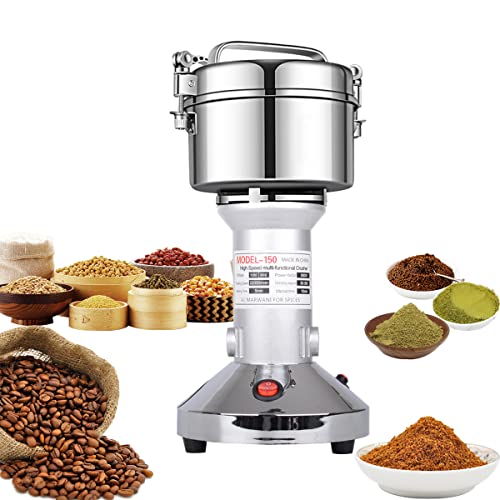
- 900W motor with 22,000 RPM speed
- Three-blade design with 50–300 mesh fineness
- Compact 150g capacity for dry ingredients
Best For: Small household batches of dry grains, spices, and herbs
Large-Batch Workhorse
VEVOR 1.8 lb Commercial Grain Mill

- 2,100W motor reaches 28,000 RPM
- 1.8 lb capacity with 800g swing cup
- 5-, 15-, and 30-second timed controls
Best For: Larger batches of dry grains, spices, cereals, and coffee
Safety-Focused Mid-Size Option
VEVOR 750g Electric Grain Mill

- 2,000W motor with 28,000 RPM speed
- 750g capacity and 30–300 mesh fineness
- Lid shutoff and overload protection included
Best For: Medium-size batches of dry grains, spices, cereals, and coffee
Best Overall Electric Mill – NutriMill Harvest
The NutriMill Harvest is a practical choice for home cooks comparing electric grain mills. Its 450-watt motor, corundum milling stones, and texture control knob are suited to making fresh flour for baking and gluten-free recipes.
Best For: Home bakers who want an adjustable electric mill with a compact footprint.
Pros:
- 450-watt heavy-duty motor
- Near-diamond-hard corundum milling stones
- Patented texture control knob for adjustment
- Thermal protection with automatic shutoff
Cons:
- Its 450 g capacity is smaller than some larger-batch mills
- At 19.3 pounds, it is not especially lightweight
With CSA testing and listing plus a design assembled in the USA, the Harvest offers a solid feature set for routine home milling. Its listed uses include various grains and, with proper cleaning, oily grains.
Best Stand Mixer Attachment – KitchenAid KGM Grain Mill
The KitchenAid KGM is a convenient option for shoppers seeking grain mills without another countertop motor. It attaches to household KitchenAid stand mixers and offers 12 grind levels for low-moisture, low-oil grains.
Best For: KitchenAid owners who want an integrated attachment for small-to-moderate milling tasks.
Pros:
- Fits all household KitchenAid stand mixers
- Offers 12 grind levels from coarse to fine
- Grinds wheat, corn, rice, and other suitable grains
- Includes a cleaning brush
Cons:
- Requires a compatible KitchenAid stand mixer
- Designed for low-moisture and low-oil grains
The KGM keeps storage and equipment needs simple by using a stand mixer you already own. Its aluminum construction and included brush make it a straightforward attachment for regular grain-grinding use.
Best High-Capacity Electric Mill – NutriMill Impact Compact
The NutriMill Impact Compact stands out among electric grain mills for its 1200-watt motor and impact milling heads. Its large hopper and flour canister are useful for frequent bread bakers who prepare larger batches of fresh flour.
Best For: Frequent bread bakers who value high power and larger batch capacity.
Pros:
- 1200-watt motor for hard grains such as wheat
- Impact heads designed for fine-textured bread flour
- 8-cup hopper and 12-cup flour canister
- Parts nest together for storage
Cons:
- Its high-speed electric design may be more capability than occasional users need
- The supplied notes do not specify grind adjustment levels
With a 20-cup listed capacity and patented cyclone air filtration, this mill is oriented toward efficient, repeated use. The nesting design helps offset its larger-batch focus by simplifying storage.
Best Manual Mill – Victoria Cast Iron Grain Mill
The Victoria Cast Iron Grain Mill is a hands-on alternative for shoppers comparing manual grain mills. Its clamp-on design, adjustable screw, and 2400 g capacity make it suitable for coarser grinding of grains and a wide range of other ingredients.
Best For: Users who prefer manual milling for corn, grains, brewing ingredients, spices, and other foods.
Pros:
- Heavy-duty cast iron construction with double tin plating
- Clamps to tables 1/2 to 2 inches thick
- Adjustable screw changes coarseness and fineness
- High hopper and 2400 g capacity
Cons:
- Cannot grind to a superfine texture
- Will not turn whole wheat into a fine powder
- Manual cranking requires physical effort
The Victoria is versatile and includes a non-slip rubber protector for more stable table use. It is best viewed as a durable coarse-grinding tool rather than a replacement for an electric mill producing superfine flour.
Best Manual Grain Mill – Marcato Marga Mulino
The Marcato Marga Mulino is a compact manual option among grain mills for home bakers who want fresh flour or flakes without relying on electricity. Its chrome-steel construction, adjustable texture settings, and compatibility with both soft and hard grains make it versatile for everyday kitchen milling.
Best For: Home bakers and users who want manual control over flour and cereal flake texture.
Pros:
- Made in Italy with sturdy chrome-steel construction.
- Handles flour and flakes from grains including oats, barley, rye, spelt, rice, and buckwheat.
- Offers coarse, medium, and fine settings.
- Manual operation avoids dependence on a motor or outlet.
Cons:
- Manual grinding requires more effort than an electric mill.
- Designed for home use rather than high-volume commercial milling.
- It is not the best choice if you specifically need wet grinding.
This is a practical, space-conscious pick for fresh flour and flakes. Choose it when quiet manual operation and adjustable results matter more than speed or automated processing.
Best High-Speed Grain Mill – 1000g Electric Powder Grinder
This 1000g electric grinder suits shoppers comparing grain mills for dry cereals, coffee, spices, and herbs. Its stainless-steel body, 25,000-rpm blades, timer, and overload protection are geared toward fast batch processing, though the short operating cycles require planned pauses.
Best For: Kitchens and small food-preparation settings that need fine powders from dry grains and other ingredients.
Pros:
- Large 1000g capacity with stainless-steel construction.
- High-speed blades can produce a stated 50–300 mesh fineness.
- Works with dry grains, beans, coffee, spices, herbs, and nuts.
- Includes overload protection and a timer with automatic shutoff.
Cons:
- Only suitable for dry materials; wet, oily, or moist ingredients should not be used.
- Recommended operation is limited to three minutes followed by a five- to ten-minute rest.
- The grinding tank should not be rinsed directly with water.
This model emphasizes speed and fine powder production rather than traditional flour milling. It is a strong fit for dry ingredients, provided you follow its capacity, cleaning, and cooldown instructions.
Best Heavy-Duty Grain Mill – VEVOR 3000W Wet & Dry Grinder
The VEVOR GM-002 is a heavy-duty choice among grain mills, combining a 3000W motor with separate discs for wet and dry grinding. Its funnel feed, adjustable thickness control, and cast-iron construction make it suited to larger or more demanding food-processing tasks.
Best For: Users who need industrial-style grinding for grains, flour, feed, or soaked soybeans and rice.
Pros:
- Supports both wet and dry grinding with included milling discs.
- 3000W motor is designed for continuous, high-capacity grinding.
- Adjustable thickness control accommodates grains, spices, coffee, cereal, wheat, and nuts.
- Solid cast-iron body and stainless-steel funnel are built for prolonged use.
Cons:
- Its industrial size and 27.56-inch height may be excessive for small kitchens.
- Heavier-duty construction can be less convenient to move or store.
- It is likely more machine than needed for occasional home flour milling.
This is the most capable and versatile option in the group, especially for wet applications and sustained grinding. Select it when capacity, adjustability, and rugged construction outweigh compactness.
Compact High-Speed Pick – 150g Stainless Steel Grain Grinder
If you need grain mills for occasional small-batch kitchen jobs, this compact electric grinder offers 900 watts of power, a 150g capacity, and speeds up to 22,000 RPM. Its three-blade design is intended to turn dry grains, spices, herbs, and similar ingredients into powder, with a stated fineness range of 50 to 300 mesh.
Best For: Home users who want a compact grinder for small quantities of dry grains, spices, herbs, coffee beans, and nuts.
Pros:
- Small 150g capacity suits quick, small-batch grinding.
- Three-blade system is designed for fine, even powder.
- Stainless-steel construction and overload shutoff add practical durability and protection.
- Compact design includes a snap-on cover and non-slip base.
Cons:
- Limited capacity is not ideal for larger batches.
- Only dry ingredients should be used; wet, oily, or moist materials are unsuitable.
- Requires a 5–10 minute rest after every three minutes of operation.
This model is a practical entry point among grain mills when counter space and batch size matter most. Its short operating cycles and hand-cleaning requirements make it better suited to occasional use than continuous processing.
Large-Batch Workhorse – VEVOR 1.8 lb Commercial Grain Mill
For shoppers comparing grain mills for higher-volume grinding, this VEVOR model provides a 1.8-pound capacity, a 2,100-watt motor, and a 28,000-RPM operating speed. Its swing-type 800g cup, triple stainless-steel blades, and timed controls are designed for dry grains, spices, cereals, coffee, corn, and pepper.
Best For: Users who need larger batches and adjustable timed grinding for kitchen, laboratory, or small commercial applications.
Pros:
- 1.8-pound stated capacity supports larger grinding sessions.
- 5-, 15-, and 30-second timer options simplify repeatable operation.
- Three blades and a 270-degree swing design help improve powder consistency and reduce sticking.
- Stainless-steel housing and included sieve, brush, and tools add useful convenience.
Cons:
- At 9.3 pounds, it is relatively heavy for a countertop grinder.
- Not suitable for wet, oily, or sticky ingredients.
- Requires a 5–10 minute rest after up to five minutes of continuous work.
This is the strongest capacity-focused option in the group. The larger chamber and timed controls make it more suitable for frequent or sizable dry batches, though its weight and required rest periods still limit true continuous production.
Safety-Focused Mid-Size Option – VEVOR 750g Electric Grain Mill
This 750g VEVOR model is a versatile choice among grain mills, combining a 2,000-watt motor with 28,000 RPM speed and a three-layer blade system. It is designed for dry grains, cereals, spices, coffee, and other dehydrated ingredients, with a 0–5 minute timer and a stated 30–300 mesh fineness range.
Best For: Home kitchens and small processing tasks that need more capacity than a compact grinder plus lid and overload safety features.
Pros:
- 750g capacity balances batch size with a smaller footprint than the largest model.
- Three-layer blade design is intended to produce superfine powder in about 30 seconds.
- Lid-open shutoff and overload protection provide two useful safety measures.
- Includes a sieve for separating coarse particles and regrinding them.
Cons:
- Restricted to dry ingredients; fresh, wet, oily, and sticky foods are unsuitable.
- Requires a 5–10 minute cooling interval after every five minutes of operation.
- The grinding tank should be cleaned with a dry rag or brush rather than water.
Choose this model if you want a middle ground between compact capacity and commercial-style power. Its safety controls, timer, and included sieve make it convenient for dry ingredients, while the cleaning and cooldown requirements call for careful routine use.
How We Picked These Grain Mills
We focused on the features that most affect everyday milling: power, capacity, milling method, adjustability, construction, cleanup, and intended workload. The selection includes dedicated stone and impact mills, a KitchenAid attachment, a manual mill, a flaker, and high-speed pulverizers. Because these designs serve different purposes, the best choice is not simply the machine with the highest wattage.
We also considered practical fit. A compact grinder may suit occasional spice or grain processing, while a dedicated mill is generally better for repeat flour production. Product descriptions should be checked carefully for supported ingredients, recommended run times, and whether the machine produces flour, cracked grain, flakes, or coarse meal.
Quick Comparison
| Best for | Look for | Notable options in this roundup |
|---|---|---|
| Regular home baking | Dedicated milling design and adjustable texture | NutriMill Harvest, NutriMill Impact |
| KitchenAid owners | Stand-mixer compatibility and convenient storage | KitchenAid KGM attachment |
| Manual milling | Durable construction and stable mounting | Victoria cast-iron mill |
| Flakes and malt | Roller-style processing | Marcato Marga Mulino |
| High-volume or very fine processing | Large capacity, powerful motor, and cooling breaks | VEVOR commercial-style models |
| Small amounts and multipurpose use | Compact chamber and simple controls | 150g and 1000g electric grinders |
Key Buying Factors for Grain Mills
Milling Method and Texture
Stone and impact mills are designed specifically for turning whole grains into flour and often offer useful texture control. Pulverizer-style grinders can be fast and powerful, but their results and operating limits vary by ingredient. A flaker is the better tool when rolled grains or malt are a priority.
Capacity and Batch Size
Choose a small chamber for occasional use or limited storage needs. Larger hoppers reduce refilling for bread-making sessions, but they also take up more counter space. Capacity claims may refer to hopper size rather than the amount of flour produced in one uninterrupted run.
Power, Noise, and Heat
Higher wattage can help with demanding ingredients, but it does not guarantee better flour. Check ventilation, recommended duty cycle, noise expectations, and whether the manufacturer advises pauses between batches. Excess heat can affect flour quality and should be managed during longer sessions.
Materials, Cleanup, and Safety
Metal construction can improve durability, while lighter plastic housings are easier to move. Removable milling parts simplify cleaning. Never process wet ingredients in a dry mill unless the instructions explicitly allow it, and follow the manual for permitted grains, spices, beans, and nuts.
Who Should Buy Which Grain Mills?
Choose the NutriMill Harvest or Impact when fresh flour is a regular part of your baking routine and you want a dedicated appliance. The KitchenAid attachment is a practical space-saving option for existing stand-mixer owners. Pick the Victoria when electricity is unavailable or you prefer manual control and do not mind slower production.
The Marcato is the most suitable choice for shoppers interested in flakes and malt as well as flour. Compact electric grinders fit occasional, smaller jobs, while the larger VEVOR models make more sense for substantial batches or demanding workloads. Before buying, match the stated capacity and operating instructions to your ingredients, available counter space, and realistic batch frequency.
