The best hard drive docking stations make it easier to access bare SATA drives, migrate data, and create backups without installing each drive inside a computer. The right model can also simplify routine cloning and storage upgrades.
This roundup compares 10 options across dual-bay, four-bay, USB-C, UASP, and multi-interface designs. Use the buying guide below to match capacity, speed, cloning features, and drive compatibility to your workflow.
Best 10 Hard Drive Docking Stations Picks for 2026
Best Dual-Bay Cloner

- Two bays for 2.5-inch and 3.5-inch SATA drives
- Offline cloning without a computer
- USB 3.0 speeds up to 5Gbps
Best For: Two-drive backups and offline cloning
Best Lay-Flat Design
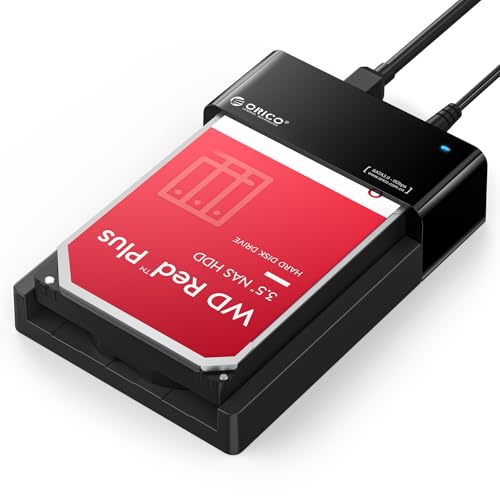
- Single bay supports drives up to 24TB
- USB 3.0 with UASP up to 5Gbps
- Tool-free design for Windows, Mac, and Linux
Best For: Single-drive access and storage expansion
Best Four-Bay Dock

- Four trayless bays for SATA HDDs and SSDs
- Offline cloning with progress indicators
- USB 3.0 connectivity up to 5Gbps
Best For: Multi-drive management and backups
Best High-Capacity Dual-Bay Dock

- Dual bays support 2.5-inch and 3.5-inch SATA drives
- Offline cloning without a computer
- Up to 32TB per drive and USB 3.0 connectivity
Best For: Large-drive cloning and two-drive workflows
Best Single-Bay SATA Dock

- Supports 2.5-inch and 3.5-inch SATA drives
- Tool-free hot-swap design
- Includes 12V adapter for 3.5-inch drives
Best For: Single-drive SATA access and routine swaps
Best Dual-Bay Cloning Dock

- Works with two 2.5-inch or 3.5-inch drives
- Offline cloning requires no computer
- Includes 12V/2.5A power adapter
Best For: Drive cloning, migration, and two-drive workflows
Best Dual-Bay SATA Cloner

- Offline one-button cloning
- Dual 2.5/3.5-inch SATA bays
- USB-C up to 5Gbps
Best For: Two-drive SATA cloning and file transfers
Best Versatile Triple-Bay Dock

- Supports NVMe and SATA drives
- Three independent tool-free bays
- USB 3.2 Gen 2 up to 10Gbps
Best For: Mixed-drive workflows and multi-system users
Best Aluminum Dual-Bay Value

- Dual-bay offline cloner
- Aluminum heat-dissipating body
- Manual mode switch and LEDs
Best For: Stable two-drive SATA transfers and cloning
Best Dual-Bay Cloner – Sabrent EC-HD2B
The SABRENT EC-HD2B is a practical choice for anyone comparing hard drive docking stations with two-bay access and offline cloning. It supports standard 2.5-inch and 3.5-inch SATA HDDs and SSDs, connects over USB 3.0, and requires no drivers for plug-and-play use.
Best For: Users who need a two-drive dock for backups, drive access, or offline cloning.
Pros:
- Supports both 2.5-inch and 3.5-inch SATA HDDs and SSDs.
- Offers offline cloning without requiring a computer.
- Supports drives up to 10TB and transfer speeds up to 5Gbps over USB 3.0.
- Includes a power supply and USB 3.0 cable.
Cons:
- Offline cloning is specified at up to 60Mbps.
- It has two bays rather than the capacity of a larger multi-bay dock.
With broad SATA drive support and a straightforward two-bay design, the EC-HD2B is a solid fit for routine drive management and occasional cloning. Its 20TB stated storage capacity provides useful room for larger drives.
Best Lay-Flat Design – ORICO 24TB Dock
The ORICO lay-flat model is one of the more flexible hard drive docking stations for single-drive access. It accepts 2.5-inch and 3.5-inch SATA HDDs and SSDs, supports up to 24TB per drive, and uses USB 3.0 with UASP for transfers up to 5Gbps.
Best For: Users who want a single-drive dock with tool-free insertion, broad operating-system compatibility, and a flat cooling-oriented design.
Pros:
- Supports 2.5-inch and 3.5-inch SATA I/II/III drives up to 24TB.
- Uses USB 3.0 with UASP and works with USB 2.0 and 1.1 systems.
- Tool-free, hot-swappable interface is tested for over 1,500 insertions.
- Compatible with Windows, Linux, and Mac OS systems without additional drivers.
Cons:
- Supports one drive at a time.
- No offline cloning function is listed in the supplied specifications.
The flat-down enclosure is designed to encourage natural convection cooling while keeping drive installation simple. It is a convenient option for accessing or expanding storage when a single-bay workflow is sufficient.
Best Four-Bay Dock – Sabrent DS-U3B4
The SABRENT DS-U3B4 is a high-capacity option among hard drive docking stations, with four trayless bays for managing multiple SATA drives. It supports 2.5-inch and 3.5-inch HDDs and SSDs, connects by USB 3.0, and includes offline drive-to-drive cloning.
Best For: Users who regularly work with several SATA drives, backups, or multi-drive data management.
Pros:
- Provides four bays for simultaneous 2.5-inch or 3.5-inch SATA drives.
- Trayless design allows direct drive insertion without tools.
- Supports offline cloning with LED indicators for clone progress.
- USB 3.0 supports transfers up to 5Gbps and is backward compatible with USB 2.0.
Cons:
- Its four-bay footprint may be more than needed for occasional single-drive access.
- The supplied notes do not specify a maximum per-drive or total storage capacity.
For users managing multiple loose drives, the DS-U3B4 offers substantially more capacity than a typical single- or dual-bay dock. The included external power adapter is intended to support stable operation with multiple installed drives.
Best High-Capacity Dual-Bay Dock – UGREEN CM198
The UGREEN CM198 stands out among hard drive docking stations for its dual-bay design and high stated capacity. It accepts two 2.5-inch or 3.5-inch SATA drives, supports offline cloning without a computer, and uses USB 3.0 with a USB-C connection for transfers up to 5Gbps.
Best For: Users who need two-drive access, large-capacity storage support, and computer-free cloning.
Pros:
- Supports two 2.5-inch or 3.5-inch SATA I/II/III drives simultaneously.
- Supports up to 32TB per drive according to the supplied product notes.
- Offers offline cloning, provided the source drive capacity does not exceed the destination.
- Includes a USB-C data cable, power adapter, dust cover, and anti-slip pads.
Cons:
- Offline cloning requires the destination drive to be at least as large as the source.
- The supplied notes list compatibility with specific Windows, Mac OS, and Linux versions rather than every current operating system.
The CM198 combines two-drive access with unusually large stated capacity support and useful physical protection features. It is a strong match for users migrating or duplicating large SATA drives without connecting the dock to a computer.
Best Single-Bay SATA Dock – Sabrent USB 3.0 SATA Dock
If you need a straightforward solution for reading bare SATA drives, this single-bay hard drive docking station supports both 2.5-inch and 3.5-inch SATA HDDs and SSDs. Its tool-free, lay-flat design is useful for occasional drive swaps, backups, and troubleshooting, but its USB Type-A connection and SATA-only compatibility require a quick setup check before buying.
Best For: Users who need an affordable, single-drive dock for bare 2.5-inch or 3.5-inch SATA drives.
Pros:
- Supports 2.5-inch and 3.5-inch SATA I/II/III HDDs and SSDs.
- Tool-free, plug-and-play operation with hot-swap support.
- Includes the required 12V power adapter for 3.5-inch drives.
- UASP support and backward compatibility with USB 2.0 and USB 1.1.
Cons:
- Works only with SATA drives; it does not support IDE/PATA, M.2, SAS, or USB-enclosed drives.
- The host connection is USB Type-A, so USB-C-only computers need an adapter.
- S.M.A.R.T. diagnostics do not pass through the USB bridge.
This Sabrent is a practical pick when simplicity matters more than extra features. Confirm that your drive is a bare SATA model and that your computer has a compatible USB-A port before ordering.
Best Dual-Bay Cloning Dock – Benfei USB-C Dual-Bay Dock
For users who regularly manage two drives, this dual-bay hard drive docking station can read and write to two 2.5-inch or 3.5-inch HDDs or SSDs at once. Its standout feature is offline cloning, allowing a source drive to be copied to a target without a computer, provided the target has equal or greater capacity.
Best For: Drive migrations, offline cloning, and users who need simultaneous access to two SATA HDDs or SSDs.
Pros:
- Dual bays support two 2.5-inch or 3.5-inch drives simultaneously.
- One-button offline cloning works without a PC.
- USB 3.1 Gen 1 with UASP supports transfers up to 5Gbps.
- Includes a 12V/2.5A adapter and an 18-month warranty.
Cons:
- The target drive must have capacity equal to or greater than the source for cloning.
- Safe operation requires turning off the power switch before connecting or removing drives.
- The supplied details identify a USB Type-C interface, so confirm your host cable and port arrangement.
The Benfei offers the most flexibility of these options for multi-drive work. Its offline clone button is especially useful for upgrading or duplicating a drive without tying up a computer.
Best Everyday SATA Dock – Sabrent USB 3.0 Dual-Size Dock
This Sabrent hard drive docking station is designed for straightforward access to bare 2.5-inch and 3.5-inch SATA HDDs and SSDs. It includes a required AC adapter, supports USB 3.0 with UASP, and adds useful status indicators and automatic sleep after 30 minutes of inactivity.
Best For: Everyday access to standard SATA drives when automatic sleep and clear activity indicators are useful.
Pros:
- Accepts 2.5-inch and 3.5-inch SATA HDDs and SSDs up to 20TB.
- USB 3.0 with UASP supports up to 5Gbps and works with older USB versions.
- Includes the required AC adapter, USB cable, and hot-swap support.
- Power and transfer LEDs make drive activity easy to monitor.
Cons:
- Supports SATA drives only, not SAS or M.2 NVMe drives.
- New or blank drives must be initialized and formatted in Windows or macOS before use.
- The dock automatically sleeps after 30 minutes of idle time.
This model is a sensible general-purpose choice for SATA drive access. Its automatic sleep feature helps reduce idle operation, while the included power supply makes it suitable for 3.5-inch drives.
Best Dual-Bay SATA Cloner – SABRENT EC-CH2B
The SABRENT EC-CH2B is a practical choice among hard drive docking stations if you work with bare 2.5-inch or 3.5-inch SATA drives and want an offline cloning option. Its two bays can mount as separate drives over USB-C, while the one-button cloner works without a computer.
Best For: Users migrating or managing two SATA HDDs or SSDs who want simple offline cloning.
Pros:
- Offline 1-to-1 cloning requires no computer.
- Supports simultaneous access to two 2.5-inch or 3.5-inch SATA drives.
- Tool-free, hot-swappable bays with individual activity LEDs.
- Includes a USB-C cable and power adapter.
Cons:
- Supports SATA drives only; it does not support IDE, M.2, or NVMe drives.
- The included cable is USB-C on the dock end, so a USB-C computer port or separate adapter may be needed.
- Offline cloning runs at up to 60MBps, and the target drive must be the same size or larger.
Choose this dock when SATA compatibility and straightforward cloning matter more than newer NVMe support. It is a focused, easy-to-use solution for two-drive workflows.
Best Versatile Triple-Bay Dock – ICY BOX 3-Bay Cloner
The ICY BOX 3-Bay Cloner stands out among hard drive docking stations for mixed storage setups. It accepts M.2 PCIe NVMe drives alongside 2.5-inch and 3.5-inch SATA drives, provides three independent slots, and supports one-touch offline cloning.
Best For: Professionals and power users handling mixed NVMe and SATA drives across multiple systems.
Pros:
- Supports M.2 PCIe NVMe, 2.5-inch SATA, and 3.5-inch SATA drives.
- Three independent bays allow multiple drives to be connected simultaneously.
- One-touch offline cloning works without software or a computer.
- USB 3.2 Gen 2 supports transfers up to 10Gbps and includes USB-C/USB-A connectivity.
Cons:
- Its plastic enclosure may feel less substantial than an aluminum design.
- Actual transfer performance depends on the installed drives and connected system.
This is the most flexible option in the group for users who regularly switch between storage formats. Its triple-bay layout and broad compatibility justify choosing it for more demanding workflows.
Best Aluminum Dual-Bay Value – SSK DK103 SATA Dock
The SSK DK103 is a sensible pick among hard drive docking stations for dual-bay SATA work, especially if you value clear controls and a heat-conducting aluminum body. A physical switch separates cloning mode from PC transfer mode, helping reduce accidental operation.
Best For: Users who need a dual-bay SATA dock with offline cloning, status indicators, and a stable aluminum design.
Pros:
- Supports two 2.5-inch or 3.5-inch SATA HDDs or SSDs, up to 20TB each according to the supplied notes.
- Offline cloning works without connecting to a computer.
- Manual mode switch helps distinguish cloning from PC transfer.
- Aluminum construction helps conduct heat away from installed drives.
Cons:
- Does not support hot-plugging.
- Uses USB 3.0 with a USB-B connection rather than USB-C.
- Supports SATA drives only.
The DK103 emphasizes stable operation and straightforward controls rather than the newest interface. It is a good fit for conventional SATA drives when hot-swapping and USB-C are not priorities.
How We Picked These Hard Drive Docking Stations
We focused on practical features that affect everyday use: compatibility with 2.5-inch and 3.5-inch SATA HDDs and SSDs, connection speed, bay count, offline cloning, tool-free installation, and support for newer USB-C or NVMe drives. We also considered whether a dock suits occasional drive access, frequent backups, or multi-drive workflows.
Offline cloning is especially useful when you need to copy one drive to another without running cloning software on a computer. However, cloning generally requires a target drive at least as large as the source, and it erases existing data on that target.
Quick Comparison
| Best For | Recommended Type | Features to Prioritize |
|---|---|---|
| Basic drive access | Single-bay SATA dock | UASP, stable power, broad compatibility |
| Drive cloning | Dual-bay cloner | Offline clone mode, clear indicators, drive-size support |
| Multiple drives | Four-bay dock | Independent bay access, cooling, power capacity |
| USB-C laptops | USB-C dock | Connector compatibility, included cable, transfer speed |
| Mixed modern storage | NVMe/SATA multi-bay dock | Interface support, 10Gbps connectivity, cloning limits |
Key Buying Factors for Hard Drive Docking Stations
Drive and Interface Compatibility
Confirm whether the dock supports 2.5-inch SATA drives, 3.5-inch SATA drives, or both. SATA support does not automatically include M.2 NVMe drives; those require a dock with a dedicated NVMe slot. Check the product’s maximum supported capacity if you plan to use high-capacity disks.
Connection Speed and Host Ports
USB 3.0 and USB 3.2 Gen 1 connections typically support up to 5Gbps in ideal conditions, while USB-C describes the connector rather than the speed. A 10Gbps dock can be worthwhile for compatible SSDs, but real-world performance also depends on the drive, cable, computer port, and file workload. UASP can improve command handling and responsiveness when supported by the operating system and enclosure hardware.
Cloning and Backup Controls
Choose a dual-bay or multi-bay model if you need direct drive-to-drive cloning. Look for clearly labeled source and target positions, status lights, and a physical clone button. For ordinary file transfers, a dock that exposes each drive separately may be more useful than a clone-only workflow.
Power, Stability, and Usability
3.5-inch hard drives require dedicated power, so use the supplied adapter and place the dock on a stable surface. Tool-free slots save time, while dust protection, cooling, and accessible power controls matter for frequent use.
Who Should Buy Which Hard Drive Docking Stations?
Choose a single-bay SATA dock for occasional recovery, drive upgrades, or quick file access. A dual-bay model is the better choice for cloning and routine backups. Pick a four-bay dock if you regularly rotate several drives or need simultaneous access. USB-C models suit newer laptops, but verify that the included cable matches your computer. If your workflow includes M.2 NVMe storage as well as SATA disks, select a dedicated multi-interface dock rather than assuming a standard SATA model will work.
