Moving video libraries, backups, disk images, and other large files is easier with the right hard drive docking station. Instead of installing drives inside a computer or buying a separate enclosure for every disk, a dock gives you quick access to bare 2.5-inch and 3.5-inch SATA drives.
This roundup covers ten options ranging from affordable USB 3.0 dual-bay docks to high-capacity multi-bay systems and premium Thunderbolt storage. The best choice depends on your transfer interface, drive mix, capacity plans, and whether you need offline cloning or extra connectivity.
Best 10 Hard Drive Docking Stations for Large Files Picks for 2026
Best Dual-Bay Cloner

- Dual bays for 2.5-inch and 3.5-inch SATA drives
- Offline cloning without a computer
- USB 3.0 transfers up to 5Gbps
Best For: SATA drive access and offline duplication
Best High-Capacity Enclosure
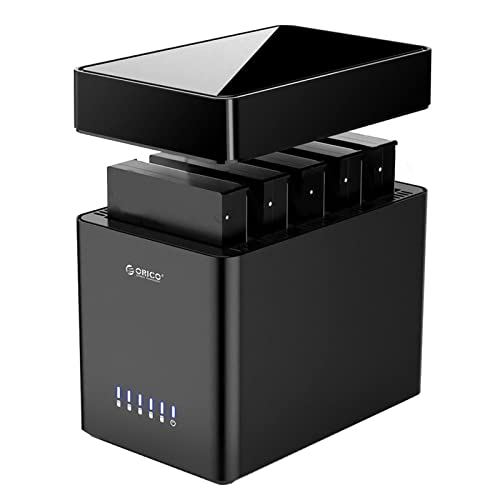
- Five bays support up to 110TB total
- Tool-free magnetic-cover installation
- Built-in fan and multiple protection features
Best For: Large desktop storage expansions and backups
Best Simple Single-Drive Dock

- Single bay for 2.5-inch and 3.5-inch SATA drives
- Tool-free plug-and-play hot-swapping
- Includes 12V adapter for 3.5-inch drives
Best For: Basic access to one bare SATA drive
Best USB-C Dual-Bay Dock

- Dual bays support 2.5-inch and 3.5-inch SATA drives
- Offline cloning without a computer
- Includes USB-C cable and supports up to 32TB per drive
Best For: USB-C systems needing dual-drive access and cloning
High-Capacity Cloner

- Up to five 20TB SATA drives
- Offline four-copy duplication
- USB 3.2 Gen 1 with USB-C cables
Best For: Photographers and professionals managing large SATA-based media libraries
Creator’s Workstation Hub

- Built-in 20TB 7200 RPM HDD
- CF/SD readers and DisplayPort 1.4
- Thunderbolt connectivity and laptop charging
Best For: Filmmakers building a centralized desktop storage and connectivity setup
Dual-Drive Transfer Tool

- Two-bay SATA drive support
- Offline 1-to-1 cloning
- USB 3.0 up to 5Gbps
Best For: Users transferring or cloning files between two bare SATA drives
Best for Creative Workflows

- 16TB 7200 RPM IronWolf Pro storage
- Thunderbolt 3, DisplayPort, CF, and SD connectivity
- Five-year Rescue Data Recovery Services
Best For: Filmmakers and creative professionals with large media libraries
Best for High-Capacity Cloning

- Supports two SATA HDDs or SSDs
- Up to 48TB total stated capacity
- Offline cloning and three USB 3.0 hub ports
Best For: Backups, batch transfers, and IT drive management
Best for Simple Dual-Drive Access

- Connects two 2.5- or 3.5-inch SATA drives
- USB 3.0 supports up to 5Gbps
- Offline cloning with broad OS compatibility
Best For: Convenient home and technician SATA drive access
Best Dual-Bay Cloner – SABRENT EC-HD2B
For users comparing hard drive docking stations for large files, the SABRENT EC-HD2B combines two-bay SATA access with offline cloning. It supports 2.5-inch and 3.5-inch SATA hard drives or SSDs, with USB 3.0 transfer rates up to 5Gbps and support for drives up to 10TB each.
Best For: Desktop users who need to read two SATA drives or clone one drive to another without a computer.
Pros:
- Supports both 2.5-inch and 3.5-inch SATA HDDs and SSDs.
- Offers offline cloning at speeds up to 60Mbps.
- Plug-and-play operation requires no drivers.
- Supports up to 20TB of combined storage capacity.
Cons:
- Limited to two drives at a time.
- Designed for SATA drives rather than M.2 or IDE devices.
The EC-HD2B is a practical choice when drive duplication matters as much as file access. Its dual-bay layout and broad SATA form-factor support make it more flexible than a single-drive dock.
Best High-Capacity Enclosure – ORICO 5-Bay HDD Enclosure
The ORICO 5-bay enclosure is built for large storage pools, supporting up to 110TB across five 2.5-inch or 3.5-inch SATA HDDs and SSDs. USB 3.0 connectivity provides transfer rates up to 5Gbps, while the built-in fan and vented rear panel help manage heat during extended use.
Best For: Home storage expansion, backups, family media libraries, and users managing several SATA drives in one enclosure.
Pros:
- Five bays support up to 110TB total capacity, with up to 22TB per drive.
- Tool-free magnetic cover simplifies drive installation.
- Built-in 60mm fan and honeycomb ventilation support heat dissipation.
- Includes over-voltage, over-current, overheat, and short-circuit protections.
Cons:
- Linux systems can read only one drive at a time, according to the supplied notes.
- The enclosure uses USB 3.0 rather than a faster interface.
- Its five-bay design takes more desk space than a single-drive dock.
Choose this ORICO model when capacity and multi-drive organization are priorities. It is especially suited to stationary storage setups where cooling and protection are important considerations.
Best Simple Single-Drive Dock – SABRENT EC-DFLT
The SABRENT EC-DFLT is a compact single-bay option for accessing bare SATA drives. It supports 2.5-inch and 3.5-inch SATA I, II, and III HDDs or SSDs, with USB 3.0 and UASP support for practical large-file transfers. A 12V adapter is included and required for 3.5-inch drives.
Best For: Users who need a straightforward, tool-free way to read or swap one bare SATA drive at a time.
Pros:
- Accepts both 2.5-inch and 3.5-inch SATA drives.
- Tool-free, plug-and-play design supports hot-swapping.
- Includes the required 12V power adapter for 3.5-inch drives.
- Supports USB 3.0 transfer rates up to 5Gbps and UASP.
Cons:
- Supports only one drive at a time.
- Works with SATA drives only; it does not support IDE, M.2, NVMe, or SAS.
- The included host cable uses USB Type-A, not USB-C.
This dock is a sensible pick for occasional drive recovery, file transfers, and upgrades. Its compatibility limits are clear, so verify that your drive is a bare SATA model before buying.
Best USB-C Dual-Bay Dock – UGREEN CM198
The UGREEN CM198 is a dual-bay SATA docking station for users moving hard drive docking stations for large files into a USB-C workflow. It accepts two 2.5-inch or 3.5-inch SATA drives, supports up to 32TB per drive, and includes offline cloning plus a USB 3.0 connection rated up to 5Gbps.
Best For: USB-C users who need simultaneous access to two SATA drives and occasional standalone cloning.
Pros:
- Supports two 2.5-inch or 3.5-inch SATA I, II, or III drives.
- Supports up to 32TB per drive, according to the supplied notes.
- Offline cloning works without connecting to a computer, provided the target drive is at least as large.
- Includes a USB-C data cable, 12V/3A adapter, cooling design, and dust cover.
Cons:
- Offline cloning requires the destination drive to have equal or greater capacity.
- USB 3.0 is limited to a maximum interface rate of 5Gbps.
- Supports SATA drives, not other drive interfaces.
The CM198 offers a useful mix of modern USB-C connectivity, dual-drive access, and offline cloning. It is a strong fit for large transfers when you want more capacity than a single-bay reader provides.
High-Capacity Cloner – ORICO 5-Bay Hard Drive Dock
For photographers, editors, and other users managing large files, the ORICO 5-bay dock combines broad SATA drive support with substantial expansion capacity. Its five bays accept 2.5-inch and 3.5-inch SATA HDDs or SSDs, while USB 3.2 Gen 1 connectivity supports use with compatible computers and other devices.
Best For: Professional users who need up to five SATA drives and offline multi-copy duplication for large media libraries.
Pros:
- Supports up to five 20TB SATA drives for a stated 100TB maximum capacity.
- Offline duplicator can create four copies with one button without a computer.
- Aluminum-alloy vertical design aids heat dissipation and includes anti-vibration pads.
- Includes both USB-C-to-C and USB-C-to-A connectivity.
Cons:
- Offline cloning overwrites the target disk, so backups are essential.
- Designed for SATA drives rather than M.2 or NVMe storage.
- USB 3.2 Gen 1 performance may be limiting for the largest transfers.
The ORICO is a strong fit when capacity and duplication flexibility matter most. Its five-bay layout is more expansive than a typical two-drive dock, but users should verify their drives are SATA and plan around the target-disk overwrite behavior.
Creator’s Workstation Hub – LaCie 1big Dock 20TB
The LaCie 1big Dock is a storage-and-connectivity solution for large files, combining a built-in 20TB 7200 RPM enterprise-class HDD with ports for displays, peripherals, and memory cards. Its Thunderbolt-compatible design is aimed at filmmakers and other creators who want to centralize their desktop setup.
Best For: Filmmakers and Mac or PC users who want high-capacity storage alongside card readers, display output, and laptop charging.
Pros:
- Includes 20TB of built-in storage for large video and project libraries.
- Offers CF and SD card readers, DisplayPort 1.4, USB, and dual Thunderbolt ports.
- 7200 RPM IronWolf Pro HDD is suited to intensive creative projects.
- Provides up to 45W USB-C laptop charging, with higher pass-through when using the laptop power supply.
Cons:
- At 2.8 kg, it is substantially less portable than a small drive dock.
- Charging power drops to up to 30W when daisy chaining other devices.
- Its integrated mechanical HDD is not as inherently fast as an SSD.
For a creator’s desk, the 1big Dock offers more than storage: it reduces the need for separate card readers, display adapters, and hubs. It is best suited to a permanent workstation where its large capacity and connectivity justify the larger enclosure.
Dual-Drive Transfer Tool – SABRENT USB-C Dock and Cloner
The SABRENT EC-CH2B is a practical choice for moving large files between two bare SATA drives. Its dual bays mount both drives as separate volumes over USB, and its standalone cloning function can copy one drive to another without a computer.
Best For: Users who regularly swap, clone, or transfer files between two 2.5-inch or 3.5-inch SATA HDDs or SSDs.
Pros:
- Supports two SATA drives simultaneously and reads or writes both when connected to a computer.
- Offline 1-to-1 cloning requires no computer and operates at up to 60MBps.
- Tool-free, hot-swappable bays include separate drive-access LEDs.
- USB 3.0 supports up to 5Gbps with plug-and-play Windows and Mac operation.
Cons:
- Only supports SATA drives; IDE, PATA, M.2, and NVMe drives are excluded.
- Offline cloning requires the target drive to be the same size as or larger than the source.
- The included cable is USB-C at the dock end, so USB-A computers may need another cable.
The SABRENT is a compact, focused option for two-drive workflows and routine large-file transfers. It lacks the capacity and expansion features of larger multi-bay systems, but its simple cloning controls and hot-swap design make drive maintenance straightforward.
Best for Creative Workflows – LaCie 1big Dock 16TB
For filmmakers and other professionals managing large media libraries, the LaCie 1big Dock combines 16TB of storage with Thunderbolt 3 connectivity. It is a strong choice among hard drive docking stations for large files when you also need desktop expansion, fast transfers, and card readers.
Best For: Filmmakers, photographers, and creative professionals who need centralized storage and workstation connectivity.
Pros:
- Includes a 16TB 7200 RPM Seagate IronWolf Pro hard drive.
- Offers Thunderbolt 3, USB compatibility, dual Thunderbolt ports, and DisplayPort 1.4.
- Built-in CF and SD card readers plus three USB-C power-delivery options.
- Includes five-year Rescue Data Recovery Services.
Cons:
- Uses a mechanical 3.5-inch hard drive rather than an SSD.
- Its full docking feature set is most useful with compatible Thunderbolt-equipped computers.
The 1big Dock is more than a high-capacity external drive: it is a creative workstation hub. Its 280 MB/s listed read speed, extensive connectivity, and recovery-service coverage make it particularly compelling for large project files.
Best for High-Capacity Cloning – MAIWO Dual-Bay SATA Dock
The MAIWO dual-bay docking station is designed for users who need to read, transfer, back up, and clone SATA drives. With support for two 2.5- or 3.5-inch drives and up to 48TB total capacity, it is a practical option among hard drive docking stations for large files.
Best For: IT work, batch file transfers, drive backups, and offline disk cloning.
Pros:
- Supports two 2.5- or 3.5-inch SATA HDDs or SSDs, with up to 24TB per bay.
- Performs offline cloning without a computer or drivers.
- USB 3.0 provides up to 5Gbps bandwidth.
- Three USB 3.0 Type-A hub ports add peripheral connectivity, including one 2.4A charging port.
Cons:
- Designed for SATA drives and uses a USB 3.0 Type-B connection.
- The unit requires its included 12V 3A power supply.
- It has a one-year manufacturer warranty.
Choose the MAIWO when drive-to-drive copying is as important as computer-based access. Its dual-bay layout, offline clone function, and generous stated capacity make it well suited to managing multiple large SATA volumes.
Best for Simple Dual-Drive Access – FIDECO Dual-Bay Dock
The FIDECO dual-bay dock offers a straightforward way to connect two SATA drives at once. Its USB 3.0 interface, plug-and-play design, and offline cloning make it a useful budget-minded choice among hard drive docking stations for large files.
Best For: Home users and technicians who need convenient access to two 2.5- or 3.5-inch SATA drives.
Pros:
- Accepts two 2.5- or 3.5-inch SATA HDDs or SSDs simultaneously.
- Supports USB 3.0 transfer rates up to 5Gbps and UASP.
- Enables offline cloning without connecting to a computer.
- Works with Windows, Mac OS, and Linux systems.
Cons:
- Supports SATA drives only.
- New drives must be initialized before the computer can recognize them.
- Includes a one-year manufacturer warranty.
FIDECO keeps the setup focused on essential dual-drive tasks: reading, transferring, and cloning SATA storage. It is a sensible pick when you want two-bay flexibility without the additional hub and workstation features of more expansive docks.
How We Picked the Best Hard Drive Docking Stations for Large Files
We focused on docks and dock-style external storage that support common 2.5-inch and 3.5-inch SATA HDDs or SSDs, with attention to practical file-transfer needs. The selection includes single- and dual-bay models for routine backups, five-bay units for larger drive collections, and integrated LaCie systems aimed at high-throughput professional workflows.
We also considered connection standards, drive capacity support, cloning features, power requirements, compatibility, and convenience features such as USB hubs. A faster interface does not automatically make every transfer faster: the drive itself, the computer port, file size, and workload all affect real-world performance.
Quick Comparison
| Best For | Look For | Typical Advantage |
|---|---|---|
| Occasional drive access | Single-bay USB 3.0 dock | Lower cost and simple setup |
| Backups and cloning | Dual-bay dock with offline clone mode | Copies one drive to another without a computer |
| Several active drives | Five-bay enclosure or dock | More storage in one desktop unit |
| Large creative workloads | USB-C, USB4, or Thunderbolt | Higher potential bandwidth |
| Ready-to-use professional storage | Integrated enterprise-class HDD | Configured capacity and premium connectivity |
Key Buying Factors for Hard Drive Docking Stations for Large Files
Connection Speed and Host Compatibility
USB 3.0 is adequate for many hard drives, while USB-C describes the connector rather than a guaranteed speed. Check whether a USB-C model uses USB 3.x, USB4, or Thunderbolt, and verify that your computer supports the same standard. Thunderbolt and USB4 can be especially useful with fast SSDs, multiple drives, or sustained media transfers.
Drive Format, Bays, and Capacity
Confirm support for both 2.5-inch and 3.5-inch SATA drives if you use mixed hardware. A dual-bay dock is usually the practical middle ground for source-and-destination backups. Five-bay models suit users who rotate several disks or need a consolidated workspace, but they require more desk space and power.
Cloning and Backup Features
Offline cloning can duplicate a source drive without a computer, but the destination generally needs to be equal to or larger than the source. For scheduled, incremental, or file-level backups, you will still need operating-system software or a dedicated backup application.
Power, Cooling, and Reliability
Most 3.5-inch drives need an external power adapter. Look for a stable power supply, sensible ventilation, and clear drive-status indicators. Safely eject drives before removing them, particularly during large transfers or when using write caching.
Who Should Buy Which Hard Drive Docking Stations for Large Files?
Choose a single-bay USB 3.0 dock if you occasionally read, recover, or archive one bare drive. Pick a dual-bay cloning model for straightforward drive duplication and local backup tasks. A five-bay unit makes more sense for photographers, video editors, technicians, and home-lab users managing several disks at once. For Mac-focused professional workflows or sustained high-speed transfers, the LaCie Thunderbolt-based options provide integrated storage and premium connectivity. Finally, choose a USB-C model when your computer has a compatible high-speed port and you expect to work with SSDs or other fast storage; otherwise, a USB 3.0 dock may deliver similar performance with conventional hard drives at a lower cost.
