Preparing deli meat, roasts, cheese, or jerky in large quantities demands more than a sharp knife. The right slicer can produce uniform portions faster while reducing repetitive prep work.
This roundup compares 10 meat slicers across motor power, blade size, thickness control, cleaning convenience, and capacity so you can choose a model suited to your kitchen and workload.
Best 10 Meat Slicers for Large Batches Picks for 2026
Heavy-Duty Pick
KWS 10-Inch Commercial Meat Slicer
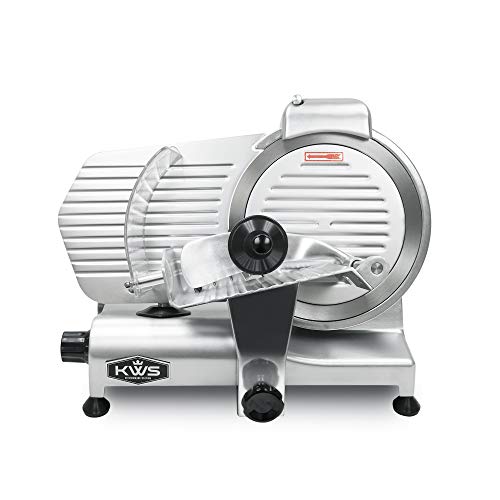
- 320W motor supports repeated slicing
- 0–14 mm thickness adjustment
- NSF blade, built-in sharpener, and removable parts
Best For: Bulk prep, game meat, and light commercial kitchens
Quiet Deli Workhorse
240W 10-Inch Adjustable Meat Slicer

- Quiet 240W motor for repeated prep
- 0–13 mm adjustable thickness
- Detachable parts and built-in sharpener
Best For: Home cooks and small deli counters
Jerky Batch Specialist
Weston Manual Beef Jerky Slicer

- 32 blades create consistent ¼-inch strips
- Handles meat up to 5 inches wide
- C-clamp, combs, and tongs included
Best For: Large jerky batches and game-meat preparation
Commercial-Style Value
FOHERE 300W Electric Meat Slicer

- 300W motor and 10-inch blade
- 0–12 mm thickness adjustment
- Large 7-inch tray and 2-year warranty
Best For: High-volume home prep and busy countertops
Best Overall

- Two 9-inch stainless steel blades
- 1–20 mm thickness adjustment
- Stable cast-metal design
Best For: Versatile home batch slicing
Best Commercial-Style Pick

- 240W copper motor with thermal protection
- 10-inch carbon steel blade
- 0–12 mm precision adjustment
Best For: Higher-volume prep with ample counter space
Best for Easy Cleanup

- Removable carriage, pusher, and blade
- Two blades for varied foods
- 1–20 mm thickness adjustment
Best For: Home batch prep with simpler cleanup
Compact Batch Helper
OSTBA 150W Electric Meat Slicer
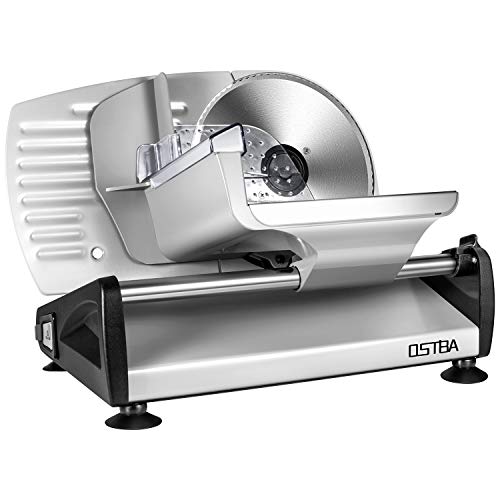
- Adjustable thickness up to approximately 3/4 inch
- Removable parts and ring guard simplify cleaning
- Safety lock, suction feet, and 2-year warranty
Best For: Home cooks needing compact, repeatable slicing
Countertop Deli Classic
Cuisinart Kitchen Pro Food Slicer
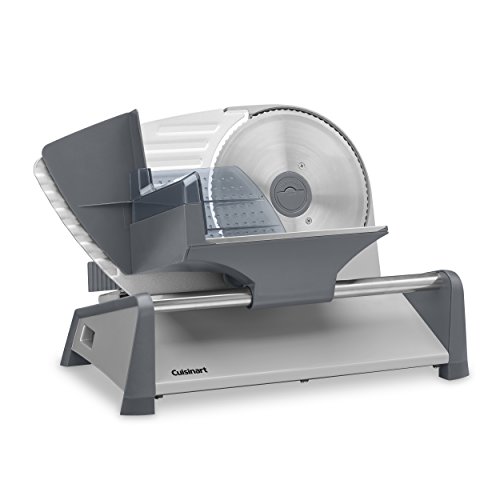
- Precise 1/32- to 1/2-inch thickness adjustment
- 130W motor with die-cast aluminum housing
- Removable slicing components and 3-year motor warranty
Best For: Thin, consistent deli-style slices
Two-Blade Batch Powerhouse
OSTBA 200W Two-Blade Meat Slicer
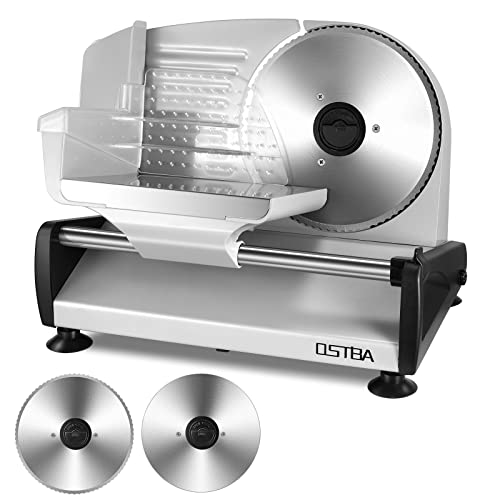
- 200W motor for higher-yield slicing
- Includes serrated and non-serrated blades
- Removable, dishwasher-safe parts with safety switches
Best For: Versatile home batch prep across meats and produce
Heavy-Duty Pick – KWS 10-Inch Commercial Meat Slicer
For meat slicers for large batches, the KWS MS-10NS stands out with a 320W high-torque motor, a 10-inch stainless steel blade, and a large carriage designed for repeated prep. Its adjustable dial supports thin, consistent cuts for meat, cheese, and semi-frozen foods.
Best For: Serious home cooks, hunters, bulk meal preparation, and light commercial use.
Pros:
- Powerful 320W belt-driven motor is designed for continuous slicing.
- Adjustable thickness from paper-thin to 14 mm.
- Built-in dual whetstone sharpener helps maintain the blade.
- Removable carriage, blade, blade cover, and hand guard simplify cleaning.
Cons:
- Its larger, heavy-duty construction may require substantial counter space.
- The optional bread-slicing attachment is sold separately.
With ETL listing, an NSF-certified blade, and U.S.-based parts and support, this is a strong choice when batch capacity and long-term serviceability matter more than a lightweight design.
Quiet Deli Workhorse – 240W 10-Inch Adjustable Meat Slicer
This 240W model is a practical option among meat slicers for large batches, pairing a 10-inch chromium-plated blade with a 0–13 mm thickness range. Its quiet motor, detachable components, and built-in sharpener suit regular home prep or a small deli setting.
Best For: Home kitchens and small delis that need versatile, repeatable slicing.
Pros:
- 10-inch blade handles meat, cheese, bread, and vegetables.
- Wide 0–13 mm adjustment covers thin deli slices through thicker cuts.
- Built-in sharpener reduces the need for separate blade maintenance.
- Detachable carriage, safety shield, and food pusher support easier cleanup.
Cons:
- The 240W motor is less powerful than some higher-wattage options in this roundup.
- At 30.8 pounds, it is not especially easy to move frequently.
Its combination of a quiet operating profile, safety features, and broad thickness control makes it a balanced choice for frequent slicing without stepping up to a larger commercial machine.
Jerky Batch Specialist – Weston Manual Beef Jerky Slicer
Unlike electric deli slicers, this Weston model is purpose-built for jerky batches. Its 32 stainless steel blades can produce consistent quarter-inch strips while accepting cuts up to 5 inches wide and 1.25 inches thick.
Best For: Hunters and home processors making uniform beef, game, turkey, or duck jerky.
Pros:
- Cuts up to 15 quarter-inch strips at once.
- Large chute accommodates substantial pieces of meat.
- Built-in C-clamp mounts to flat surfaces up to 2 inches thick.
- Included combs help prevent jamming, and tongs support safer handling.
Cons:
- It is designed for jerky strips rather than adjustable deli-style slices.
- Manual operation requires feeding the meat by hand.
For dedicated jerky production, the Weston’s specialized blade array and large chute can make batch preparation faster and more uniform than knife work. It is less suitable if you need varied slice thicknesses or general deli tasks.
Commercial-Style Value – FOHERE 300W Electric Meat Slicer
The FOHERE combines a 300W motor, 10-inch stainless steel blade, and large 7-inch loading tray for efficient batch prep. Its 0–12 mm adjustment handles thin cold cuts, cheese, bread, and thicker sandwich slices while keeping a countertop-friendly format.
Best For: Home users and busy prep areas seeking commercial-style capacity with a 2-year warranty.
Pros:
- 300W motor operates at a stated 350–400 RPM for fast slicing.
- 10-inch chromium-plated blade is designed to resist corrosion.
- Large carriage accommodates bigger cuts and helps reduce prep time.
- ETL certification, removable parts, and a 2-year warranty add practical reassurance.
Cons:
- Product care instructions specify hand washing rather than dishwasher cleaning.
- Its 38.6-pound weight makes repositioning less convenient.
With a strong motor and wide loading tray, the FOHERE is well suited to repeated slicing when you want substantial capacity. Plan for a permanent or semi-permanent counter location and hand-cleaning after use.
Best Overall – CUSIMAX 200W Meat Slicer
For shoppers comparing meat slicers for large batches, the CUSIMAX combines a 200W motor, two 9-inch stainless steel blades, and a broad 1–20 mm thickness range. Its cast-metal housing and enlarged suction cups are designed to provide a stable platform for repeated slicing.
Best For: Home cooks who want flexible thickness control and interchangeable blades for meat, cheese, bread, and produce.
Pros:
- Two 9-inch blades: smooth-edge and serrated.
- Wide 1–20 mm adjustable slicing range.
- Cast-metal construction with enlarged non-slip suction cups.
- Removable blade and sliding rail; tray rotates outward for cleanup.
Cons:
- At 10.9 pounds, it is not especially lightweight.
- Removable parts are specified for hand washing or dishwasher use depending on the component.
With its sturdy build, two-speed control, and wide adjustment range, this is a versatile choice when batch prep includes more than just deli meat. The removable components also make cleanup more manageable after extended use.
Best Commercial-Style Pick – 240W Electric Meat Slicer
For meat slicers for large batches, this 240W model emphasizes sustained operation with a copper motor, thermal protection, and a 10-inch carbon steel blade. Its automatic operation and 300–450 RPM blade speed are suited to shoppers seeking a larger, commercial-style setup.
Best For: Users who prioritize a larger blade, motor thermal protection, and consistent slicing for meat, deli foods, and cheese.
Pros:
- 240W copper motor with built-in thermal protection.
- Large 10-inch carbon steel blade with 300–450 RPM rotation.
- Precise 0–12 mm thickness adjustment.
- Transparent safety guard and built-in sharpener.
Cons:
- Its 19.7-by-15.7-by-14.2-inch footprint requires substantial counter space.
- Product care instructions specify hand washing only.
- The thickness range tops out at 12 mm, narrower than some alternatives.
This slicer is the strongest fit for higher-volume prep when counter space is available. The thermal protection and built-in sharpener add practical features for repeated slicing, while the larger blade can cover broad cuts efficiently.
Best for Easy Cleanup – CUSIMAX 8.7-Inch Meat Slicer
If cleanup is a major consideration when choosing meat slicers for large batches, this CUSIMAX model has a removable food carriage, food pusher, and blade. Its 200W motor, two blades, and 1–20 mm adjustment provide practical flexibility for recurring home food preparation.
Best For: Home users who want removable food-contact parts and a choice of serrated or non-serrated blades.
Pros:
- Removable blade, food pusher, and food carriage simplify cleaning.
- Includes serrated and non-serrated stainless steel blades.
- 1–20 mm adjustable thickness supports thin to approximately 3/4-inch slices.
- Non-slip feet, blade guard, and food pusher help support stable operation.
Cons:
- The 8.7-inch blade is smaller than the 10-inch blade on the commercial-style option.
- At 10.8 pounds, it still takes dedicated storage space.
- Its listed care instructions specify dishwasher-safe cleaning, but removable components still require handling.
The removable carriage is the standout feature for batch prep because it helps expose areas where food can collect. Choose it over a larger commercial-style slicer when easier disassembly and broad food versatility matter more than maximum blade size.
Compact Batch Helper – OSTBA 150W Electric Meat Slicer
For shoppers comparing meat slicers for large batches, the OSTBA SL518-1 offers a practical balance of adjustable thickness, removable components, and a compact countertop design. Its 150W motor and 7.5-inch serrated stainless steel blade are suited to slicing meats, cheeses, bread, produce, and deli foods.
Best For: Home cooks who want consistent slices and straightforward cleanup without a bulky machine.
Pros:
- Adjusts from super-thin slices to approximately 3/4 inch thick.
- Removable blade, carriage, food pusher, slide-rod extension, and ring guard support thorough cleaning.
- Safety lock and power button must be pressed together, while suction-cup feet help stabilize the unit.
- Includes a 2-year warranty and offers compatible replacement blades and food pushers.
Cons:
- Uses a single serrated blade, so it is less versatile than models with interchangeable blades.
- The 150W motor may be less suited to demanding continuous workloads than higher-powered options.
This OSTBA is a sensible choice when easy sanitation and flexible thickness settings matter more than maximum throughput. Its removable parts and compact footprint make it convenient for recurring home batch preparation.
Countertop Deli Classic – Cuisinart Kitchen Pro Food Slicer
For meat slicers for large batches that prioritize precise portion control, the Cuisinart Kitchen Pro FS-75 provides a fine adjustment range and a 130W motor. Its 7.5-inch stainless steel blade can slice roasts, meats, cheeses, vegetables, bread, and other foods directly on the countertop.
Best For: Home deli-style preparation where paper-thin slices and repeatable thickness settings are priorities.
Pros:
- Slice control adjusts from 1/32 inch to 1/2 inch for fine thickness control.
- Die-cast aluminum housing and premium-coated steel provide a heavy-duty design.
- Removable blade, food guide, and stainless steel carriage make cleanup easier.
- Includes a limited 3-year motor warranty and non-slip feet for stability.
Cons:
- Its maximum 1/2-inch setting is narrower than the approximately 3/4-inch range of the OSTBA models.
- Components are hand-wash only, requiring more hands-on cleaning.
The Cuisinart stands out for users who value exact, thin slicing and a more substantial housing. It is a strong countertop option for batch prep, provided hand washing is acceptable.
Two-Blade Batch Powerhouse – OSTBA 200W Two-Blade Meat Slicer
Among meat slicers for large batches, the upgraded OSTBA SL-518 is designed for broader food prep with a 200W motor and two interchangeable 7.5-inch stainless steel blades. Its adjustable range reaches approximately 3/4 inch, making it useful for meats, deli foods, cheese, bread, fruits, and vegetables.
Best For: Home users who want more power and separate blades for hard foods, meats, bread, and produce.
Pros:
- 200W motor supplies more power than the 150W OSTBA model.
- Includes serrated and non-serrated blades for different foods.
- Adjusts from super-thin slices to approximately 3/4 inch thick.
- Removable food-contact parts, dishwasher-safe care, safety switches, and suction feet support convenient operation.
Cons:
- Interchangeable blades require additional handling and storage.
- Its semi-automatic operation still requires hands-on feeding and control.
This is the most versatile OSTBA in the group for mixed batch preparation. The stronger motor and dual-blade setup make it especially appealing when one slicer needs to handle both firmer foods and softer bakery or produce items.
How We Picked the Best Meat Slicers for Large Batches
We evaluated these slicers by the features that matter most during repeated preparation: motor wattage, blade diameter, adjustment range, construction, carriage size, safety features, and cleanup. Electric models generally offer the speed needed for frequent slicing, while the manual option can be useful for jerky and occasional jobs without relying on a motor.
Because product specifications vary, consider both advertised power and practical workflow. A strong motor, stable base, and sufficiently wide food carriage are more useful for large batches than a high wattage number alone.
Quick Comparison
- Highest-capacity choices: Look for 10-inch blades, sturdy construction, and high-torque motors when processing roasts or multiple pounds at once.
- Balanced home options: Models in the 200W to 240W range can handle regular batches of meat, bread, and cheese when used with sensible pauses.
- Compact choices: Smaller 7.5- to 8.7-inch slicers take up less counter space and suit lighter workloads.
- Manual alternative: A hand-operated jerky slicer avoids motor maintenance and is practical for specific cuts, provided the user is comfortable with slower throughput.
Key Buying Factors for Meat Slicers for Large Batches
Motor and Duty Cycle
For repeated slicing, prioritize a reliable motor and clear guidance on operating time. Higher-powered units may move through dense food more efficiently, but every slicer benefits from short pauses to prevent overheating.
Blade Size and Material
A 10-inch blade typically provides more cutting area for large roasts and deli portions. Stainless steel is common and easy to maintain, while carbon steel may offer sharp cutting performance but requires careful drying to limit corrosion.
Thickness Control
Choose a broad, precise adjustment range if you need both thin sandwich slices and thicker portions. A secure dial or knob is preferable to a control that shifts while the machine is running.
Cleaning and Safety
Removable blades, carriages, and food trays make a major difference after large batches. Confirm that removable parts can be cleaned safely and that the slicer has a food pusher, non-slip feet, and accessible power controls. Always unplug the unit before disassembly.
Counter Space and Storage
Commercial-style slicers can be heavy and wide. Measure your work surface, check the available clearance, and account for storage space if the machine will not remain on the counter.
Who Should Buy Which Meat Slicers for Large Batches?
Choose a 10-inch commercial-style electric slicer if you regularly process roasts, deli meat, or large quantities for entertaining, meal prep, or a small food business. These models are the strongest fit for speed and capacity.
Choose a midrange 200W to 240W slicer if you want a versatile home appliance for occasional large batches, sandwiches, cooked meats, bread, and cheese. It offers a practical balance of performance, footprint, and cost.
Choose a compact 150W to 200W model if storage and counter space matter more than maximum throughput. Expect to work in smaller batches and allow cooling breaks.
Choose the manual slicer for specialized jerky preparation, off-grid use, or occasional slicing where quiet operation and simple mechanics outweigh speed. Whichever type you select, match the machine to your batch size and follow the manufacturer’s limits for food dimensions and operating time.
