Traveling musicians need MIDI gear that is compact, dependable, and quick to connect in unfamiliar spaces. The right interface or controller can keep a mobile studio, rehearsal setup, or live rig organized without adding unnecessary weight.
We selected 10 portable options spanning traditional MIDI interfaces, USB and Bluetooth controllers, pad units, and MIDI splitters. Use the guide below to match the connections, controls, and portability you need.
Best 10 Midi Interfaces for Traveling Musicians Picks for 2026
Best Routing Hub

- Standalone 3-in/3-out MIDI routing
- USB-C compatibility across major operating systems
- Low-latency support for advanced MIDI data
Best For: Traveling musicians managing multiple MIDI devices
Best Portable Pad Controller

- Eight RGB MPC-style drum pads
- Eight assignable knobs for DAW control
- Slim USB-powered design for laptop bags
Best For: Traveling beat makers and producers
Best for Mobile Guitar Recording

- 24-bit/48 kHz guitar recording
- Headphone output with direct monitoring
- USB-C connection for Mac, PC, iPad, and compatible iPhone
Best For: Guitarists recording and practicing on the go
Best All-in-One Travel Keyboard

- 25 keys plus eight drum pads and OLED display
- Smart scales, arpeggio, chord, and note-repeat modes
- USB-C support with bundled DAW software and lessons
Best For: Mobile producers and keyboard learners
Compact Connection Hub
Midiplus 2x2 USB MIDI Interface

- 2 MIDI inputs and 2 MIDI outputs
- USB powered with no external supply
- Driver-free support for Mac and Windows
Best For: Laptop-based musicians needing compact two-in/two-out MIDI connectivity
Wireless Mobile Studio
DaierTek 25-Key Bluetooth MIDI Controller

- 25 velocity-sensitive keys and 8 backlit pads
- Bluetooth or USB MIDI with a 16-hour battery
- Compatible with computers, tablets, and smartphones
Best For: Mobile producers wanting wireless control and hands-on performance features
Multi-Device MIDI Splitter
MIDI Thru 6 USB MIDI Interface
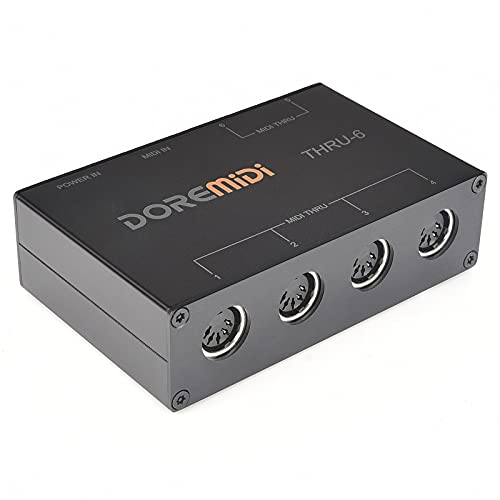
- One MIDI input feeds six MIDI outputs
- Standard 5-pin MIDI and 16-channel support
- USB powered with plug-and-play operation
Best For: Travel rigs that route one MIDI source to multiple instruments
Portable Key Controller
Donner N-25 Mini MIDI Keyboard

- 25 velocity-sensitive mini keys in a compact body
- USB and mobile-device compatibility
- Includes programmable controls and 40 courses
Best For: Beginners needing a portable keyboard controller
Wireless MIDI Link
FORE K1 Bluetooth MIDI Interface

- Wireless connection for five-pin DIN MIDI devices
- Supports iOS, Android, macOS, and Windows
- Up to 32 feet of range and stated 3 ms latency
Best For: Traveling players seeking fewer MIDI cables
Best Routing Hub – CME U6MIDI Pro
For musicians comparing MIDI interfaces for traveling musicians, the CME U6MIDI Pro is a compact choice when reliable routing matters. Its USB-C connection works with major desktop and mobile operating systems, while the standalone 3-in/3-out design supports MIDI setups without requiring a computer.
Best For: Traveling keyboardists, producers, and performers who need flexible MIDI routing and broad device compatibility.
Pros:
- Compact 3-in/3-out MIDI interface with router, filter, merge, split, and thru functions.
- Works with macOS, iOS, Windows, Android, Linux, and Chrome OS.
- Supports detailed MIDI data, including clock, SysEx, MIDI timecode, and MPE.
- Designed for low-latency, jitter-free wired transmission.
Cons:
- Advanced routing configuration uses free software available for supported platforms.
- Provides MIDI connectivity only, not audio inputs or outputs.
The U6MIDI Pro stands out for travelers carrying several MIDI devices or needing dependable synchronization on the road. Its small 3.49-ounce body and standalone operation make it particularly practical for compact rigs.
Best Portable Pad Controller – Akai Professional LPD8
The Akai Professional LPD8 is a practical option for musicians seeking MIDI interfaces for traveling musicians who want hands-on beat-making control. Its slim USB-powered design fits easily in a laptop bag and combines eight RGB pads with eight assignable knobs.
Best For: Mobile beat makers, producers, DJs, and performers who need compact pad and parameter control.
Pros:
- Eight RGB-backlit MPC-style pads for triggering samples, loops, and instruments.
- Eight assignable Q-Link knobs provide tactile DAW and effects control.
- USB-powered plug-and-play operation requires no AC adapter or driver installation on Mac or PC.
- Four programmable presets support quick mapping changes.
Cons:
- Offers eight pads rather than a piano-style keyboard.
- Listed platform compatibility is centered on Mac and Windows.
At 0.4 kg and just over an inch thick, the LPD8 is easy to pack without giving up essential performance controls. It is best suited to beat production and software control rather than connecting traditional five-pin MIDI hardware.
Best for Mobile Guitar Recording – IK Multimedia iRig USB
For guitarists researching MIDI interfaces for traveling musicians alongside portable recording gear, the IK Multimedia iRig USB offers a compact way to capture instrument performances. It connects through the included USB-C cable to Mac, PC, iPad, and newer USB-C iPhone models.
Best For: Guitarists who want portable recording, headphone monitoring, and amp or pedal-rig connectivity.
Pros:
- Records at up to 24-bit/48 kHz resolution.
- Includes headphone output and direct monitoring for silent practice.
- Dedicated amp output supports processed or direct-through settings.
- Compact 1.9-ounce design includes a USB-C cable and bundled recording software and plug-ins.
Cons:
- It is a guitar audio interface, not a traditional MIDI interface.
- The supplied notes specify USB-C use and say it will not work properly with a Lightning cable.
The iRig USB is a strong travel companion for guitarists recording ideas or practicing quietly away from the studio. Its compact format and flexible monitoring connections make it more useful for mobile audio capture than MIDI hardware control.
Best All-in-One Travel Keyboard – Donner DMK 25 Pro
The Donner DMK 25 Pro is a useful pick for musicians comparing MIDI interfaces for traveling musicians who prefer an integrated keyboard controller. Its 25 keys, eight drum pads, OLED display, smart scales, and USB-C connectivity provide a broad mobile composition setup.
Best For: Traveling producers and learners who want keyboard, pad, arpeggio, and DAW controls in one portable controller.
Pros:
- Combines 25 keys, eight drum pads, arpeggio, note repeat, chord functions, and transport controls.
- Smart dynamic scale mode offers 16 scale options for guided melodic playing.
- USB-C adapter supports compatible computers and mobile devices.
- Includes four DAW software options and 40 teaching courses.
Cons:
- It does not produce sound independently and requires a computer or mobile device with DAW software.
- Mobile use may require a separately purchased adapter for interfaces such as Micro USB or Lightning.
- At 680 g, it is less minimal than a small pad-only controller.
The DMK 25 Pro is a versatile travel controller for creators who want more than pads alone. Its built-in performance modes and learning resources make it especially appealing for mobile composition, provided the required host device and compatible adapter are available.
Compact Connection Hub – Midiplus 2×2 USB MIDI Interface
For traveling musicians who need a straightforward way to connect MIDI hardware to a computer, the Midiplus 2×2 USB MIDI interface offers two MIDI inputs and two MIDI outputs in a USB-powered design. It works with Mac OS X and Windows XP or later without requiring a driver, making it a practical choice for mobile setups.
Best For: Musicians who need compact two-in/two-out MIDI connectivity for a laptop-based setup.
Pros:
- Provides 2 MIDI inputs and 2 MIDI outputs, supporting 32 MIDI channels in each direction.
- USB powered, so no external power supply is required.
- Compatible with Mac OS X and Windows XP or later without a separate driver.
- Includes a USB cable and weighs about 5.28 ounces.
Cons:
- Requires a computer with USB connectivity for operation.
- Offers fewer MIDI connections than a dedicated multi-output MIDI splitter.
The Midiplus is a sensible travel companion when your priority is simple, lightweight MIDI integration rather than extensive routing or standalone operation.
Wireless Mobile Studio – DaierTek 25-Key Bluetooth MIDI Controller
For traveling musicians who want an expressive controller without carrying a full-size keyboard, the DaierTek 25-key MIDI controller combines Bluetooth and USB connectivity with a built-in battery. Its 25 velocity-sensitive keys, pads, knobs, and touch controls make it suited to portable composition and computer recording.
Best For: Mobile producers who want a compact keyboard controller with wireless connectivity and hands-on controls.
Pros:
- Includes 25 velocity-sensitive keys, 8 RGB backlit pads, 8 assignable encoders, and two touch strips.
- Built-in 2,000 mAh battery provides about 16 hours of operation.
- Supports Bluetooth and USB MIDI, with compatibility across Windows, Mac OS, Android, and iOS.
- Works with supported DAWs and includes arpeggio, smart chord, and smart scale functions.
Cons:
- At 1.07 kg, it is less lightweight than a basic MIDI interface.
- It produces no sound by itself and requires music software or a DAW.
- Bluetooth setup varies by platform; Windows requires a MIDI driver for Bluetooth use.
The DaierTek is a versatile travel controller for creators who value wireless freedom and multiple performance controls, though its larger feature set also means a heavier carry than a simple interface.
Multi-Device MIDI Splitter – MIDI Thru 6 USB MIDI Interface
For traveling musicians who perform with several MIDI devices, the MIDI Thru 6 Box provides one MIDI input and six MIDI outputs in a plug-and-play format. It sends incoming MIDI messages to all six outputs, while USB power keeps the setup free from batteries.
Best For: Performers and studios that need to distribute one MIDI source to up to six compatible devices.
Pros:
- Provides 1 MIDI input and 6 MIDI outputs for connecting multiple devices.
- Passes incoming MIDI messages to all six Thru outputs.
- Uses standard 5-pin MIDI connections and supports standard 16-channel MIDI communication.
- Requires no batteries and runs from a 5V DC USB power supply.
Cons:
- It is a MIDI splitter rather than a general-purpose multi-input interface.
- Only one MIDI input is available.
- Requires USB power during use.
The MIDI Thru 6 is a strong option when portability means simplifying a multi-device rig, especially for routing one controller or sequencer to several MIDI instruments at once.
Portable Key Controller – Donner N-25 Mini MIDI Keyboard
For musicians seeking MIDI interfaces for traveling musicians, the Donner N-25 is a compact keyboard controller with 25 velocity-sensitive mini keys. Its USB connection, mobile compatibility, and beginner-friendly controls make it practical for portable melody and arrangement work.
Best For: Beginners and traveling musicians who want a small, expressive keyboard controller for laptops, tablets, or smartphones.
Pros:
- Compact, lightweight design with 25 velocity-sensitive mini keys
- Includes arpeggiator, sustain, octave, tap-tempo, and programmable banks
- Works with Mac, Windows, iOS, Android, and multiple DAWs
- Includes 40 keyboard-teaching courses and music-production software
Cons:
- Mini keys may be less comfortable for players accustomed to full-size keyboards
- Requires a USB or OTG connection for use with compatible devices
- It is a controller and does not produce sound on its own
The N-25 balances portability with useful performance controls, making it a sensible choice when bag space matters but hands-on keyboard input is still important.
Wireless MIDI Link – FORE K1 Bluetooth MIDI Interface
For MIDI interfaces for traveling musicians, the FORE K1 replaces a traditional wired MIDI connection with a wireless system for compatible five-pin DIN devices. It supports mobile devices and computers, with plug-and-pair operation and a stated range of up to 32 feet.
Best For: Performers and producers traveling with keyboards, synthesizers, electronic drums, or other five-pin DIN MIDI equipment.
Pros:
- Wireless 2.4 GHz transmission with up to 32 feet of range
- Supports iOS, Android, macOS, and Windows connections
- Works with MIDI devices using five-pin DIN ports
- Offers multiple connection modes and stated ultra-low 3 ms latency
Cons:
- Requires an app-based Bluetooth MIDI connection for iOS and iPad use
- Designed for five-pin DIN MIDI devices, so compatibility depends on available ports
- The computer connection uses the included paired interface arrangement
The K1 is a useful travel option when reducing cable clutter is a priority, particularly for musicians using traditional DIN-equipped hardware across rehearsal, studio, and live setups.
Pocket Beat Controller – Donner STARRYPAD MINI Pad Controller
Among MIDI interfaces for traveling musicians, the Donner STARRYPAD MINI stands out as a pocket-sized pad controller for beat making and mobile composition. It combines 16 RGB velocity-sensitive pads with wireless and USB-C connectivity, plus a rechargeable battery rated for up to 10 hours.
Best For: Mobile producers, beat makers, and performers who need a small pad controller for DAW-based music creation.
Pros:
- Ultra-portable 4.53-by-5.71-inch design fits easily in a bag or pocket
- 16 RGB pads provide velocity sensitivity, polyphonic aftertouch, and Note Repeat
- Supports Android, iOS, Mac, and Windows through wireless or USB-C connections
- Rechargeable battery provides up to 10 hours of use
Cons:
- Requires DAW software to produce sound
- Compact pads may offer less physical room than a larger performance controller
- Wireless operation still requires compatible device and software support
The STARRYPAD MINI is especially travel-friendly for rhythm-focused workflows, offering flexible connectivity and quiet backlit pads without taking up much space.
How We Picked the Best Midi Interfaces for Traveling Musicians
We focused on equipment that suits mobile music-making: compact dimensions, practical connectivity, straightforward setup, and flexible use with laptops, tablets, keyboards, drum machines, and other MIDI hardware. The selection includes both dedicated MIDI interfaces and portable controllers because traveling musicians often need one or both in a compact rig.
We also considered connection types, power requirements, control layouts, wireless convenience, and the number of inputs or outputs. Because portability means different things to different players, the list covers simple 2×2 interfaces, multi-output routing boxes, pad controllers, mini keyboards, and wireless adapters.
Quick Comparison
- Traditional MIDI connections: Choose a 2×2 interface or multi-output unit when you need reliable hardware integration.
- Portable hands-on control: Pad controllers and mini keyboards add playable controls without requiring a full-size instrument.
- Wireless convenience: Bluetooth and wireless adapters can reduce cable clutter, but require careful attention to compatibility and power.
- MIDI distribution: A MIDI Thru box is useful when one controller must feed several external devices at once.
Key Buying Factors for Midi Interfaces for Traveling Musicians
Connectivity and Compatibility
Check whether your equipment uses standard 5-pin MIDI, USB, USB-C, Bluetooth, or a combination. Confirm compatibility with your computer, tablet, phone, keyboard, and music software before buying. If you use an iPad or USB-C laptop, you may need the correct cable or adapter.
Size, Weight, and Setup
A small controller is easier to pack, but mini keys and compact pads may feel less spacious during extended sessions. Look for a layout that fits your playing style and a setup process that does not depend on complicated drivers or excessive cabling.
Power and Reliability
USB-powered units are convenient for hotel rooms and rehearsals, while wireless models may provide a cleaner setup. Consider battery demands, charging options, cable strain, and whether a wired backup is important for performances.
Inputs, Outputs, and Control Surface
Count the MIDI ports you actually need. More outputs are valuable for routing several synthesizers, while knobs, pads, scales, arpeggiators, and velocity-sensitive keys can make a compact controller more expressive.
Who Should Buy Which Midi Interfaces for Traveling Musicians?
Choose a compact 2×2 MIDI interface if you need dependable computer-to-hardware connectivity for a keyboard, synthesizer, or drum machine. Choose a multi-output interface or MIDI Thru box if your travel rig includes several sound modules that must receive the same performance data.
Choose a mini keyboard controller if you want playable keys for composing in small spaces. Choose a pad controller if beat programming, finger drumming, and clip triggering matter more than melodic keyboard parts. Choose a Bluetooth or wireless adapter when minimizing cables is a priority, provided your devices support the required wireless standard.
For most mobile setups, prioritize compatibility and dependable power before adding advanced features. The best choice is the one that connects to your existing gear quickly, fits your case, and provides the controls you will actually use while traveling.
