Choosing among power amplifiers means balancing output, impedance support, connectivity, size, and the demands of your speakers. The right model can provide clean headroom and dependable performance without paying for features your system cannot use.
This roundup compares 10 options for PA systems, DJs, rack-mounted installations, desktop listening, and home theater. Use the guide below to narrow the field by application, power requirements, and essential features.
Best 10 Power Amplifiers Picks for 2026
High-Output Workhorse

- 2 x 2,000W at 2 ohms
- 4,000W bridge-mode output
- Limiters and monitoring LEDs
Best For: High-power PA and live sound systems
Lightweight DJ Power
Rockville D12 Class D Amplifier

- 1,400W RMS at 4 ohms
- Stereo, parallel, and bridge modes
- LCD and selectable crossover
Best For: Portable DJ and event sound setups
Compact Stereo Choice

- 750W two-channel output
- ATR response technology
- 18.7-pound chassis
Best For: Straightforward stereo amplification
Connected Rack Flexibility
Pyle PTA1000BT Bluetooth Amplifier

- 2,000W bridge-mode output
- Bluetooth and USB-A playback
- TRS, XLR, and SpeakON connections
Best For: Flexible rack-based PA and audio systems
Studio Reference Power

- Two-channel amplifier with bridged-mono capability
- Convection-cooled for quiet operation
- Level meters and clip indicators aid monitoring
Best For: Recording, live sound, post-production, and HiFi systems
Flexible Desktop Power

- Stereo and mono operating modes
- Balanced XLR/TRS input and 12V trigger-in
- Compact design with swappable op-amps
Best For: Desktop audio, home theater, and passive speakers
High-Output Live Sound

- Up to 2,000 watts in bridged mode
- XLR and 1/4-inch TRS inputs
- Selectable 30Hz or 50Hz low-frequency filters
Best For: High-power live sound and speaker installations
High-Output Pick
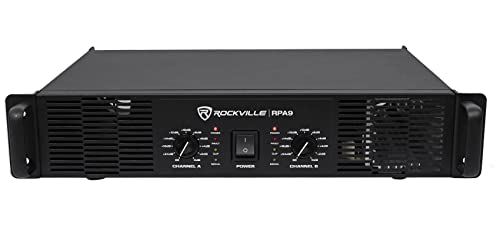
- 800W RMS and 3000W peak output
- Stereo/bridged modes with built-in crossover
- Flexible pro connections and 2U rack design
Best For: DJs, live venues, and large professional audio systems
Established Pro Choice

- 300W per channel at 4 ohms
- 600W bridged output at 8 ohms
- Forced-air cooling and flexible I/O
Best For: Two-channel PA, DJ, and stage systems
Flexible Mid-Power Pick
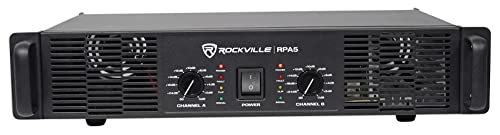
- 200W per channel or 400W bridged RMS
- Built-in crossover and stereo/mono switching
- Broad connections with protection features
Best For: Compact PA systems, DJs, and mobile entertainers
High-Output Workhorse – Behringer EUROPOWER EP4000
The Behringer EUROPOWER EP4000 is a serious choice for buyers who need high-output power amplifiers for demanding passive-speaker setups. Its stereo and bridge-mode ratings, ATR technology, limiter protection, and front-panel monitoring make it suited to applications where substantial headroom and control matter.
Best For: High-power PA systems, live events, and installations requiring stereo or bridged operation.
Pros:
- Delivers 2 x 2,000 watts at 2 ohms and 2 x 1,400 watts at 4 ohms.
- Supports 4,000 watts at 4 ohms in bridge mode.
- Includes ATR technology, switchable limiters, detented gain controls, and status LEDs.
Cons:
- At 38.4 pounds, it is relatively heavy for a rack amplifier.
- Its 15.94 x 19.02 x 3.54-inch chassis requires adequate rack space.
The EP4000 prioritizes power and monitoring over portability. It is a practical fit when your system can accommodate a heavier corded amplifier and needs substantial output across different speaker loads.
Lightweight DJ Power – Rockville D12 Class D Amplifier
The Rockville D12 is one of the more portable power amplifiers for DJ rigs, live events, and home audio systems. Its two-channel design supports stereo, parallel, and bridge modes, while the LCD monitoring and switchable crossover add useful control for full-range speakers or subwoofers.
Best For: DJs and mobile sound users who want rack mounting, flexible routing, and a lightweight Class D chassis.
Pros:
- Provides 1,400 watts RMS at 4 ohms and 700 watts RMS at 8 ohms.
- Supports stereo and bridged operation with 4-ohm and 8-ohm stability.
- Includes an LCD display, selectable 80Hz/160Hz crossover, quiet fans, and rack-mount handles.
Cons:
- The listed 5,000-watt figure is peak power, while the 4-ohm RMS rating is 1,400 watts.
- Its 1.5U chassis may offer less rack capacity than larger amplifiers.
With a 9.7-pound Class D design and useful crossover controls, the D12 emphasizes portability and versatility. It is a strong option for users who need substantial output without carrying a heavier conventional chassis.
Compact Stereo Choice – Behringer KM750
The Behringer KM750 is a straightforward two-channel option for buyers comparing power amplifiers for stereo systems. Its 750-watt output and ATR technology provide a focused feature set for users who want a conventional amplifier without the higher output or added controls of larger models.
Best For: Stereo setups and users seeking a relatively compact, 750-watt two-channel amplifier.
Pros:
- Offers two-channel operation with up to 750 watts of output.
- Uses Accelerated Transient Response technology.
- Its 18.98 x 12.48 x 3.46-inch dimensions and 18.7-pound weight are manageable for many setups.
Cons:
- The supplied notes do not specify output ratings by speaker impedance.
- It has a relatively focused feature set, with no listed Bluetooth, crossover, or LCD monitoring.
The KM750 makes the most sense when dependable two-channel amplification is the priority. Check your speakers’ power and impedance requirements before choosing it, since detailed load-specific ratings are not provided in the supplied specifications.
Connected Rack Flexibility – Pyle PTA1000BT Bluetooth Amplifier
The Pyle PTA1000BT combines rack-mount power amplification with Bluetooth and USB playback, making it a flexible choice for users who want more than traditional wired inputs. It can deliver 1,000 watts per channel in stereo or 2,000 watts in bridge mode and includes multiple connector options for mixed audio systems.
Best For: Rack-based PA and home audio setups needing wireless streaming, MP3 playback, and bridgeable two-channel output.
Pros:
- Offers 1,000 watts per channel in stereo or 2,000 watts in bridge mode.
- Provides Bluetooth, USB-A MP3 playback, TRS, XLR, SpeakON, and binding-post connections.
- Includes LED level indicators, an LCD display, bridge outputs, and built-in cooling fans.
Cons:
- The supplied voltage details list 220 volts and a 120-volt AC minimum, so buyers should verify compatibility.
- At 6.94 kg, it is less portable than the lightest Class D options.
The PTA1000BT stands out among power amplifiers for its built-in playback and connectivity options. It is especially practical for installations or PA systems where wireless source access and varied input/output connections simplify setup.
Studio Reference Power – Behringer A800
The Behringer A800 is a practical choice among power amplifiers for recording studios, post-production, live sound, and HiFi systems. It provides two channels, flexible bridged-mono operation, and convection cooling for quiet, stable performance.
Best For: Studios, post-production setups, live sound, and passive HiFi speakers.
Pros:
- Delivers 2 x 400 watts into 4 ohms or up to 800 watts in bridged mono operation.
- Ultra-low impedance design can drive a wide range of passive speakers, including studio monitors.
- Convection cooling operates without a cooling fan, while level meters and clip indicators help monitor performance.
Cons:
- Its rack-style dimensions may be less convenient for compact desktop systems.
- The supplied notes do not identify included speaker cables or other accessories.
Choose the A800 when quiet operation, straightforward monitoring, and dependable power for passive speakers matter more than compact size.
Flexible Desktop Power – Fosi Audio ZA3
The Fosi Audio ZA3 is a compact option among power amplifiers for desktop audio, home theater, and passive speaker systems. Its switchable stereo and mono modes, balanced input, and included 48V power supply make it adaptable to different setups.
Best For: Desktop listening, home theater, subwoofer applications, and passive bookshelf or floorstanding speakers.
Pros:
- Switches between stereo output up to 180W and mono output up to 235W.
- Balanced XLR/TRS input and 12V trigger-in support cleaner connections and system integration.
- Compact chassis includes upgraded ventilation, dust covers, and swappable op-amps for customization.
Cons:
- Its maximum output depends on using the included 48V power supply and the selected operating mode.
- Op-amp rolling requires separately compatible components and user experimentation.
The ZA3 is a strong fit when you want flexible power in a small enclosure, especially if balanced connectivity and sound customization are priorities.
High-Output Live Sound – Behringer EP2000
The Behringer EUROPOWER EP2000 is a high-output choice among power amplifiers for demanding stereo and bridged speaker setups. It supports multiple input and speaker connection types while providing front-panel indicators and selectable low-frequency filtering.
Best For: Live sound systems and installations requiring substantial power and broad speaker connectivity.
Pros:
- Produces 2 x 1,000 watts into 2 ohms, 2 x 750 watts into 4 ohms, or 2,000 watts in 4-ohm bridge mode.
- XLR and 1/4-inch TRS inputs accommodate a range of audio sources.
- Professional speaker connectors, touch-proof binding posts, and power, signal, and clip LEDs support flexible operation and monitoring.
Cons:
- At 34.6 pounds, it is substantially heavier than compact desktop amplifiers.
- The supplied notes do not specify cooling details or included speaker cables.
Consider the EP2000 when output headroom and connection flexibility are more important than portability, particularly for larger speaker systems.
High-Output Pick – Rockville RPA9
The Rockville RPA9 is a high-output choice among power amplifiers for DJs, live events, and larger professional audio systems. It combines 800W RMS output with stereo or bridged operation, flexible inputs and outputs, and a 2U rack-mount design.
Best For: DJs, touring entertainers, live venues, and professional setups that need substantial output and flexible connectivity.
Pros:
- Delivers 800W RMS and up to 3000W peak output.
- Supports XLR, 1/4-inch, and RCA inputs, plus speakON and banana outputs.
- Includes stereo/bridged modes, a built-in crossover, dual fans, and front-panel monitoring.
- Rugged 2U rack-mount chassis suits demanding setups.
Cons:
- Its high-power design may be more amplifier than smaller systems require.
- Rack-mount installation may be less convenient for casual, freestanding use.
Choose the RPA9 when output capacity and connection flexibility matter most. Its cooling system and monitoring features also support extended use during gigs or studio sessions.
Established Pro Choice – Crown XLi800
Crown XLi800 Two-channel, 600-Watt Bridged 8Ω Power Amplifier. Professional DJ, PA, Stage Amp. Black
Check Price On AmazonThe Crown XLi800 is a straightforward two-channel option among power amplifiers, offering 300W per channel at 4 ohms and up to 600W in bridged operation. It adds selectable input voltage, forced-air cooling, and flexible I/O for DJ, PA, and stage applications.
Best For: PA systems, DJs, and stage setups seeking a two-channel Crown amplifier with bridged capability.
Pros:
- Provides 300W continuous output per channel at 4 ohms.
- Can deliver up to 600W when bridged at 8 ohms.
- Uses forced-air cooling for operation during performances.
- Offers selectable input voltage and flexible I/O.
Cons:
- Its listed output is lower than the Rockville alternatives in this roundup.
- At 25.1 pounds, it is not especially lightweight for portable setups.
The XLi800 makes sense for buyers who want a conventional two-channel professional amplifier with clear power specifications and bridged operation. Its authorized-dealer warranty coverage is an additional purchasing consideration.
Flexible Mid-Power Pick – Rockville RPA5
The Rockville RPA5 is a practical mid-power choice among power amplifiers for smaller professional audio systems, delivering 200W RMS per channel at 4 ohms or 400W bridged at 8 ohms. Its crossover, stereo/mono switching, protection circuitry, and rack-ready construction support varied speaker setups.
Best For: DJs, mobile entertainers, and compact PA systems that need flexible stereo or bridged operation.
Pros:
- Produces 200W RMS per channel or 400W RMS bridged.
- Includes a built-in crossover and stereo/mono switch.
- Offers combo XLR/1/4-inch and RCA inputs with banana, speakON, and XLR outputs.
- Dual fans, protection circuitry, and clipping LEDs support reliable operation.
Cons:
- Its output capacity is below the RPA9 for larger venues.
- The 2U rack-mount format may not suit users seeking a compact desktop amplifier.
The RPA5 is a balanced option when you need useful configuration controls and broad connectivity without stepping up to the RPA9’s output level. It is especially suitable for rack-based mobile or installed systems.
How We Picked These Power Amplifiers
We selected models across several common use cases rather than focusing on wattage alone. The lineup includes high-output stereo amps for PA and DJ systems, compact Class D designs for efficient installations, reference-oriented models for home audio, and flexible units with Bluetooth, USB, or balanced inputs.
Our comparison emphasizes rated output, channel configuration, bridge capability, connection options, form factor, and practical system compatibility. Because amplifier specifications can vary by impedance and operating mode, treat maximum wattage as only one part of the decision.
Quick Comparison
For large PA or stage systems, the Behringer EUROPOWER EP4000 and EP2000 offer substantial headroom in familiar rack-mount formats. The Behringer KM750, A800, Crown XLi800, and Rockville rack amplifiers suit smaller or more specialized professional setups. The Pyle model adds convenient Bluetooth and USB playback features, while the Fosi Audio ZA3 is the most compact choice for desktop, bookshelf, and home-theater applications.
Before buying, compare power ratings at the impedance your speakers actually use. A two-channel amplifier may deliver different output at 8 ohms, 4 ohms, or in bridged operation, and some compact models are designed for a very different workload than touring-style rack amplifiers.
Key Buying Factors for Power Amplifiers
Power and Impedance
Choose an amplifier that matches your speakers’ nominal impedance and recommended power range. Extra headroom can help reduce clipping, but excessive output can damage speakers if the system is operated carelessly. Check whether the listed wattage is per channel, bridged, peak, or continuous RMS.
Inputs and Outputs
Balanced XLR or TRS inputs are valuable for longer cable runs and professional mixers. Speakon outputs are common in PA systems, while binding posts or terminal connections may be more suitable for installed or home-audio setups. Bluetooth and USB playback are convenient, but they should not replace the connections your primary source requires.
Size, Cooling, and Controls
Rack-mount construction is useful for mobile rigs and permanent installations, but fans and amplifier heat require adequate ventilation. Compact Class D models are easier to place near a desk or television. Also check front-panel controls, protection circuitry, bridge mode, and whether the amplifier supports the operating environment you expect.
Who Should Buy Which Power Amplifiers?
- Large PA and stage systems: Consider the EP4000 or another high-output rack amplifier when you need substantial headroom and conventional professional connections.
- Medium DJ and event rigs: The EP2000, KM750, Crown XLi800, and Rockville models offer practical two-channel formats for speakers, monitors, or mobile systems.
- Feature-focused installations: Choose the Pyle model if Bluetooth, USB playback, and bridgeable operation are priorities.
- Home and desktop listening: The Fosi Audio ZA3 is the natural fit for compact stereo, bookshelf speakers, subwoofer projects, and home-theater components.
- Value-conscious buyers: Compare the Rockville RPA5 and RPA9 by required output and speaker impedance, not just the advertised maximum.
Finally, confirm speaker sensitivity, crossover requirements, connector compatibility, available power, and ventilation before ordering. The best amplifier is the one that matches the entire signal chain reliably—not simply the model with the largest number on its specifications sheet.
