Choosing the right press can make home screen printing easier, cleaner, and far more consistent. The best options balance frame size, station count, build quality, and the kind of projects you actually want to print.
This roundup highlights screen printing presses for home workshops that suit beginners, hobbyists, and small-volume makers looking for dependable performance without overspending.
Best 10 Screen Printing Presses for Home Workshops Picks for 2026
Compact 1-Color Press for Small Shops
VEVOR 1-Color 1-Station Screen Printing Press

- Space-saving 1-color, 1-station design
- Double-layer positioning for better alignment
- Built from cold-rolled steel with durable hardware
Best For: Small workshops and occasional DIY printing
Registration-Friendly Frame Setup
Speedball 110 Monofilament Frame & Base Unit

- 110 mesh supports precise design registration
- Hardwood frame with base, hinges, and kick legs
- Cord-locked mesh can be tightened or replaced
Best For: Accurate registration projects in a home shop
Press and Frame Kit for Bigger Projects
VEVOR 1-Color Press with 4 Screen Frames
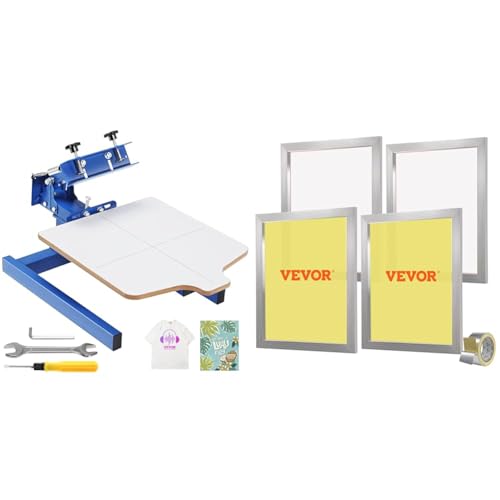
- Press plus four 20x24-inch frames included
- 355 mesh frames for detailed prints
- Double springs help balance frame weight
Best For: Home users who want a press and frame bundle
Heavy-Duty Starter Pick
INTBUYING 1-Color 1-Station Press

- Steel plate build with easy-clean finish
- Adjustable clamp and pallet for setup flexibility
- Double springs help balance different screen weights
Best For: Home workshop users needing a sturdy manual starter press
Accessory-Friendly Bundle
VEVOR 1-Color 1-Station Press Kit

- Comes with two aluminum silk frames
- Includes starter tools and tapes
- Metal build with spring-assisted screen adjustment
Best For: Beginners wanting an all-in-one press kit
Compact Hat Printing Pick

- Designed for hats and visors
- Includes 4 interchangeable platens
- Lightweight iron frame with foam pads
Best For: Small workshops that mainly print caps and visors
High-Capacity Multi-Color Press
6 Color 6 Station T-Shirt Press

- 6 color, 6 station manual overprinting setup
- Adjustable 28 to 35 inch stand height
- All-metal build with 360-degree rotation
Best For: Small businesses and individual print shops
Compact Multi-Color Starter
4 Color 1 Station Screen Printer

- Compact 4 color, 1 station design
- 360-degree rotation with metal bearings
- Double-layer pallet helps reduce deviation
Best For: Small spaces and occasional DIY printing
Small-Batch Production Press
4 Color 4 Station Screen Printer

- 4 color, 4 station layout for repeat jobs
- 360-degree rotation with stable bearings
- Cold-rolled steel body with corrosion resistance
Best For: Home users and small businesses doing repeat printing jobs
Compact 1-Color Press for Small Shops – VEVOR 1-Color 1-Station Screen Printing Press
If you’re comparing screen printing presses for home workshops, this VEVOR 1-color, 1-station press is built for small spaces and occasional use. Its compact footprint, metal-bearing structure, and double-layer positioning make it a practical pick when you want steadier alignment without a bulky setup.
Best For: Home users, DIY artists, and small-batch printers who need a space-saving press for flat materials.
Pros:
- Compact design that does not take up much space.
- Double-layer positioning helps reduce deviation during printing.
- Cold-rolled steel frame with carbon steel spring and 304 stainless steel rod.
- Works on clothing, paper, wood, glass, ceramics, leather, and other flat surfaces.
Cons:
- Single-color, single-station setup limits throughput.
- Assembly is required.
Overall, this is a straightforward screen printer for workshop users who value stability, versatility, and a smaller footprint over production speed.
Registration-Friendly Frame Setup – Speedball 110 Monofilament Frame & Base Unit
Speedball 110 Monofilament Screen Printing Frame & Base Unit, 12-Inch x 18-Inch
Check Price On AmazonFor screen printing presses for home workshops, this Speedball frame and base unit is a solid choice when registration matters. The 110 monofilament mesh, hardwood frame, and hinge/base hardware are geared toward precise textile and graphic printing rather than high-volume output.
Best For: Makers who want a dependable frame-and-base setup for projects that need accurate registration.
Pros:
- 110 monofilament polyester mesh suited to precise designs and registrations.
- Includes base attachment, hinges, screws, and kick legs.
- Hardwood frame with securely fastened mitered corners.
- Cord-locked mesh allows tightening or replacement.
Cons:
- Assembly is required.
- Screen size is limited to a 14-inch by 10-inch inner dimension.
This is a focused, workshop-friendly option if your priority is a stable frame system for accurate print placement rather than a full multi-color press.
Press and Frame Kit for Bigger Projects – VEVOR 1-Color Press with 4 Screen Frames
If you want screen printing presses for home workshops with more complete starter coverage, this VEVOR bundle combines a 1-color, 1-station press with four 20×24-inch frames. It is aimed at users who want a compact press but also need multiple high-mesh frames ready for repeated printing.
Best For: Home workshop printers who want a press plus multiple frames in one package.
Pros:
- Includes a 1-color, 1-station press with a 21.2 x 17.7 in printing area.
- Comes with 4 aluminum alloy frames in 20×24 inch size.
- 355 mesh and high-tension nylon mesh support detailed printing.
- Double springs help balance different frame weights on the press.
Cons:
- Still limited to one color and one station.
- Assembly is required.
This bundle makes sense when you want a press system that is ready for more organized workflow, but you still plan to work in a small-space, single-color setup.
Beginner-Friendly Wood Hinge Press – Caydo 1-Color 1-Station Silk Screen Press
This Caydo press fits well into the screen printing presses for home workshops category if you’re looking for an easier first setup. Its wood structure, lift-and-hover hinge design, and base groove for garment alignment are aimed at helping beginners print more steadily and with less fuss.
Best For: Beginners and hobbyists who want a simple, stable press for DIY garment printing.
Pros:
- Unique hinge design lets the wood frame lift and hover for easier use.
- Base groove and centerline support garment stability and alignment.
- Easy installation and user-friendly operation.
- Adapts to 10×14, 8×12, and 6×10 inch frames.
Cons:
- Designed around smaller frame sizes.
- Best suited to DIY and beginner use rather than heavy production.
For a home workshop, this is the most approachable option in the group if you value easy setup, visible alignment aids, and a durable wood build.
Heavy-Duty Starter Pick – INTBUYING 1-Color 1-Station Press
If you’re comparing screen printing presses for home workshops, this INTBUYING 1-color, 1-station model is a straightforward manual option for flat garment and craft printing. The steel plate build, adjustable clamp, and movable pallet make it practical for users who want a simple press that can be fixed securely to a table and tuned for different frame thicknesses.
Best For: Home workshop users who want a sturdy, manual single-color press for garments and other flat items.
Pros:
- Steel plate construction with electrostatic spray surface treatment for durability
- Adjustable screen clamp and pallet help fit different frame sizes and positions
- Double spring design adds balance and stability during setup and printing
- Wide use across clothing, fabrics, paper, wood, glass, ceramics, and more
Cons:
- Needs to be fixed to a table with screws
- Screen frame shown in images is not included
- Single-color, single-station setup limits production speed
This is a practical entry-level press if your priority is a durable frame and adjustable mechanics rather than high-volume output. It’s best suited to users who want a stable bench-mounted machine for learning or small jobs.
Accessory-Friendly Bundle – VEVOR 1-Color 1-Station Press Kit
For buyers looking at screen printing presses for home workshops and wanting extra setup support, this VEVOR package pairs a 1-color, 1-station press with two aluminum silk frames and basic printing accessories. The metal construction and spring device design are aimed at making manual operation easier, while the included frames and tools help you get started on flat printing projects sooner.
Best For: Beginners who want a press kit with frames and basic tools included.
Pros:
- Includes two aluminum silk frames in 8×10 and 10×14 sizes
- Metal construction with electrostatic spraying and electroplating
- Spring device helps adjust the screen up and down for different weights
- Comes with useful starter accessories like squeegee, scrapers, films, sticks, and tape
Cons:
- Still a single-color, single-station press
- Best suited to flat printing rather than specialized applications
- Frame sizes are included, but the setup remains fairly compact
This bundle stands out if you want a more complete starter package instead of buying the press and accessories separately. It’s a sensible pick for home users who value convenience and a smoother first setup.
Compact Hat Printing Pick – Hat Champ 4-Platen Cap Press
If your home workshop needs screen printing presses for home workshops focused on hats and caps, this Hat Champ machine is built around a compact 6″ x 3.5″ platen and interchangeable platens. It’s a manual, space-saving setup designed for cap work, with a pull-lock system and removable foam pads that make it easier to print on different hat styles.
Best For: Home users printing hats, visors, and other cap styles in a small workspace.
Pros:
- Interchangeable 4-platen setup supports different hat and visor styles
- Compact and lightweight iron construction takes up little space
- Pull-lock system is designed for secure multi-color printing
- Removable foam pads help protect hats and reduce deformation
Cons:
- Platen size is small at 6″ x 3.5″
- Specialized for hats rather than general garment printing
- Manual operation means lower output than larger production presses
This is the most focused option here if your main project is cap decoration rather than shirts or flat goods. Its small footprint and interchangeable platens make it a useful workshop add-on when hat printing is the priority.
High-Capacity Multi-Color Press – 6 Color 6 Station T-Shirt Press
If you’re comparing screen printing presses for home workshops, this 6-color, 6-station model is built for multi-color overprinting and faster workflow once each arm is adjusted. Its all-metal construction, adjustable-height stand, and 360-degree screen frame rotation make it a practical choice for users who want a more capable manual press without moving into a full industrial setup.
Best For: Small businesses and individual print shops that need a manual multi-color press with adjustable height.
Pros:
- 6 color, 6 station layout supports multi-color overprinting.
- Adjustable metal stand changes height from 28 to 35 inches.
- 360-degree rotating screen frame holder helps with color alignment.
- All-metal body with corrosion-resistant, easy-clean finish.
Cons:
- Large fully assembled footprint may be more than a very tight workspace wants.
- Manual setup requires adjusting each arm and spring balance.
- Built for flat printing tasks and T-shirt use, not a compact hobby-only machine.
This press stands out if you value output capacity and adjustable ergonomics over compact size. For a workshop that can handle the footprint, it offers a solid manual platform for repeatable multi-color printing.
Compact Multi-Color Starter – 4 Color 1 Station Screen Printer
For home workshops looking at screen printing presses for home workshops, this 4-color, 1-station VEVOR model is designed to save space while still handling a range of flat materials. The 360-degree rotatable frame, independent metal bearings, and double-layer positioning pallet are aimed at stable manual printing for DIY users and light commercial work.
Best For: Small spaces, occasional printing, and DIY artists who want a compact multi-color press.
Pros:
- Compact 4 color, 1 station layout fits limited workspaces.
- 360-degree rotation and metal bearings support stable positioning.
- Double-layer positioning design helps reduce deviation.
- Works with many flat materials, including clothing, paper, wood, glass, and more.
Cons:
- Must be screwed to a workbench for more stability.
- One-station setup is less efficient for bigger batch runs than multi-station presses.
- Manual operation is better suited to occasional or small-scale production.
This model makes sense when your priority is flexibility in a smaller footprint rather than high-volume throughput. It brings a durable steel build and useful alignment features to a home-friendly format.
Small-Batch Production Press – 4 Color 4 Station Screen Printer
If you want screen printing presses for home workshops that can handle more organized batch work, this 4-color, 4-station VEVOR model gives you multiple stations without leaving the manual press category. It shares the same 21.2 x 17.7 inch printing area and 360-degree rotatable design as the 1-station version, but the added stations make it better suited to repeated color work and small production runs.
Best For: Home users and small businesses that want more station capacity for repeat printing jobs.
Pros:
- 4 color, 4 station layout supports more efficient workflow.
- 360-degree rotation with independent metal bearings aids stable operation.
- Double-layer positioning helps lower the risk of alignment errors.
- Cold-rolled steel construction with corrosion-resistant finish.
Cons:
- Requires bolting to a workbench for stability.
- Heavier and larger than a 1-station unit, so it needs more room.
- Still a manual press, so it is not built for fully automated output.
Compared with the 1-station model, this version is the better fit when you expect to switch screens more often and want a smoother small-batch rhythm. It keeps the same durable build and positioning features while improving station count for home or light commercial use.
How We Picked the Best Screen Printing Presses for Home Workshops
We focused on Screen Printing Presses for Home Workshops that offer a practical mix of stability, usable platen size, straightforward operation, and value for small-batch printing. We also looked for options that make sense in garages, spare rooms, and compact studios where space and setup time matter.
Quick Comparison
If you want the simplest path, a 1-color 1-station press is usually the easiest entry point. If you print shirts with multiple inks or want better throughput, a 4-color or 4-station setup is more flexible. Specialty presses, like hat machines, are best when you already know your product niche.
Key Buying Factors for Screen Printing Presses for Home Workshops
Press Style and Station Count
Station count affects workflow more than almost anything else. One-station presses are compact and affordable, while multi-station presses help when you need to flash, rotate, or stage multiple screens. For most home users, the right choice depends on whether you print simple one-color designs or more advanced multi-color jobs.
Platen Size and Print Surface
Make sure the platen fits your most common garment sizes and substrate types. T-shirt presses generally need enough room for adult and youth apparel, while hat presses and other specialty units are only worth it if you will use them often.
Frame Compatibility and Screen Count
Check whether the press supports the screen frames you already own or plan to buy. For Screen Printing Presses for Home Workshops, compatibility with common frame sizes and mesh counts can save money and reduce setup frustration.
Build Stability and Adjustability
A stable base, firm clamps, and smooth registration adjustments help improve print consistency. If you are still learning, easier alignment and reliable locking mechanisms are more valuable than extra features you may not use.
Who Should Buy Which Screen Printing Presses for Home Workshops?
Beginners and casual hobbyists should usually start with a compact 1-color 1-station press because it is easier to learn and easier to store. Makers who want more creative control should consider a 4-color or 4-station model for layering inks and improving workflow. If your focus is caps or hats, a dedicated hat press is the better fit. For small-shop owners or ambitious home printers, a sturdier, larger-format press can offer the best long-term value if you plan to print regularly.
