Fast external storage can make a major difference when editing high-bitrate 4K, 6K, or 8K footage. The right enclosure lets you reuse an NVMe or SATA SSD while balancing sustained speed, portability, cooling, and reliability.
We selected 10 options for different workflows, from compact 10Gbps enclosures to 40Gbps USB4 models, rugged dual-interface designs, and multi-drive storage docks. Use the guide below to match the enclosure to your computer, SSD, and editing workload.
Best 10 SSD Enclosures for Video Editing Picks for 2026
Best for 4K Editing
Yottamaster 40Gbps NVMe Enclosure

- 40Gbps USB4 and Thunderbolt 4 support
- Active cooling for sustained workloads
- Tool-free installation for multiple NVMe sizes
Best For: 4K editors and professional workflows
Best Rugged Dual-Interface Pick

- Supports M.2 NVMe and SATA SSDs
- USB-C 3.2 Gen 2x2 up to 20Gbps
- MIL-STD-810H and IP68-tested design
Best For: Mobile editors needing rugged, flexible storage
Mobile ProRes Pick
Magnetic 10Gbps NVMe Enclosure

- Magnetic design for compatible iPhone Pro models
- 4K/60Hz HDMI and direct ProRes recording support
- Cooling fan and aluminum construction
Best For: Mobile iPhone ProRes recording and on-the-go creators
High-Capacity Studio Pick

- Four M.2 NVMe bays for up to 32TB total
- USB 4.0 interface with up to 40Gbps bandwidth
- Aluminum body, fan, and ventilation for sustained use
Best For: Multi-drive editing studios and DIT workflows
Simple Portable Pick
Tool-Free 10Gbps NVMe Enclosure

- Tool-free flip-open installation
- USB-C 10Gbps connectivity with no external power
- Aluminum cooling for one M.2 NVMe drive
Best For: Portable single-drive editing, transfers, and upgrades
Best Multi-Drive Pick
TERRAMASTER D4 40Gbps NVMe Enclosure

- Four M.2 NVMe bays with up to 32TB capacity
- 40Gbps USB-C connectivity for fast transfers
- Active cooling and tool-free, hot-swap access
Best For: Multi-drive editing workstations and large media libraries
Best Versatile Value
SSK USB 3.2 Gen 2 M.2 Enclosure

- Supports compatible NVMe and SATA M.2 SSDs
- Includes USB-C and USB-A cables
- Slim aluminum shell with thermal pads
Best For: Portable editing and mixed USB-C/USB-A setups
Best Tool-Free Option
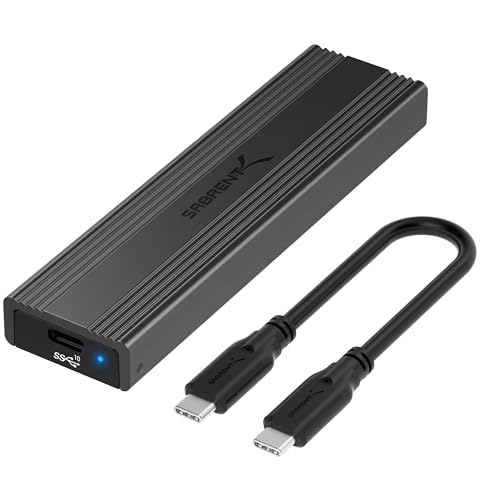
- Tool-free SSD installation and removal
- Supports NVMe and SATA M.2 drives
- Slim 10Gbps USB-C aluminum enclosure
Best For: Editors who swap bare M.2 project drives frequently
Best USB4 Performance – Sabrent USB4 NVMe Enclosure
For editors seeking fast SSD enclosures for video editing, the SABRENT EC-U4TN pairs USB4 bandwidth with active cooling. It supports PCIe NVMe drives up to 2280 size and can reach up to 3,900 MB/s with a compatible USB4 host.
Best For: Video editors and creators using USB4 or Thunderbolt systems who need fast portable NVMe storage.
Pros:
- Up to 3,900 MB/s over USB4 and up to 2,700 MB/s over Thunderbolt 3/4.
- Tool-free installation for 2230, 2242, 2260, and 2280 PCIe NVMe SSDs.
- Integrated active cooling fan helps maintain performance during large transfers.
- Works with Windows and macOS without drivers or external power.
Cons:
- Supports PCIe NVMe SSDs only, not SATA M.2 drives.
- Top speeds require a compatible USB4 host and suitable SSD.
This is a strong choice for demanding editing workflows when your computer supports USB4. Its cooling and broad high-speed host compatibility make it particularly suitable for sustained file transfers.
Best SATA Value – ORICO 2.5-Inch USB-C Enclosure
The ORICO DD25-C3 is a practical option among SSD enclosures for video editing when you are using a 2.5-inch SATA SSD. Its USB 3.2 Gen 2 interface, aluminum housing, and included USB-C to USB-A/C cable support flexible desktop and mobile setups.
Best For: Editors repurposing 2.5-inch SATA SSDs or HDDs for secondary project storage and backups.
Pros:
- Supports 2.5-inch SATA SSDs and HDDs in 7mm or 9.5mm thicknesses.
- USB 3.2 Gen 2 connectivity with UASP support and up to 6Gbps SATA transmission.
- Includes a USB-C to USB-A/C 2-in-1 cable for broad device compatibility.
- Tool-free, plug-and-play installation with built-in protection features.
Cons:
- SATA performance is lower than USB4 NVMe enclosures.
- Designed for 2.5-inch drives rather than M.2 SSDs.
Choose this enclosure if you already have a 2.5-inch SATA drive and want an affordable way to access it externally. It is better suited to general editing storage, transfers, and backups than the fastest high-bandwidth editing workloads.
Best for 4K Editing – Yottamaster 40Gbps NVMe Enclosure
The Yottamaster 40Gbps enclosure is built for demanding workflows and stands out among SSD enclosures for video editing with its ASM2464PD controller and active cooling fan. Real-world sustained speeds are listed at approximately 2,800 to 3,200 MB/s when paired with a suitable host, cable, and SSD.
Best For: 4K video editing, professional workflows, and users who want tool-free NVMe installation with visible status indicators.
Pros:
- Supports Thunderbolt 4 and USB4 connectivity with a 40Gbps interface.
- Active cooling and overcurrent and overheating protection support sustained operation.
- Tool-free installation supports 2230, 2242, 2260, and 2280 NVMe SSDs.
- Transparent cover makes the activity LED and fan status easy to see.
Cons:
- Peak performance depends on a 40Gbps-rated cable, host, and compatible SSD.
- Real-world speeds are lower than the headline 40Gbps interface rate.
With its cooling-focused design and stated suitability for 4K editing, this enclosure is a compelling fit for creators moving large media files. Confirm your computer and cable support USB4 or Thunderbolt 4 before expecting its best performance.
Best Rugged Dual-Interface Pick – ASUS TUF Gaming A2
The ASUS TUF Gaming A2 combines portability and drive flexibility in a durable enclosure for video editing. Its USB-C 3.2 Gen 2×2 interface reaches up to 20Gbps, while the dual M.2 design accepts both NVMe PCIe and SATA SSDs.
Best For: Mobile editors who need a rugged enclosure compatible with both M.2 NVMe and SATA drives.
Pros:
- Supports M.2 NVMe PCIe and SATA SSDs in 2242, 2260, and 2280 sizes.
- USB-C 3.2 Gen 2×2 provides speeds up to 20Gbps.
- MIL-STD-810H and IP68 testing, plus a silicone-rubber exterior, add protection.
- Q-Latch installation enables screw-free SSD swaps, while the aluminum chassis and thermal pad help dissipate heat.
Cons:
- Its 20Gbps interface is slower than USB4 and Thunderbolt 4 alternatives.
- Drive capacity is listed up to 4TB.
This is a versatile choice for editors who value durability and compatibility over maximum interface speed. The ability to use either NVMe or SATA M.2 drives also makes it useful for mixed-drive collections and frequent drive swaps.
Mobile ProRes Pick – Magnetic 10Gbps NVMe Enclosure
For creators seeking SSD enclosures for video editing on the go, the ACASIS combines 10Gbps NVMe connectivity with a magnetic design and built-in cooling. Its HDMI port and supported iPhone ProRes workflow make it especially relevant for mobile recording, though the enclosure requires a separately purchased SSD.
Best For: iPhone Pro and Pro Max users recording 4K ProRes video directly to an external SSD.
Pros:
- Magnetic attachment is designed for compatible iPhone models and MagSafe cases.
- Supports 4K at 60Hz HDMI output and direct ProRes recording on compatible iPhones.
- Uses an aluminum body, thermal pad, and cooling fan for sustained workloads.
- Compact design is convenient for travel, event recording, and mobile editing.
Cons:
- SSD is not included.
- Compatibility is focused on M.2 2230 NVMe drives and supported iPhone models.
- External power may be recommended with drives over 1TB or multiple connected devices.
This is a specialized choice rather than a general desktop enclosure. Its strongest advantage is the combination of magnetic mounting and mobile ProRes support, while its format and phone-focused features may be unnecessary for conventional laptop editing.
High-Capacity Studio Pick – 40Gbps Four-Bay NVMe Dock
The ORICO 8848U4 is built for demanding SSD enclosures for video editing setups that need multiple NVMe drives and substantial capacity. Its four-bay design supports up to 32TB total, with USB 4.0 connectivity and active cooling for extended transfers and editing workloads.
Best For: Professional editors, DITs, and production teams managing multiple NVMe drives and large media libraries.
Pros:
- Four M.2 NVMe bays support 2230, 2242, 2260, and 2280 drives.
- Supports up to 8TB per drive and 32TB total capacity.
- USB 4.0 interface provides up to 40Gbps bandwidth, with up to 10Gbps stated for single-disk operation.
- Aluminum housing, cooling fan, and ventilation support sustained operation.
Cons:
- SSD drives are not included.
- Its four-bay desktop-oriented design is less compact than a single-drive enclosure.
- Fan noise is specified below 30 decibels, so it is not completely silent.
The 8848U4 stands out when capacity and drive count matter more than simplicity. It is a strong fit for organized production storage, but users needing only one portable scratch drive may prefer a smaller enclosure.
Simple Portable Pick – Tool-Free 10Gbps NVMe Enclosure
The SABRENT EC-PNVO is a straightforward option among SSD enclosures for video editing, offering tool-free installation and USB-C connectivity up to 10Gbps. Its aluminum cooling surface and compact build make it useful for portable transfers, upgrades, cloning, and creator workflows.
Best For: Editors and general users who need a compact, single-drive NVMe enclosure with quick, screw-free installation.
Pros:
- Flip-open tool-free design makes drive installation fast and convenient.
- Supports M.2 NVMe drives in 2230, 2242, 2260, and 2280 sizes.
- USB 3.2 Gen 2 USB-C connection supports speeds up to 10Gbps without external power.
- Aluminum construction and direct thermal-pad contact help manage heat during transfers.
Cons:
- Supports NVMe drives only and is not compatible with M.2 SATA SSDs.
- Single-drive design does not provide the capacity or expansion of a multi-bay dock.
- SSD is not included.
This enclosure keeps the setup uncomplicated and portable. It is a practical choice for one NVMe drive, especially when tool-free access matters, but users with SATA M.2 drives or multi-drive storage needs should look elsewhere.
Best Multi-Drive Pick – TERRAMASTER D4 40Gbps NVMe Enclosure
For demanding video editing workflows, the TERRAMASTER D4 is a high-capacity choice among SSD enclosures for video editing. It holds four M.2 NVMe 2280 SSDs and supports up to 40Gbps connectivity, with rated speeds up to 3,224MB/s using four compatible SSDs. It is a diskless enclosure, so you supply the drives.
Best For: Editors who need multi-drive NVMe storage, substantial capacity, and a compact desktop enclosure.
Pros:
- Supports four M.2 NVMe SSDs and up to 32TB total capacity.
- 40Gbps USB-C connectivity is compatible with Thunderbolt 3, 4, and 5, plus USB 4.
- Active cooling, temperature sensors, and a 19dB(A) standby noise rating help manage sustained workloads.
- Tool-free access and hot-swappable drive support simplify SSD changes.
Cons:
- Does not include SSDs.
- No built-in RAID; software RAID requires third-party tools.
- Its four-drive design needs external power and is less portable than a single-drive enclosure.
The D4 is the most capable option here for editors building a fast, expandable media workspace. Choose it when multiple NVMe drives and capacity matter more than the simplicity of a pocket-sized enclosure.
Best Versatile Value – SSK USB 3.2 Gen 2 M.2 Enclosure
The SSK M.2 enclosure is a flexible option for SSD enclosures for video editing when you want to reuse either an NVMe or SATA M.2 drive. Its USB 3.2 Gen 2 interface supports transfer rates up to 10Gbps, while the aluminum shell and included thermal pads help with portability and heat management.
Best For: Editors who need an affordable, bus-powered enclosure compatible with several M.2 drive types and sizes.
Pros:
- Supports M-Key and B+M Key NVMe PCIe or SATA M.2 SSDs in 2242, 2260, and 2280 sizes.
- Includes both USB-C and USB-A cables for flexible connectivity.
- Aluminum construction, thermal pads, UASP, and TRIM support aid everyday performance.
- Bus-powered and compatible with Windows, macOS, and Linux without additional drivers.
Cons:
- Limited to 10Gbps USB 3.2 Gen 2 speeds rather than 40Gbps-class performance.
- Does not support M.2 PCIe AHCI drives, mSATA SSDs, or non-M.2 drives.
- SSD is not included and must be formatted before use.
With broad M.2 compatibility and two cable options, the SSK is a practical fit for editors moving projects between newer USB-C systems and older USB-A computers. It is best suited to portable editing and transfers rather than maximum-throughput professional setups.
Best Tool-Free Option – SABRENT EC-SNVE M.2 Enclosure
The SABRENT EC-SNVE keeps SSD enclosures for video editing simple: insert a compatible M.2 drive without tools, connect over USB 3.2 Type-C, and start transferring files. It supports both NVMe and SATA M.2 SSDs in common lengths and reaches up to 10Gbps, or up to 1,000MB/s in real transfers according to the supplied specifications.
Best For: Editors who frequently swap bare M.2 SSDs and want a compact, tool-free enclosure.
Pros:
- Tool-free installation lets you install or remove an SSD in seconds.
- Supports M.2 NVMe and SATA SSDs in 2242, 2260, and 2280 sizes.
- Slim aluminum and ABS construction includes a thermal pad for heat transfer.
- Bus-powered, driver-free, and compatible with Windows, macOS, and Linux.
Cons:
- Limited to 10Gbps USB 3.2 performance.
- Does not include an SSD or provide clearance for a pre-installed heatsink.
- Does not support 2.5-inch SATA drives or mSATA SSDs.
The EC-SNVE is a convenient choice for editors who rotate project drives or repurpose spare M.2 SSDs. Its straightforward tool-free design is especially useful for quick changes, provided your drive is bare and compatible.
How We Picked the Best SSD Enclosures for Video Editing
We evaluated these enclosures around the factors that matter most in real editing workflows: interface bandwidth, SSD compatibility, sustained performance, thermal management, portability, durability, and ease of installation. We also considered whether each model suits a specific use case, such as mobile editing, 4K ProRes capture, scratch-disk work, archival transfers, or multi-drive storage.
Advertised speeds represent theoretical interface limits. Actual performance depends on the installed SSD, host computer, cable, file sizes, cooling, and workload. A fast enclosure cannot overcome a slower drive or a USB port with lower bandwidth.
Quick Comparison
| Best For | Recommended Type | What to Look For |
|---|---|---|
| Maximum single-drive speed | USB4 or 40Gbps NVMe | USB4/Thunderbolt compatibility and effective cooling |
| Everyday 4K editing | 10Gbps NVMe | Reliable controller, tool-free access, and a quality cable |
| Mixed SSD collection | Dual NVMe/SATA enclosure | Support for both drive interfaces and clear installation guidance |
| Rugged field production | Protected or water-resistant enclosure | Drop resistance, dust protection, and secure connectors |
| Several scratch or project drives | Multi-bay NVMe enclosure | Independent drive support, cooling, and adequate host bandwidth |
Key Buying Factors for SSD Enclosures for Video Editing
Interface and Real-World Speed
USB 3.2 Gen 2 models can approach 1,000MB/s, which is sufficient for many 4K timelines and media transfers. USB 3.2 Gen 2×2 can be faster, while USB4 and 40Gbps designs offer more headroom for demanding footage and large project files. Confirm that your computer supports the same standard; otherwise, the enclosure will operate at the slower connection speed.
SSD Compatibility
Check whether the enclosure accepts M.2 NVMe drives, SATA M.2 drives, 2.5-inch SATA drives, or more than one format. M.2 keying also matters: an NVMe PCIe drive is not automatically compatible with a SATA M.2 enclosure. Capacity limits, single- or double-sided drive clearance, and included thermal pads are worth checking before purchase.
Heat Management and Sustained Writes
Video transfers can produce sustained workloads that expose thermal throttling. Aluminum bodies, thermal pads, heatsinks, ventilation, or active cooling can help maintain consistent performance. A model that is extremely fast for short bursts may slow during long exports if heat is not controlled.
Portability, Durability, and Accessories
For on-location editing, prioritize a compact enclosure, a secure USB-C connector, durable construction, and a cable that supports the advertised speed. Tool-free designs simplify drive swaps, while rugged or water-resistant models provide extra protection in travel environments. Multi-bay units are better suited to desks because they are larger and often need more careful cable and power management.
Who Should Buy Which SSD Enclosures for Video Editing?
Choose a USB4 or 40Gbps Model
Buy one of the high-bandwidth NVMe enclosures if you have a compatible USB4 or Thunderbolt computer and regularly move large 4K, 6K, or 8K projects. These models are best for editors who value shorter transfer times and higher performance headroom.
Choose a 10Gbps Enclosure
A 10Gbps model is the sensible choice for most laptops, desktop workstations, and portable editing kits. It typically offers strong performance without requiring the newest host ports, and it can be more than adequate for project files, proxies, and many 4K workflows.
Choose a Rugged or Flexible-Format Enclosure
Field editors should prioritize protection and dependable connectivity, while users with older or mixed drives should select a model supporting the formats they already own. For large libraries or several active SSDs, a multi-bay enclosure can simplify organization, but confirm that your computer and software support the intended storage configuration.
