The best stage monitors help performers hear vocals, instruments, and timing clearly without relying on the main PA. The right choice depends on venue size, required volume, portability, and whether you need an active or passive design.
This roundup compares 10 stage monitors ranging from compact powered 10-inch wedges to high-output 12- and 15-inch models, plus affordable passive pairs for larger setups.
Best 10 Stage Monitors Picks for 2026
Premium Powered Pick

- 700W powered coaxial monitor
- Built-in mixer and advanced DSP
- 90° x 90° coverage with 55° monitor angle
Best For: Performers and engineers wanting powerful, highly adjustable monitoring
Best Pair Value
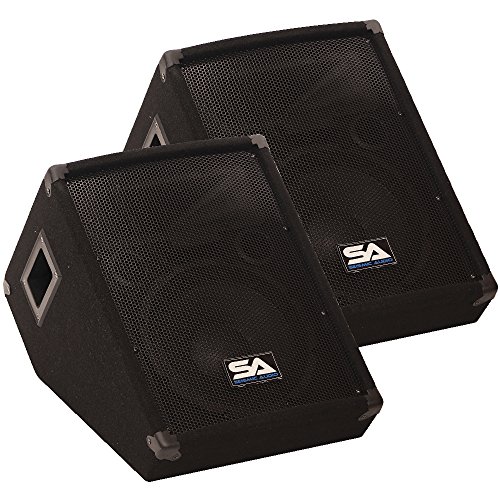
- Pair of 10-inch wedge monitors
- 150W RMS and 300W peak specification
- Titanium compression horn driver
Best For: Bands and venues needing two straightforward passive stage monitors
Easy Active Setup

- 300W powered two-way monitor
- 12-inch woofer with 1-inch compression driver
- Feedback filter, limiter, and 3-band EQ
Best For: Live performers wanting active monitoring with built-in control features
Reliable Passive Classic

- 12-inch two-way floor monitor
- 300W program and 600W peak handling
- 97dB sensitivity with built-in pole socket
Best For: Existing amplified PA systems needing a traditional passive monitor
Compact Control

- 250-watt Class-D powered monitor
- Adjustable feedback filter and limiter
- 12-inch woofer with multiple wired inputs
Best For: Live performers wanting feedback control and flexible connectivity
High-Output Coaxial

- 800-watt Class-D active monitor
- 10-inch driver and 1-inch tweeter
- FOH/Monitor selector with XLR link output
Best For: Stages and DJ booths needing high output in a coaxial design
Flexible Small-Venue Wedge

- 300-watt powered 2-way monitor
- Onboard 3-band EQ controls
- XLR, auxiliary, and MP3 inputs
Best For: Rehearsals and small venues needing flexible connections and quick EQ changes
Matched Pair Power
Rockville RSM12P 12-Inch Passive Monitors

- Matched pair of 12-inch passive wedge monitors
- 250 watts RMS per cabinet with 70° x 50° dispersion
- Speakon and 1/4-inch input/thru connections
Best For: Bands, worship teams, DJs, and compact passive PA systems
Self-Powered Convenience
Seismic Audio SA-10MT-PW Powered Monitor Pair

- Pair of active 10-inch two-way wedge monitors
- Built-in gain, volume, and 3-band EQ controls
- XLR, 1/4-inch, Speakon, and 3.5 mm inputs
Best For: Live performers and studios seeking powered wedges with onboard controls
Large-Woofer Output
Rockville RSM15P 15-Inch Passive Monitor

- 15-inch woofer with 1.75-inch titanium compression driver
- 1,400 watts listed peak power handling
- 70° x 50° coverage with 1/4-inch and Speakon I/O
Best For: DJs, bands, and PA systems needing a high-output passive wedge
Premium Powered Pick – Electro-Voice PXM 12MP
The Electro-Voice PXM 12MP is a powerful, flexible choice for stage monitors when you want built-in amplification, mixing, and DSP control. Its coaxial design provides consistent 90° x 90° coverage, while the 55° monitoring angle helps maintain intelligibility from different positions onstage.
Best For: Musicians, DJs, audio engineers, and compact PA setups needing advanced control and high output.
Pros:
- 700W Class-D amplification with system protection and limiting
- 12-inch/1.75-inch coaxial driver with consistent 90° x 90° coverage
- Three input channels, including combination XLR/¼-inch inputs and stereo RCA
- DSP includes EQ presets, feedback notch filtering, low-cut filters, and user settings
Cons:
- Heavier and more feature-rich than a basic passive wedge
- Requires corded power for operation
- Not waterproof
With its integrated mixer, extensive DSP, and high-output amplifier, the PXM 12MP is one of the most self-contained stage monitors in this group. It is especially compelling when setup flexibility and feedback control matter.
Best Pair Value – Seismic Audio SA-10MT
Seismic Audio - SA-10MT - Pair of 10" Floor / Stage Monitors Wedge Style with Titanium Horn
Check Price On AmazonThe Seismic Audio SA-10MT is a practical two-speaker solution for stage monitors, supplying a pair of wedge-style cabinets with 10-inch woofers and titanium compression horn drivers. Its passive design suits live performances and music events where an external amplifier is already part of the system.
Best For: Bands, venues, and mobile setups needing two floor monitors in one package.
Pros:
- Includes two wedge-style floor monitors
- 10-inch woofers with 150W RMS and 300W peak handling per listed model specification
- Titanium compression horn driver for high-frequency reproduction
- Designed for live performances, music events, and stage monitoring
Cons:
- Passive speakers require a separate amplifier
- Limited to basic wired connectivity through auxiliary and XLR-related specifications
- Not water resistant
The SA-10MT stands out when quantity and straightforward coverage are priorities. Because it is a pair of passive wedges, confirm that your amplifier can support the speakers before purchasing.
Easy Active Setup – Behringer EUROLIVE F1320D
The Behringer EUROLIVE F1320D simplifies stage-monitor setup with a built-in 300W amplifier and a 12-inch two-way design. Its integrated sound processor, feedback filter, and limiter provide useful control for live and playback applications without requiring a separate power amplifier.
Best For: Performers and small live systems seeking an active monitor with built-in feedback and protection features.
Pros:
- Built-in 300W Class-D amplifier
- 12-inch woofer and 1-inch compression driver in a two-way design
- Adjustable feedback filter and integrated limiter
- Integrated sound processor and 3-band EQ
Cons:
- Requires corded power
- Less amplifier headroom than the 700W Electro-Voice option
- Not water resistant
The F1320D is a sensible middle-ground option for users who want active stage monitors with essential signal-management tools. Its powered format can reduce setup complexity compared with passive cabinets.
Reliable Passive Classic – Yamaha BR12M
The Yamaha BR12M is a passive 12-inch floor monitor built for stage monitoring, public address, and sound reinforcement. It combines a 12-inch woofer with a 1-inch compression driver, 97dB sensitivity, and 300W program/600W peak power handling for conventional amplified systems.
Best For: Live sound users who already have an amplifier or powered mixer and prefer a traditional passive monitor.
Pros:
- 12-inch woofer with 1-inch compression driver
- 300W program and 600W peak power handling
- 97dB sensitivity for efficient operation
- Built-in pole socket, steel handles, corner protectors, and protection circuitry
Cons:
- Requires an external amplifier or powered mixer
- Single monitor rather than a pair
- Not waterproof and has no wireless communication technology
The BR12M is a straightforward choice for established PA rigs that already provide amplification. Its durable handling features and pole socket add practical flexibility for live sound applications.
Compact Control – Behringer F1220D
The Behringer EUROLIVE F1220D is a practical choice for stage monitors when you want a powered 12-inch wedge with built-in feedback control. Its 250-watt Class-D amplifier, wide frequency bandwidth, and multiple wired input options suit live performances and general music playback.
Best For: Performers and small live setups needing a powered 12-inch monitor with feedback filtering.
Pros:
- Adjustable feedback filter and integrated limiter help support system control and speaker protection.
- 12-inch woofer and 3-inch tweeter provide a broad, dynamic sound presentation.
- Class-D amplification keeps the unit relatively lightweight at 23.6 pounds.
- Offers XLR, 1/4-inch, RCA, and Speakon connectivity.
Cons:
- Its 250-watt maximum output is lower than the other powered monitors in this roundup.
- The enclosure is not water resistant.
Choose the F1220D if feedback management and flexible wired connectivity matter more than maximum output. It is a versatile tabletop monitor for straightforward live-performance use.
High-Output Coaxial – Samson RSXM10A
The Samson RSXM10A is a high-output option for stage monitors, combining an 800-watt Class-D amplifier with a compact coaxial design. Its 10-inch low-frequency driver, 1-inch tweeter, combo input, and FOH/Monitor selector make it adaptable for live stages and DJ setups.
Best For: Live performers, DJs, and sound engineers who need powerful, compact monitoring.
Pros:
- Provides up to 800 watts of output power.
- Coaxial 2-way design pairs a 10-inch driver with a 1-inch tweeter.
- XLR-1/4-inch combo input and XLR link output support flexible signal routing.
- FOH/Monitor selector helps optimize the speaker for its placement.
Cons:
- At 30 pounds, it is heavier than the Behringer model listed here.
- Its 10-inch driver has a stated 55 Hz frequency response.
- The cabinet is not waterproof.
The RSXM10A stands out when output and routing flexibility are priorities. Its all-wood cabinet and pole-mount receptacle also give it useful placement options beyond wedge monitoring.
Flexible Small-Venue Wedge – Sound Town METIS-10MPW
The Sound Town METIS-10MPW is a compact powered option for stage monitors, with a 10-inch woofer, 1-inch titanium compression driver, and integrated 300-watt amplifier. Its 3-band EQ and varied input selection make it convenient for rehearsals, small venues, churches, bars, and other live-sound applications.
Best For: Small-venue performers and rehearsal spaces needing simple tone controls and flexible source inputs.
Pros:
- Powered 2-way design combines a 10-inch woofer with a 1-inch titanium compression driver.
- Built-in bass, mid, and treble controls allow quick tonal adjustments.
- Includes XLR input, XLR output, 1/4-inch auxiliary input, and 1/8-inch MP3 input.
- Low-profile cabinet includes a recessed handle, metal grille, and reinforced corners.
Cons:
- Its 300-watt integrated amplifier is intended more for small-venue use than high-output applications.
- The speaker is not water resistant.
- It has a one-year warranty.
The METIS-10MPW is a practical pick when quick EQ changes and broad input compatibility are more important than maximum power. Its reinforced wedge enclosure is well suited to regular transport and stage use.
Matched Pair Power – Rockville RSM12P 12-Inch Passive Monitors
For bands, DJs, and worship teams that need consistent coverage across the stage, the Rockville RSM12P supplies a matched pair of passive stage monitors. Its 12-inch woofer, titanium horn, broad dispersion, and daisy-chain-friendly connections suit compact live rigs and rehearsal spaces.
Best For: Bands, houses of worship, DJs, and users building a paired passive monitoring system.
Pros:
- Includes two matched 12-inch, two-way wedge monitors.
- Offers 250 watts RMS and 500 watts program handling per cabinet.
- Provides 70° x 50° dispersion with Speakon and 1/4-inch input and thru connections.
- Rugged carpeted MDF cabinets include steel grilles, recessed handles, and rubber feet.
Cons:
- Requires a compatible amplifier or powered mixer.
- At 36.8 pounds per cabinet, the pair is less convenient than smaller monitors.
- Not waterproof.
The RSM12P is a practical choice when you want two matching wedges and flexible cabling in one package. Its pole-mount capability also allows the cabinets to serve as small-room mains when needed.
Self-Powered Convenience – Seismic Audio SA-10MT-PW Powered Monitor Pair
The Seismic Audio SA-10MT-PW-Pair gives performers two active 10-inch stage monitors without requiring a separate power amplifier. Built-in controls, multiple inputs, and a 3-band EQ make this pair a flexible option for live sound, studio, and stage setups.
Best For: Users who want powered stage monitors with onboard level and tone controls.
Pros:
- Includes two powered 10-inch, two-way wedge monitors.
- Built-in gain, volume, and 3-band treble/mid/bass controls simplify setup.
- Offers XLR combo, 1/4-inch, Speakon, and 3.5 mm input options.
- Features recessed handles, metal grilles, carpeted cabinets, and selectable 110V/220V power.
Cons:
- Requires access to power outlets at the monitoring positions.
- The listed pair weight is 70 pounds.
- Not waterproof.
These active wedges are a straightforward choice for performers who prefer integrated amplification and quick onboard adjustments. Their 10-inch format offers a more compact alternative to larger 12- and 15-inch monitors.
Large-Woofer Output – Rockville RSM15P 15-Inch Passive Monitor
For applications that benefit from a larger low-frequency driver, the Rockville RSM15P uses a 15-inch woofer and 1.75-inch titanium compression driver to deliver high-output stage monitoring. Its angled cabinet, wide horn coverage, and passive connections fit bands, DJs, and event PA systems.
Best For: DJs, live bands, and PA users who prioritize a large woofer and high peak power handling.
Pros:
- 15-inch woofer and 1.75-inch titanium compression driver support powerful two-way output.
- Lists 1,400 watts of peak power handling.
- 70° x 50° horn coverage helps distribute sound across the stage.
- Includes dual 1/4-inch and Speakon input/output connectors for system integration.
Cons:
- Requires an external amplifier or powered mixer.
- The larger cabinet weighs 54.9 pounds.
- Listed with no warranty.
The RSM15P makes sense when a single passive wedge with a 15-inch woofer better matches the demands of the system. Its rugged carpeted cabinet, steel grille, handles, and pole-mount flexibility add practical value for mobile use.
How We Picked These Stage Monitors
We selected these monitors to represent the most common needs in live sound: compact practice and small-venue wedges, powered models with built-in amplification, passive speakers for expandable PA systems, and higher-output monitors for bands, DJs, churches, and event production. We also considered woofer size, power handling, portability, feedback-control features, connectivity, and whether each speaker is sold individually or as a pair.
Specifications such as wattage are useful for comparison, but they do not tell the whole story. Speaker efficiency, cabinet design, amplifier quality, crossover behavior, and placement all affect real-world volume and clarity.
Quick Comparison
- Best for maximum versatility: Electro-Voice PXM-12MP, with a powered coaxial design suited to demanding live applications.
- Best for compact powered setups: Samson RSXM10A and Seismic Audio SA-10MT-PW-Pair.
- Best budget powered options: Behringer F1320D, Behringer F1220D, and Sound Town METIS-10MPW.
- Best passive pair: Rockville RSM12P, useful when you already have a compatible amplifier.
- Best for fuller low-frequency output: A 15-inch passive wedge such as the Rockville RSM15P.
Key Buying Factors for Stage Monitors
Powered or Passive
Powered monitors include an amplifier, so they connect directly to a mixer or signal source and are usually faster to deploy. They are a strong choice for solo performers, small bands, churches, and mobile setups. Passive monitors can cost less per speaker and simplify multi-speaker systems when you already own an amplifier, but you must match amplifier power, impedance, and cabling correctly.
Woofer Size and Coverage
Ten-inch monitors are generally lighter and easier to position, while 12-inch models offer a useful balance of vocal presence, headroom, and low-end response. A 15-inch wedge can produce more bass and move more air, but it is typically heavier and may be excessive when the monitor mix mainly contains vocals.
Output, Clarity, and Feedback Control
Choose enough headroom to hear the monitor clearly over stage volume without running the system at its limit. Compression drivers and horns help project vocals and upper frequencies. Feedback filters, equalization, and careful microphone placement are equally important; no monitor can eliminate feedback caused by poor positioning or excessive gain.
Inputs, Transport, and Placement
Check the available input and link connections, cabinet angle, carrying handles, grille protection, and weight. A wedge should aim toward the performer’s ears while remaining outside the microphone’s most sensitive pickup zone. For repeated setup and teardown, a lighter powered model may be more practical than a heavier passive cabinet.
Who Should Buy Which Stage Monitors?
Solo performers and small venues should prioritize a powered 10- or 12-inch wedge with simple connections. Bands and churches may prefer multiple powered monitors for independent mixes, or passive pairs if an existing amplifier and distribution system are already available. DJs and event operators should look for higher output, durable cabinets, and enough low-frequency support for the program material. Large stages and professional production crews should favor models with strong headroom, dependable construction, predictable coverage, and flexible signal routing.
Before buying, confirm the speaker’s dimensions, weight, power requirements, connector type, warranty, and whether the listing includes one monitor or a pair. Those details often matter more to a smooth stage setup than headline wattage alone.
