Great monitors can still sound wrong in an untreated room. That’s why studio monitors with room correction are so valuable: they help reduce the guesswork and make your mixes translate more reliably.
In this roundup, we focused on systems that improve accuracy without making setup overly complicated, from compact desktop options to full-size nearfield monitors and standalone correction solutions.
Best 10 Studio Monitors with Room Correction Picks for 2026
Compact ARC-Calibrated Nearfields
IK Multimedia iLoud MTM MKII Pair

- Built-in ARC room correction support
- 36 Hz to 32 kHz frequency range
- ARC X monitor emulation options
Best For: Compact mixing setups needing calibration and reference switching
Precision DSP Nearfield
Neumann KH 80 DSP 4-inch Monitor

- DSP engine for monitoring control
- MMD waveguide for focused dispersion
- Compact 4-inch nearfield footprint
Best For: Precision-minded studios needing compact DSP monitoring
Standalone Room Correction System
IK Multimedia ARC Studio Processor

- Includes mic, software, and processor
- Corrects frequency and imaging issues
- Adds monitor emulation for reference checks
Best For: Existing studio setups that need room correction
Room-Controlled 8-Inch Pair
Yamaha HS8 Pair with Room Control

- ROOM CONTROL and HIGH TRIM adjustments
- 8-inch bi-amp monitor pair
- XLR and TRS connectivity
Best For: Users wanting larger monitors with manual room tuning
Calibration-First Precision

- ARC X room correction with included mic
- Linear phase, time-coherent monitoring
- Virtual monitoring with 20+ emulations
Best For: Mix engineers and producers who need accurate monitoring with room correction
Traditional Reference Pair

- 43 Hz to 30 kHz response
- 60W LF + 35W HF bi-amp design
- XLR and TRS balanced inputs
Best For: Mixers wanting a trusted nearfield pair without onboard correction
Tunable Compact Monitor

- Rear knobs plus app room compensation
- 3-way active crossover design
- XLR, TRS, RCA, AUX, and Bluetooth
Best For: Small studios and desks that need easy room tuning and flexible inputs
Large-Room Precision
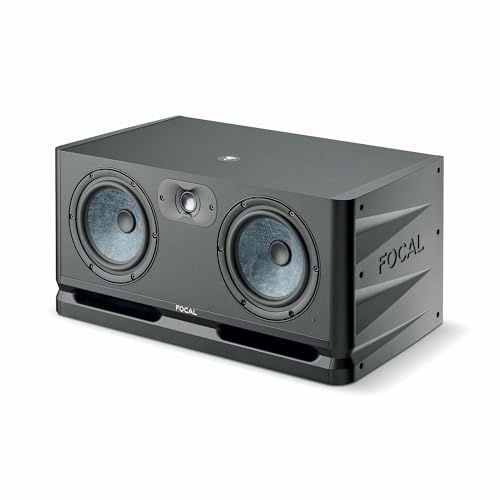
- Wide dispersion for consistent sound across the room
- Neutral Slatefiber cone with low distortion
- XLR, TRS, and RCA inputs for flexible setup
Best For: Users who need full-size monitors with stable tonal balance in a room
Auto-Tuned Portable Pick

- Built-in ARC calibration with included mic
- Compact, lightweight pair for easy setup
- Flat, detailed sound with ARC X software tuning
Best For: Mobile and home-studio users who want automatic room calibration
Desk-Friendly DSP Choice
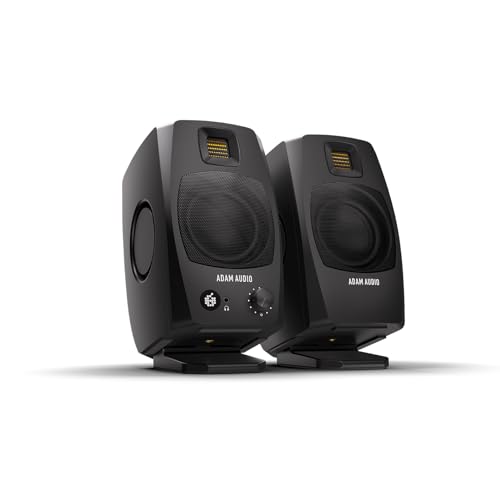
- DSP switches help address placement-related issues
- USB-C connectivity for direct computer hookup
- Compact 3.5-inch desktop monitors with passive radiators
Best For: Desktop users who want compact monitors with basic placement correction
Compact ARC-Calibrated Nearfields – IK Multimedia iLoud MTM MKII Pair
If you want studio monitors with room correction for a small or changing workspace, the iLoud MTM MKII pair is built around that use case. These compact monitors combine a wide 36 Hz to 32 kHz response, built-in ARC room correction support, and monitor emulation features so you can hear mixes clearly and compare them against other reference styles.
Best For: Mixers and producers who need compact nearfields with room calibration and reference emulation.
Pros:
- Built-in ARC room correction support helps adapt playback to the room.
- Ultra-flat 36 Hz to 32 kHz response is designed for detailed listening.
- Time alignment aims to reduce phase distortion and listening fatigue.
- ARC X software can emulate different monitor and reference systems.
Cons:
- ARC mic is sold separately according to the notes.
- 3.5-inch speakers may be limiting if you want larger nearfield output.
- Best suited to careful placement and setup for optimal results.
The iLoud MTM MKII is a strong fit if you value room correction plus flexible reference checking in a compact form. It leans toward precision and calibration rather than raw size, which makes it especially appealing for desktop studios and detailed mix work.
Precision DSP Nearfield – Neumann KH 80 DSP 4-inch Monitor
The Neumann KH 80 DSP is a compact choice in studio monitors with room correction when accuracy and controlled dispersion matter most. Its 4-inch nearfield design, DSP engine, and MMD waveguide make it a practical fit for professional or home studios where you want consistent monitoring behavior in a small footprint.
Best For: Engineers and creators who want a compact reference monitor with DSP-based control.
Pros:
- DSP engine adds monitoring control for studio calibration workflows.
- Mathematically modeled dispersion waveguide supports focused nearfield listening.
- Compact 4-inch design fits smaller desks and studio spaces.
- Suitable for professional reference, post, broadcast, and home studio use.
Cons:
- Single monitor listing, so a stereo pair requires buying two units or a pair elsewhere.
- 25 watts maximum output is modest versus larger monitors.
- 4-inch woofer size limits low-end reach compared with bigger studio speakers.
For users who care more about precision than size, the KH 80 DSP is an easy monitor to take seriously. It is especially appealing in environments where DSP and controlled dispersion are more important than sheer volume.
Standalone Room Correction System – IK Multimedia ARC Studio Processor
ARC Studio is not a monitor, but it belongs on any shortlist for studio monitors with room correction because it corrects the room itself. With a measurement microphone, calibration software, and a dedicated processor, it is designed to improve balance, imaging, and translation across a wide range of studio setups.
Best For: Producers and engineers who want room correction for existing monitors without replacing their speakers.
Pros:
- Includes a high-precision measurement microphone and correction processor.
- Corrects frequency imbalances and improves stereo imaging.
- Works with a range of studio, home studio, and professional audio setups.
- Monitor emulation adds useful reference-checking options.
Cons:
- Does not function as a standalone speaker system.
- Requires setup and calibration rather than plug-and-play listening only.
- Most valuable when paired with monitors you already trust.
If your main goal is better monitoring accuracy in your current room, ARC Studio is the most direct solution here. It is built for users who want consistent correction and reference flexibility without changing their monitor pair.
Room-Controlled 8-Inch Pair – Yamaha HS8 Pair with Room Control
The Yamaha HS8 pair is a straightforward option for buyers comparing studio monitors with room correction features. While it does not use full auto-calibration, the built-in ROOM CONTROL and HIGH TRIM adjustments let you fine-tune the response for your space, which is useful when placement and room acoustics are not ideal.
Best For: Studio users who want a larger 8-inch monitor pair with simple room tuning controls.
Pros:
- ROOM CONTROL and HIGH TRIM help tailor the sound to the room.
- 8-inch drivers and bi-amp design are aimed at clear, powerful monitoring.
- XLR and TRS support makes integration flexible.
- Pair format is convenient for building a stereo studio setup.
Cons:
- Room correction is manual, not an automated calibration system.
- Larger 8-inch cabinets take more desk or stand space.
- At 28.8 pounds, the pair is relatively heavy to move around.
The HS8 is a practical pick if you want familiar Yamaha monitoring with useful room tuning instead of a separate correction processor. It suits users who want a robust nearfield pair and prefer simple controls over software-driven calibration.
Calibration-First Precision – iLoud Precision 5 MKII
If you want studio monitors with room correction that stay highly detailed in less-than-ideal rooms, the iLoud Precision 5 MKII is built for serious accuracy. It combines linear phase coherence, an ultra-flat response, and ARC X calibration so you can tune the monitor to your space instead of fighting it.
Best For: Mixing, mastering, and immersive audio work where calibration and translation matter most.
Pros:
- ARC X room correction with included mic helps adapt the monitor to your room.
- Linear phase, time-coherent design is aimed at highly precise monitoring.
- 46 Hz to 30 kHz response with low-end extension down to 39 Hz (-4 dB).
- ARC X virtual monitoring can emulate over 20 studio and consumer playback systems.
Cons:
- Room correction and advanced control rely on software and setup.
- 5-inch design may not replace a larger monitor for very deep bass needs.
- Premium features are oriented more toward pro workflows than casual listening.
Overall, this is the most technically advanced option here for users who need correction, consistency, and translation tools in one package. It is especially appealing if you want a compact nearfield monitor with a strong calibration-focused feature set.
Traditional Reference Pair – Yamaha HS7 Pair
The Yamaha HS7 is a straightforward choice if you want studio monitors with room correction-style results through careful placement and clean, revealing playback. It does not include built-in calibration, but its honest 43 Hz to 30 kHz response and bi-amped design make it a dependable nearfield reference for recording and mixing.
Best For: Producers and mixers who want a neutral, wired nearfield monitor pair for traditional studio use.
Pros:
- 43 Hz to 30 kHz frequency response supports detailed monitoring.
- 60W LF plus 35W HF bi-amp system provides dedicated power to each driver.
- XLR and TRS inputs accept balanced or unbalanced connections.
- Sold as a pair, making it easy to build a stereo monitoring setup.
Cons:
- No built-in room correction or calibration software.
- Bigger 7-inch monitors may be less convenient on very small desks.
- Best results depend more on room setup and acoustics than on onboard processing.
If you want a well-known studio reference rather than a feature-heavy smart monitor, the HS7 remains a practical option. It is best suited to users who value a proven, wired monitoring chain and are comfortable managing their room acoustics separately.
Tunable Compact Monitor – Edifier MR5
The Edifier MR5 is a strong pick if you want studio monitors with room correction features in a compact, flexible setup. Its rear tuning knobs and EDIFIER ConneX app let you adjust low and high frequencies, apply room compensation, and use acoustic space presets to better match your desk or studio.
Best For: Home studios and near-field setups that need easy room tailoring plus lots of connectivity.
Pros:
- Room acoustic tuning includes rear knobs and app-based compensation tools.
- 3-way active crossover with woofer, mid driver, and silk dome tweeter aims for detailed playback.
- 110W RMS output and 101dB peak SPL suit near-field use or mid-sized rooms.
- Multiple inputs, including XLR, TRS, RCA, AUX, and Bluetooth 6.0, add flexibility.
Cons:
- Room compensation is adjustment-based rather than full automatic correction.
- Bluetooth and app features may be more than some studio-only users need.
- Smaller bookshelf form factor is not ideal for very bass-heavy monitoring needs.
For buyers who want practical tuning controls without stepping into a more expensive calibration ecosystem, the MR5 offers a balanced mix of control and convenience. It is especially appealing if your workspace needs both studio monitoring and everyday listening versatility.
Large-Room Precision – Focal Alpha Twin EVO
If you want studio monitors with room correction-style consistency through a wider listening area, the Focal Alpha Twin EVO is built for exactly that kind of practical monitoring. Its wide dispersion, identical tonal balance at low and high volume, and neutral Slatefiber cone design make it a strong fit when you need your mix to stay dependable as you move around the room.
Best For: Producers and engineers who want full-size desktop monitors with stable tonal balance across the room.
Pros:
- Wide dispersion helps the same sound carry throughout the room.
- Identical tonal balance at low and high volume supports more reliable decisions.
- Slatefiber cone is designed for neutrality and low distortion.
- Offers XLR, TRS, and RCA connectivity for flexible studio setups.
Cons:
- Large 6.5-inch, 26.9-pound design is less suited to very small desks.
- No built-in room calibration or software-based correction.
As a straightforward nearfield monitor choice, the Alpha Twin EVO prioritizes consistent playback and generous output over digital correction features. If your room is already reasonably treated, its dispersion and tonal stability can still make it easier to trust what you’re hearing.
Auto-Tuned Portable Pick – iLoud Micro Monitor Pro White
For buyers searching for studio monitors with room correction, the iLoud Micro Monitor Pro stands out because it includes built-in ARC calibration that instantly tunes the speakers to the room. That makes this compact pair especially appealing if you need reference-style sound in a space that changes often, or if you want a fast setup with software-based custom tuning.
Best For: Mobile producers and home-studio users who want automatic room calibration in a compact monitor pair.
Pros:
- Built-in ARC calibration tunes the speakers to the room, with mic included.
- ARC X software allows custom tuning for different spaces.
- Compact, lightweight design is easy to move and set up.
- Claims flat, detailed sound with bass extension to 42 Hz and up to 95 dB max SPL.
Cons:
- 3-inch drivers are small compared with larger studio monitors.
- Uses RCA and XLR only, with no wireless connectivity.
If room matching is a priority, this is the most correction-focused option in the group. Its portability and calibration tools make it a smart pick for small studios, mixed-use rooms, or on-the-go mixing setups.
Desk-Friendly DSP Choice – ADAM Audio D3V Black
The ADAM Audio D3V is a compact option for people looking for studio monitors with room correction features in a desktop-friendly form factor. Its DSP-powered switches are designed to address common acoustic issues from speaker placement, while USB-C connectivity, passive radiators, and a precise ribbon tweeter make it practical for small production spaces.
Best For: Desktop producers and listeners who want placement-aware monitoring in a compact monitor system.
Pros:
- DSP-powered switches help address common acoustical issues from placement.
- USB-C input makes direct connection to computers simple.
- 3.5-inch woofers plus passive radiators extend response down to 45 Hz.
- D-ART ribbon tweeter is designed for precise, unfatiguing highs.
Cons:
- Smaller desktop design is not built for large-room monitoring.
- Only one pair of balanced 1/4-inch inputs on the left speaker.
The D3V is a strong fit when space is limited and placement flexibility matters more than sheer size. It does not offer full automatic calibration, but its DSP tools and compact design make it easier to get solid results on a desk.
How We Picked the Best Studio Monitors with Room Correction
We prioritized models and systems that combine honest monitoring with practical correction tools, strong output quality, and features suited to real-world home and project studios. We also looked at ease of calibration, connectivity, and whether the monitor makes sense for nearfield, desktop, or larger-room use.
Quick Comparison
Some options include built-in DSP correction, while others rely on bundled software and a measurement mic. A few are traditional monitors that perform well in treated spaces, but they still belong in this roundup because they pair well with external room correction workflows. The best choice depends on your room size, listening distance, and how much control you want over the tuning process.
Key Buying Factors for Studio Monitors with Room Correction
Correction Method
Built-in correction is the simplest path if you want fast setup and a cleaner signal chain. Software-based systems can offer more control, but they usually require measurement, calibration, and occasional retuning.
Room Size and Listening Distance
Smaller monitors tend to work better on desks and at short distances, while larger woofers can deliver more low-end reach in bigger rooms. Choose a size that matches your space rather than chasing bass extension you can’t accurately hear.
Frequency Balance and Translation
The goal is not exaggerated detail; it is dependable mix decisions. Look for monitors known for even mids, controlled highs, and predictable low-end behavior after correction.
Connectivity and Integration
Check for balanced inputs, digital options, and software compatibility if you plan to use external correction. Studio Monitors with Room Correction should fit into your workflow without adding unnecessary complexity.
Who Should Buy Which Studio Monitors with Room Correction?
Producers working in small or reflective rooms will benefit most from monitors with built-in or bundled correction. If you already own capable speakers, a standalone correction system can be the smartest upgrade. If you need a more traditional reference monitor for an untreated but manageable room, prioritize strong voicing and room-friendly placement options, then use correction to fine-tune the result.
For the best outcome, match the monitor size, correction method, and room conditions to your actual setup. That’s the fastest way to get more accurate sound and fewer mix surprises.
