The best subwoofers for desktop setups add deeper, fuller bass without forcing you to build a full-size home theater system. The right choice depends on your speakers, available space, connection options, and how much low-end output you actually need.
This roundup includes compact 2.1 computer speaker systems, powered desktop subwoofers, studio-focused models, and larger options for listeners who want room-filling bass.
Best 10 Subwoofers for Desktop Setups Picks for 2026
Best Studio-Controlled Pick

- 8-inch driver reaches down to 30 Hz
- Bluetooth 5.0 plus TRS, RCA, and aux inputs
- Adjustable crossover and room-tuning controls
Best For: Music production and flexible desktop listening setups
Best Complete Budget System
Cyber Acoustics CA-3610 2.1 Speaker System

- Complete 2.1 system with satellites and subwoofer
- 62 watts peak power and 30 watts RMS
- 5.25-inch down-firing tuned-port subwoofer
Best For: Everyday computer music, movies, and gaming
Best MDF-Enclosed Upgrade

- 8-inch driver with 70-watt RMS output
- Low-pass filter reaches down to 38 Hz
- Dense MDF enclosure and automatic standby
Best For: Existing RCA-based stereo and desktop speaker systems
Best Pro Monitoring Choice

- 22–150 Hz frequency response
- 150-watt amplifier with 8-inch bass-reflex driver
- Low-cut, high-cut, and phase controls
Best For: Recording and professional studio monitoring
Compact RGB All-in-One

- 60W peak 2.1 stereo system with dedicated subwoofer
- USB, AUX, and Bluetooth 5.4 connectivity
- Eight RGB modes in a space-saving design
Best For: Compact gaming and desktop setups needing an all-in-one bass solution
Adjustable Deep-Bass Upgrade
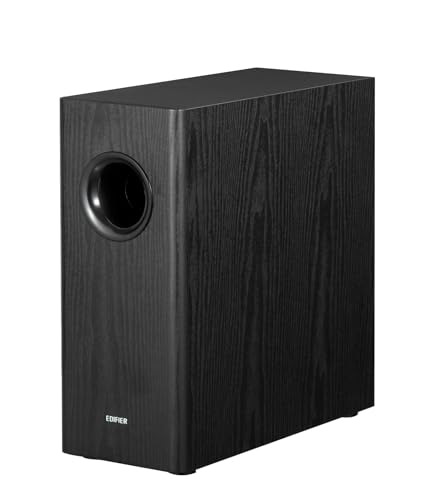
- 70W RMS Class-D power with bass down to 35Hz
- Adjustable crossover and phase controls
- RCA connections and included audio cables
Best For: RCA-equipped desktop speaker systems needing tunable deep bass
Studio Monitor Bass Extension

- 8-inch powered subwoofer for CR Series monitors
- TRS, RCA, and Bluetooth connectivity
- Desktop remote with volume and sub bypass
Best For: Studio-style desktop monitor systems needing convenient bass control
Room-Filling Bass

- 12-inch high-excursion woofer
- 200W RMS, 400W peak output
- Wired RCA, floor-standing design
Best For: Dedicated setups needing powerful, deep bass
Compact USB Bass
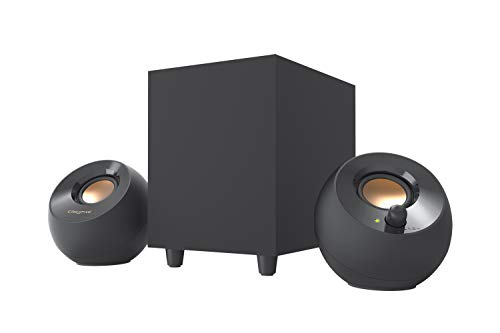
- 4-inch down-firing subwoofer
- USB-powered with 3.5mm AUX
- Up to 8W RMS in High Gain Mode
Best For: Compact computer and laptop desks
Best Studio-Controlled Pick – PreSonus Eris Sub 8BT
For desktop setups that need accurate, adjustable low end, the PreSonus Eris Sub 8BT is a versatile choice. Its 8-inch front-firing driver reaches down to 30 Hz, while Bluetooth 5.0 and multiple wired inputs make it easy to integrate with studio monitors, computers, or mobile devices.
Best For: Music production, hi-fi listening, and multimedia setups that need flexible connections and precise crossover control.
Pros:
- 8-inch driver delivers low frequencies down to 30 Hz.
- Bluetooth 5.0 complements balanced TRS, RCA, and front-panel auxiliary inputs.
- Adjustable highpass, lowpass, and room-tuning controls help refine the sound.
- Front headphone output and automatic power-saving mode add convenience.
Cons:
- Its studio-focused controls may be more than a basic desktop setup requires.
- The subwoofer is floor-standing rather than a compact tabletop unit.
The Eris Sub 8BT stands out when integration and tuning matter as much as bass output. It is especially appealing for users who want one subwoofer to serve both creative work and everyday listening.
Best Complete Budget System – Cyber Acoustics CA-3610 2.1 Speaker System
The Cyber Acoustics CA-3610 is a practical all-in-one option for desktop setups that need both speakers and a subwoofer. This wired 2.1 system combines dual-driver satellites with a down-firing 5.25-inch subwoofer and offers 62 watts of peak power for music, movies, and games.
Best For: Computer users who want an affordable, complete 2.1 speaker system rather than a standalone subwoofer.
Pros:
- Complete 2.1 package includes satellites, subwoofer, power adapter, and guide.
- 62 watts peak power and 30 watts RMS provide substantial desktop output.
- Down-firing, tuned-port subwoofer adds deep bass for games and movies.
- Compatible with computers, laptops, smartphones, tablets, televisions, and projectors.
Cons:
- Uses wired connectivity rather than Bluetooth.
- The 5.25-inch subwoofer offers less driver size than the 8-inch alternatives here.
If you are starting from scratch, the CA-3610 simplifies the buying process by supplying the full speaker system in one package. It is less suited to studio integration but well matched to everyday desktop entertainment.
Best MDF-Enclosed Upgrade – Edifier T5 Powered Subwoofer
Edifier T5 Powered Subwoofer - 70w RMS Active Woofer with 8 inch Driver and Low Pass Filter
Check Price On AmazonThe Edifier T5 adds dedicated low-end reinforcement to desktop setups through an 8-inch powered driver and a 70-watt RMS amplifier. Its low-pass filter reaches down to 38 Hz, while the dense MDF enclosure is designed to reduce unwanted acoustic resonance.
Best For: Users upgrading an existing stereo system who want a standalone wired subwoofer with a substantial cabinet and straightforward RCA connectivity.
Pros:
- 8-inch driver and 70-watt RMS output provide powerful bass.
- Low-pass filter helps limit the woofer to frequencies below the main speakers’ range.
- Thick MDF enclosure is designed to reduce acoustic resonance.
- Automatic standby helps avoid unnecessary power use when idle.
Cons:
- Connectivity is wired through RCA rather than wireless.
- The large enclosure may require more floor or desk-adjacent space.
The T5 is a sensible middle ground for a desktop audio system that needs more authority than compact multimedia speakers can provide. Its cabinet and low-pass filter make it a focused upgrade, provided your source system has compatible RCA output.
Best Pro Monitoring Choice – Yamaha HS8S Studio Subwoofer
The Yamaha HS8S is built for desktop studio setups that require deeper monitoring and more control over the low end. Its 8-inch bass-reflex design uses a 150-watt amplifier, covers 22–150 Hz, and includes low-cut, high-cut, and phase controls for system integration.
Best For: Recording and professional monitoring setups using compatible wired connections and requiring extended low-frequency response.
Pros:
- 22–150 Hz frequency response reaches notably deep bass.
- 150-watt amplifier provides strong headroom for monitoring.
- Low-cut, high-cut, and phase controls support system matching.
- 8-inch bass-reflex design is suitable for studio-oriented use.
Cons:
- Its 33.6-pound cabinet is substantial for a compact desktop environment.
- It is a specialized studio subwoofer rather than a simple plug-and-play multimedia speaker.
- The supplied notes identify wired XLR connectivity, so compatibility should be checked before purchase.
For serious monitoring, the HS8S offers the deepest stated response and the most extensive integration controls in this roundup. Its size and studio focus make it best for users with suitable space and audio hardware.
Compact RGB All-in-One – Nylavee SK400Pro 2.1 Speakers
For shoppers seeking subwoofers for desktop setups without adding a separate component, the Nylavee SK400Pro combines stereo speakers and a wired subwoofer in one compact 2.1 system. It delivers up to 60W peak power, supports USB, AUX, and Bluetooth 5.4, and adds customizable RGB lighting for gaming desks.
Best For: Desktop users who want an all-in-one speaker system with impactful bass, flexible connectivity, and compact placement.
Pros:
- 2.1 sound with a dedicated subwoofer and up to 60W peak power
- USB, AUX, and Bluetooth 5.4 support for computers and mobile devices
- Eight RGB lighting modes with four brightness levels
- Extended cable supports flexible subwoofer positioning
Cons:
- Maximum output is listed as peak power rather than RMS
- Subwoofer connectivity is wired
- Requires an external power adapter
The SK400Pro is a practical choice when desk space, simple controls, and visual customization matter as much as bass. Its single rotary control and broad input selection make it easy to integrate into a gaming or general desktop setup.
Adjustable Deep-Bass Upgrade – Edifier T5s 8-Inch Subwoofer
The Edifier T5s is a standalone powered option for subwoofers for desktop setups built around compatible bookshelf speakers or active monitors. Its 8-inch long-throw woofer, 70W RMS Class-D amplifier, and 35Hz frequency response target deeper, fuller bass, while adjustable crossover and phase controls help tailor the blend.
Best For: Desktop audio systems with RCA connectivity that need a configurable, higher-output bass upgrade.
Pros:
- 8-inch woofer with 70W RMS output and bass extending to 35Hz
- Adjustable 30Hz–160Hz low-pass filter and 0°/180° phase selector
- Compact MDF cabinet with front-firing driver and acoustic port
- Includes 3.5mm-to-RCA and RCA cables
Cons:
- Uses wired RCA connections only
- Series connection requires main speakers with LINE IN
- Its roughly 10.38 kg weight may limit easy repositioning
With more control than a basic plug-and-play bass module, the T5s suits users who are willing to tune crossover and phase settings. Confirm that your desktop speakers or amplifier provide compatible RCA inputs or a subwoofer output before buying.
Studio Monitor Bass Extension – Mackie CR8SBT Subwoofer
The Mackie CR8SBT is a dedicated 8-inch powered subwoofer for desktop monitor systems, especially Mackie CR Series speakers. It connects through TRS or RCA, offers Bluetooth input, and includes an adjustable crossover plus a desktop remote for convenient volume and subwoofer-bypass control.
Best For: CR Series monitor users and desktop audio setups that value remote control and multiple wired input options.
Pros:
- Designed to add low-end weight to CR Series monitors
- TRS, RCA, and Bluetooth connectivity
- Adjustable crossover for blending with monitors
- Desktop remote controls volume and subwoofer bypass
Cons:
- Best suited to compatible monitor-based systems
- Listed frequency response reaches 40Hz, not as low as some alternatives
- Large and heavy at 32.4 pounds
The CR8SBT is a feature-rich choice for a studio-style desktop setup where access to the subwoofer matters. Its remote and bypass function are particularly useful when switching between bass-enhanced listening and more monitor-focused work.
Room-Filling Bass – Klipsch R-120SW
For desktop setups that need substantially deeper, louder bass, the Klipsch R-120SW is a floor-standing subwoofer with a 12-inch high-excursion spun-copper woofer. Its wired RCA connection and large cabinet make it better suited to a dedicated listening or home-entertainment space than a compact desk.
Best For: Desktop-adjacent setups where powerful, room-filling bass matters more than a small footprint.
Pros:
- 12-inch woofer reaches down to 29 Hz at ±3 dB.
- 200 watts of amplifier power and 400 watts peak output.
- Rear-firing bass-reflex port and included grille.
- Five-year woofer and two-year amplifier warranty listed.
Cons:
- Large 19.2-by-14-by-16.5-inch floor-standing enclosure.
- 31-pound weight is not convenient for frequent repositioning.
- Wired RCA connectivity is less flexible than a compact USB setup.
The R-120SW is the power-focused choice here. It can add serious low-end impact, but measure your space first because its cabinet is much larger than typical desktop audio gear.
Compact USB Bass – Creative Pebble Plus
The Creative Pebble Plus is a practical pick for subwoofers for desktop setups, pairing two elevated 2-inch satellite drivers with a standalone 4-inch down-firing subwoofer. It uses USB power and a 3.5mm AUX connection, making it easy to add to a computer or laptop without a wall outlet.
Best For: Computer and laptop users who want a compact, simple 2.1 speaker system with stronger bass than basic desktop speakers.
Pros:
- Compact 4-inch down-firing, ported subwoofer.
- USB-powered design avoids requiring a wall socket.
- High Gain Mode raises output to 8W RMS with a 5V/2A USB adapter.
- Front-mounted volume controls and 45-degree elevated drivers.
Cons:
- 8W RMS output is modest compared with larger powered subwoofers.
- 5V/2A USB adapter for High Gain Mode is not included.
- Wired AUX and subwoofer connections limit cable-free placement.
Choose the Pebble Plus when desk space and setup simplicity are priorities. It is designed for near-field computer listening rather than high-volume, room-filling bass.
Simple 2.1 Value – Logitech Z313
The Logitech Z313 is a straightforward 2.1 multimedia speaker system for desktop setups, combining a compact subwoofer with two speakers and a wired control pod. Its 25W RMS output and 3.5mm auxiliary connection suit everyday computer, MP3 player, and television use.
Best For: Everyday desktop listening when you want an uncomplicated 2.1 system with separate bass.
Pros:
- 25W RMS total output.
- Compact subwoofer designed for tabletop use.
- Convenient wired control pod for easy operation.
- 3.5mm auxiliary connectivity supports desktops and other common devices.
Cons:
- Does not offer USB audio connectivity.
- Wired system limits placement flexibility.
- Supplied details list a 48 Hz frequency response, so it may not reach as deeply as larger subwoofers.
The Z313 is a sensible basic option for a desk or small personal listening area. Its control pod and 25W output keep the system convenient, though it is less feature-rich than newer USB-oriented alternatives.
How We Picked the Best Subwoofers for Desktop Setups
We compared these models by considering their intended use, power ratings, driver size, connectivity, control options, footprint, and compatibility with common desktop audio systems. The selection includes complete 2.1 speaker systems as well as standalone powered subwoofers, because desktop buyers have different starting points. A compact USB system may suit a small workstation, while a studio subwoofer is better for powered monitors and accurate mixing.
Specifications such as RMS power and driver size provide useful context, but they do not tell the entire story. Room size, crossover settings, speaker placement, and the output of your existing speakers all affect perceived bass.
Quick Comparison
| Best For | Recommended Type | What to Prioritize |
|---|---|---|
| Basic computer audio | Compact 2.1 system | Simple setup, USB or 3.5mm input, small footprint |
| Gaming and movies | Multimedia subwoofer system | Strong bass, convenient controls, easy connectivity |
| Music production | Studio subwoofer | Low-pass control, balanced connections, accurate response |
| Large rooms | Higher-output powered subwoofer | Larger driver, greater headroom, placement flexibility |
Key Buying Factors for Subwoofers for Desktop Setups
Compatibility and Connections
Check whether the subwoofer is designed to connect to powered monitors, a computer, or a complete speaker system. RCA, 3.5mm, Bluetooth, USB, and balanced studio inputs are not interchangeable in every setup. A standalone subwoofer usually needs a compatible audio output and may require a crossover or volume-management solution.
Size and Output
An 8-inch woofer can produce more authoritative low bass than a very compact driver, but it also takes up more space and can overwhelm a small room. For a desk in a bedroom or office, moderate output is often easier to integrate than maximum volume. Look for clean, controlled bass rather than power ratings alone.
Crossover and Volume Controls
A variable low-pass filter helps blend the subwoofer with your main speakers and prevents muddy overlap. Separate volume control is useful for adjusting bass by source or time of day. Remote controls and Bluetooth can also make multimedia systems more convenient.
Placement
Place the subwoofer on a stable surface near the desk, avoiding corners when possible because walls can exaggerate bass. Keep cables away from power adapters and leave ventilation space around powered units.
Who Should Buy Which Subwoofers for Desktop Setups?
Choose a compact 2.1 system such as the Creative Pebble Plus, Logitech Z313, Cyber Acoustics CA-3610, or Nylavee system if you need an affordable all-in-one upgrade for everyday music, video, and gaming. These are generally easier to install than standalone subwoofers.
Choose an Edifier, PreSonus, or Mackie model if you already use compatible powered speakers and want a dedicated bass upgrade with more control. Studio users should focus on crossover behavior, connection type, and tonal accuracy. For the biggest rooms or strongest cinematic impact, the Yamaha or Klipsch options provide a more substantial output potential, but they require more space and careful integration.
