The best vocal processors with looper let singers build harmonies, layer percussion or backing parts, and shape a polished sound without relying on a full studio setup. The right model can simplify live performance while adding useful tools such as pitch correction, reverb, delay, formant control, and anti-feedback.
These 10 options cover compact personal loopers, floor pedals for stage use, and versatile processors suited to recording, streaming, guitar accompaniment, and beatboxing. Compare looping workflow, connectivity, effects, control layout, and portability before choosing.
Best 10 Vocal Processors with Looper Picks for 2026
Best Compact Vocal Looper

- Phrase looper for harmonies and layered beatboxing
- Six core vocal effect types
- Mic-stand mount and one-touch operation
Best For: Portable vocal performances and easy beatboxing loops
Best Advanced Performance Workstation
TC Helicon VOICELIVE 3 EXTREME

- Backing tracks with effects automation
- Vocal and guitar effects in one pedal
- Performance recording and USB flash-drive output
Best For: Complex live shows with vocals, guitar, tracks, and looping
Best Vocal Effects Toolbox

- Compressor, EQ, delay, echo, and reverb
- Automatic pitch correction and harmonies
- USB-C support for modern setups
Best For: Singers needing broad vocal processing for stage or livestreaming
Best Creative Formant Control
Zoom V6-SP Vocal Effects Pedal

- Three-part harmony and 12 vocal effects
- Expression pedal for real-time formant shifts
- USB recording, streaming, and 100 patch slots
Best For: Creative live vocal performance and expressive sound shaping
Flexible All-in-One
AVE-100 Multi-Effect Vocal Processor

- XLR/6.35mm input with 48V phantom power
- Auto-tune, harmony, echo, and reverb effects
- Overlay looper with OTG recording
Best For: Singers and creators needing versatile vocal processing
Preset-Focused Performer

- 200+ song- and artist-inspired presets
- Looping in a three-button stompbox
- AUX input with Vocal Cancel
Best For: Performers wanting quick presets and sing-along tools
Live Harmony Specialist
AVE-100 Vocal Effects Processor

- KeyLearn with three harmony modes
- Loop recorder with vocal layering
- 48V phantom power and anti-feedback
Best For: Live singers building key-aware vocal arrangements
Mooer MVP3
Flexible Vocal Looper for Live Performance

- 11 memory slots and up to 70 minutes of recording
- Unlimited dub layers with auto recording
- XLR, 6.35mm, and optional 48V phantom power
Best For: Live singers and streamers layering vocals with instruments
Vocal Effects Processor

- Auto pitch, harmony, delay, and reverb
- Key Learn and multi-layer vocal looping
- OTG connection with feedback suppression
Best For: Singers and creators recording or streaming from mobile devices
FLAMMA FV05
Vocal and Guitar Looper for Songwriting
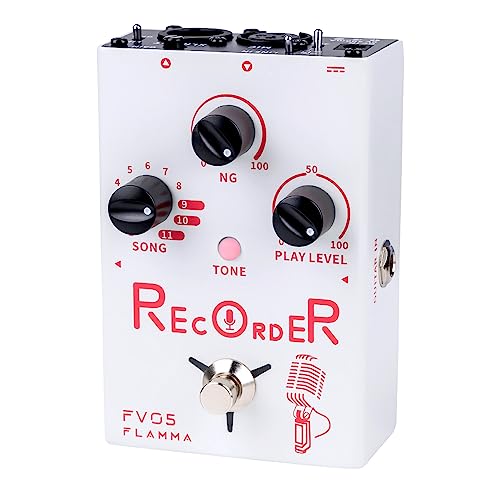
- 70 minutes of recording across 11 slots
- Unlimited vocal and instrument dub tracks
- Noise gate, reverb, EQ, and 48V phantom power
Best For: Singer-songwriters layering vocals and guitar
Best Compact Vocal Looper – BOSS VE-5
The BOSS VE-5 is a compact choice for vocalists seeking vocal processors with looper functionality. Its one-touch controls, mic-stand mount, and built-in effects suit mobile performances, beatboxing, livestreaming, and casual vocal experimentation.
Best For: Singers, rappers, beatboxers, and webcasters who want a portable vocal processor with straightforward looping.
Pros:
- Phrase looper supports harmonizing and layered beatboxing.
- Includes reverb, delay, doubling/harmony, dynamics, pitch correction, and tone/SFX effects.
- Compact tabletop design can attach to a microphone stand.
Cons:
- Offers fewer effects than more advanced multi-effects pedals.
- Its compact controls may be less suitable for complex floor-based setups.
The VE-5 emphasizes simplicity and portability rather than extensive routing or recording features. It is a practical entry point for performers who want quick vocal effects and looping without a large pedalboard.
Best Advanced Performance Workstation – TC Helicon VOICELIVE 3 EXTREME
The TC Helicon VOICELIVE 3 EXTREME is a full floor-based system for performers who need vocal processors with looper, backing-track, recording, and automation features. It combines vocal and guitar effects in one performance-oriented unit.
Best For: Live performers who want synchronized backing tracks, advanced looping, vocal and guitar processing, and onboard performance recording.
Pros:
- Supports backing-track import with effects automation.
- Provides next-generation vocal harmony processing and effects.
- Includes guitar effects, amp tones, flexible outputs, and USB recording to a flash drive.
Cons:
- Its larger, heavier floor-pedal format is less portable than compact vocal processors.
- The broad feature set may require more setup and learning.
This is the most comprehensive option in the group for integrated stage production. Choose it when automated tracks, guitar support, and recording matter as much as vocal looping.
Best Vocal Effects Toolbox – BOSS VE-22
The BOSS VE-22 is a portable vocal effects processor for singers who want studio-style enhancement and creative sound design. It includes harmony and doubling functions, automatic pitch correction, and support for stage, recording, practice, and livestreaming applications.
Best For: Singers seeking a versatile vocal effects unit with pitch correction, harmonies, and livestream-friendly connectivity.
Pros:
- Offers compressor, EQ, delay, echo, reverb, and specialty effects.
- Provides automatic pitch correction plus real-time harmony and doubling.
- Compact design includes knob, button, and footswitch controls with USB-C.
Cons:
- The supplied notes do not identify a dedicated phrase looper.
- Its wide range of effects may be more than needed for basic vocal enhancement.
The VE-22 is a strong fit when vocal processing is the priority, but shoppers specifically requiring a looper should verify the looping features before choosing it. Its strength is breadth, from subtle polish to dramatic voice changes.
Best Creative Formant Control – Zoom V6-SP Vocal Effects Pedal
The Zoom V6-SP combines vocal effects, three-part harmony, and looping in a performance pedal. Among vocal processors with looper features, it stands out for its expression pedal, which shifts vocal formants in real time without changing pitch.
Best For: Vocalists and content creators who want hands-on harmony, formant shaping, patch recall, and USB recording or streaming.
Pros:
- Includes 12 vocal effects and real-time three-part harmonies.
- Built-in formant pedal enables distinctive vocal-character changes.
- Offers compressor, enhancer with de-essing, USB recording, and 100 memory slots.
Cons:
- The supplied notes do not specify the looper’s recording duration or loop memory.
- Its larger pedal format may be less convenient for tabletop or battery-powered use.
The V6-SP is appealing for performers who want expressive control beyond standard reverb and harmony. Its patch storage and USB capabilities also make it useful for repeatable live setups and recording workflows.
Flexible All-in-One – AVE-100 Multi-Effect Vocal Processor
If you want vocal processors with looper functionality for singing, streaming, or home recording, the AVE-100 combines looping with pitch correction, harmony, echo, and reverb. Its XLR/6.35mm combo input, 48V phantom power, OTG recording, and automatic feedback reduction make it adaptable for several setups.
Best For: Singers, streamers, podcasters, and home users who want broad microphone compatibility and simple loop-based vocal creation.
Pros:
- Supports dynamic, condenser, and ribbon microphones through its XLR/6.35mm combo input.
- Offers two auto-tune modes, three harmony modes, echo, and reverb.
- Includes unlimited overlay looping, OTG internal recording, and intelligent feedback reduction.
- Compact design and one-button operation suit mobile and live use.
Cons:
- The supplied information does not specify detailed loop-memory controls or timing limits.
- Its feature-rich design may require some setup time for users seeking a minimal pedal.
The AVE-100 is a versatile choice when microphone flexibility and recording features matter as much as looping. It is especially appealing for creators who want one compact unit for performance and content production.
Preset-Focused Performer – TC-Helicon VOICELIVE PLAY
The TC-Helicon VOICELIVE PLAY is a straightforward option among vocal processors with looper functionality, pairing looping with more than 200 song- and artist-inspired presets. Its AUX input and Vocal Cancel feature also make it practical for singing along with an MP3 player.
Best For: Performers and karaoke-style users who prefer ready-made vocal sounds and backing-track support.
Pros:
- Includes more than 200 song- and artist-inspired presets.
- Provides looping in a compact three-button stompbox format.
- AUX input supports MP3 playback for sing-along use.
- RoomSense microphones can set the key automatically for harmonies.
Cons:
- The supplied notes provide fewer connection and microphone specifications than the other listed processors.
- Its preset-driven approach may offer less clearly documented manual control.
This model makes sense for users who want quick access to established vocal sounds rather than extensive configuration. The AUX input, Vocal Cancel feature, and automatic key setting are useful additions for practice and live sing-along applications.
Live Harmony Specialist – AVE-100 Vocal Effects Processor
For singers comparing vocal processors with looper features, this AVE-100 focuses on live harmony and loop recording alongside pitch correction, reverb, and delay. Automatic key detection, 48V phantom power, and intelligent anti-feedback support performance, recording, and karaoke setups.
Best For: Live singers and performers who want key-aware harmonies, loop layering, and flexible microphone or instrument connections.
Pros:
- Provides Unison, +3rd, and +6th harmony modes with KeyLearn detection.
- Combines adjustable pitch correction with reverb and delay.
- Built-in loop recorder supports recording and layering vocal tracks.
- XLR input includes 48V phantom power, while 6.35mm input supports instrument and line-level signals.
Cons:
- The supplied notes do not state how many loop layers or how much loop time are available.
- Its controls and connections may be more than needed for users seeking a basic vocal looper.
This AVE-100 is a strong fit when harmony accuracy and live control are priorities. Key detection and anti-feedback make it particularly practical for stage use, while the loop recorder broadens its creative potential.
Mooer MVP3 – Flexible Vocal Looper for Live Performance
The MOOER MVP3 is one of the more capable vocal processors with looper functionality for singers who want layered vocal and instrument parts in a compact stompbox. It offers automatic recording, multiple memory slots, separate vocal and instrument reverbs, and both XLR and 6.35mm output options.
Best For: Live singers, streamers, and performers who need substantial loop storage and flexible vocal-instrument mixing.
Pros:
- Stores recordings in 11 memory slots with up to 70 minutes of total recording time.
- Supports unlimited dub layers and automatic recording when a vocal signal is detected.
- Includes vocal tones, separate vocal and instrument reverbs, reverse playback, and adjustable signal balance.
- Offers XLR balanced output, 6.35mm unbalanced output, and optional 48V phantom power.
Cons:
- Its feature set may require some setup time for users seeking a simple looper.
- The unit requires corded power, although a power supply is included.
With its recording capacity and broad connection options, the MVP3 is a strong choice when a vocal looper needs to handle both voice and instruments without adding several separate pedals.
Vocal Effects Processor – All-in-One Looper with OTG
This digital vocal processor combines a looper with auto pitch, harmony, delay, and reverb, making it a versatile option among vocal processors with looper features. Its key detection, vocal practice tools, feedback suppression, and OTG connection are especially useful for rehearsals, streaming, and mobile recording.
Best For: Singers, content creators, and home users who want pitch and harmony effects plus direct smartphone or computer connectivity.
Pros:
- Combines auto pitch, harmony, delay, and reverb in one compact device.
- Key Learn detects the key of compatible backing tracks to support pitch adjustment.
- Records multiple vocal layers and includes Vocal Erase for practice with compatible AUX sources.
- Provides three feedback-suppression levels, OTG audio, headphone monitoring, and XLR and dual 6.35mm connections.
Cons:
- Some practice features depend on compatible AUX audio sources or backing tracks.
- The digital feature set may be more than needed for users seeking only basic looping.
The combination of vocal processing, looping, and OTG audio makes this a practical pick for creators who want to perform, rehearse, and record through a single device.
FLAMMA FV05 – Vocal and Guitar Looper for Songwriting
The FLAMMA FV05 is a focused vocal looper stompbox for singers and songwriters who want to build layered ideas with vocal and guitar inputs. It provides up to 70 minutes of recording, automatic signal-triggered recording, vocal noise gate and reverb, plus separate guitar reverb and selectable vocal EQ profiles.
Best For: Singer-songwriters who want a straightforward pedal for vocal-and-guitar layering, practice, and creative recording.
Pros:
- Offers up to 11 recording slots and 70 minutes of total recording capacity.
- Supports unlimited vocal and instrument dub tracks with automatic recording.
- Includes individual vocal noise gate and reverb, plus a dedicated guitar reverb effect.
- Provides 48V phantom power and three vocal EQ choices: Flat, Warm, and Bright.
Cons:
- Its listed effects are more focused than processors that include pitch or harmony features.
- The pedal uses a 9V, 500mA corded power setup.
For songwriting and live layering, the FV05 keeps the core looper functions practical while adding vocal cleanup, reverb, and guitar-specific input control.
How We Picked the Best Vocal Processors with Looper
We focused on processors that combine vocal effects with a usable looper rather than treating looping as an afterthought. The comparison considers loop length and control, harmony quality, pitch and formant tools, effects selection, microphone and instrument connectivity, monitoring options, and suitability for live performance or streaming.
We also considered how quickly each unit can be operated while singing. Footswitch layout, hands-free control, phrase overdubbing, loop cancellation, preset access, and visual feedback can matter as much as the number of included effects. Models with broader use cases, such as guitar processing, backing tracks, recording, or USB/OTG audio, may offer better value for performers who need one central rig.
Quick Comparison
- For compact setups: Look for a small pedal with straightforward looping, essential vocal effects, and minimal menu navigation.
- For full live shows: Choose a floor processor with multiple footswitches, presets, harmony control, and dependable performance routing.
- For beatboxing and layered vocals: Prioritize responsive phrase looping, easy overdubbing, and effects that remain clear across stacked parts.
- For streaming and recording: USB or OTG connectivity, direct monitoring, and noise-control features can reduce the need for extra equipment.
Key Buying Factors for Vocal Processors with Looper
Looping Workflow
Check whether loops are controlled by one multifunction switch or separate record, play, stop, and undo controls. Simple pedals are portable, but dedicated controls make live overdubs easier. Confirm maximum recording time, loop storage, quantization or synchronization features, and whether loops survive preset changes.
Vocal Effects and Harmony
Harmony generation is most useful when the processor can detect a key, accept an instrument reference, or follow programmed chords. Also compare reverb, delay, doubling, distortion, auto-pitch, formant shifting, and gender-style effects. Natural-sounding harmony usually depends on accurate key information and clean microphone input.
Connections and Control
Verify microphone input type, phantom-power support if needed, instrument input, auxiliary or backing-track input, headphone output, and USB or OTG capability. Expression-pedal, MIDI, or external footswitch support can improve control when both looping and effects changes must happen during a song.
Portability and Stage Reliability
Compact units suit solo performers and mobile rigs, while larger floor pedals provide more direct control. Consider power requirements, switch spacing, display visibility, preset organization, and whether the enclosure can withstand frequent transport.
Who Should Buy Which Vocal Processors with Looper?
Solo singers and beginners should choose an easy-to-learn processor with automatic harmony, core effects, and uncomplicated loop controls. Beatboxers and vocal arrangers should prioritize fast overdubbing, adequate loop time, and clear playback of layered phrases. Gigging vocalists will benefit from rugged floor units with multiple footswitches, preset management, and reliable key or chord detection. Singers who also play guitar should consider models with instrument effects, backing-track support, or guitar-guided harmony. Streamers and home creators should look for USB or OTG audio, headphone monitoring, anti-feedback, and recording-friendly routing.
