The best voice recorders for beginners make it simple to capture lectures, meetings, interviews, and personal notes without a steep learning curve. The models in this roundup cover straightforward playback devices, compact recorders, high-capacity options, and newer AI-assisted tools.
Use the guide below to compare storage, microphones, controls, battery options, and transcription features so you can choose a recorder that matches your routine and budget.
Best 10 Voice Recorders for Beginners Picks for 2026
Best All-Around Starter
EVISTR L357 64GB Voice Recorder

- One-touch recording and saving
- 64GB storage with voice activation
- WAV/MP3 playback and USB-C transfers
Best For: Students, teachers, writers, and everyday recording
Best Simple Sony Option
Sony ICD-PX312 Digital Voice Recorder

- 2GB built-in flash memory
- MP3 recording from 8Kbps to 320Kbps
- Approximately 72 hours of recording battery life
Best For: Straightforward voice notes and general recording
Best for Long Battery Life
Olympus WS-853 Stereo Recorder

- True Stereo microphone recording
- Up to 110 hours of battery life
- 8GB storage with microSD expansion
Best For: Students and note-takers who review recordings frequently
Best for AI Note-Taking

- Transcription in 113 languages
- 128GB storage and voice activation
- Wired OTG transfer with app-based summaries
Best For: Students and professionals organizing spoken content
Best Ultra-Portable Pick

- Simple slide-switch recording
- Ultra-light 32GB aluminum body
- 35–40-hour battery life
Best For: Beginners who want a small, easy recorder for classes and meetings
Best Beginner-Friendly Controls
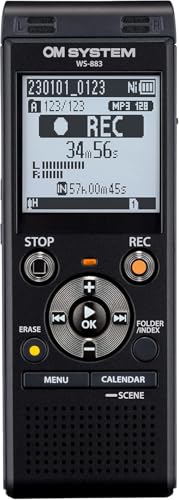
- Large-text Simple Mode
- Stereo microphones with auto levels
- Direct USB connection
Best For: New users who want clear controls for lectures and meetings
Best High-Capacity Option

- 128GB storage capacity
- Six-level voice activation
- Password and file-organization tools
Best For: Frequent recorders who need abundant storage and playback features
Best Simple Starter
Cappsu 32GB Digital Voice Recorder

- One-click recording with straightforward controls
- 32GB built-in storage with no TF card needed
- Voice activation and compact 1.6-ounce design
Best For: Beginners who prioritize simple operation and generous storage
Best for Transcription

- Three stereo microphones for distant speakers
- Remote control through a smartphone app
- Sembly AI speech-to-text trial and 8GB storage
Best For: Beginners recording meetings, lectures, and interviews for later transcription
Best Budget Playback Pick

- Dedicated REC, STOP, PLAY, and A-B buttons
- Voice activation with DSP noise reduction
- 16GB storage and over 30 hours of continuous recording
Best For: Budget users who want simple controls and easy passage review
Best All-Around Starter – EVISTR L357 64GB Voice Recorder
For beginners comparing voice recorders for beginners, the EVISTR L357 offers a straightforward design with strong storage, adjustable recording controls, and playback features for lectures, meetings, interviews, and everyday notes.
Best For: Students, teachers, writers, and anyone who wants simple operation with substantial storage.
Pros:
- One-touch recording and saving make it easy to start quickly.
- 64GB storage can hold up to 4,660 hours at 32Kbps.
- Voice activation, adjustable gain, noise reduction, and up to 1536Kbps stereo recording provide flexible capture options.
- Supports WAV and MP3, A-B repeat, variable-speed playback, and USB-C file transfers.
Cons:
- Its many settings may require more setup than a basic recorder.
- The advertised 32 hours of continuous recording is shorter than its playback rating.
With generous capacity and beginner-friendly controls, this is a practical starting point for recording classes and conversations. Its advanced options are useful as your needs grow, though the feature-rich menu may take a little familiarization.
Best Simple Sony Option – Sony ICD-PX312 Digital Voice Recorder
The Sony ICD-PX312 is a sensible choice for shoppers seeking voice recorders for beginners without an overly complicated feature list. It combines built-in storage, MP3 recording, long battery life, and expandable memory.
Best For: Beginners who want a familiar, uncomplicated recorder for general voice notes and conversations.
Pros:
- Built-in 2GB flash memory provides onboard storage.
- Records in MP3 at selectable rates from 8Kbps to 320Kbps.
- Approximately 72 hours of recording battery life.
- Memory card expansion and USB 2.0 connectivity add transfer and storage flexibility.
Cons:
- Its 2GB internal memory is smaller than the capacities of the other listed recorders.
- Uses a Mini-B USB connection rather than USB-C.
The ICD-PX312 keeps the essentials clear: record in MP3, store files internally or on a compatible memory card, and connect through USB. It is a good fit if you prioritize a straightforward Sony recorder over newer high-capacity or AI features.
Best for Long Battery Life – Olympus WS-853 Stereo Recorder
The Olympus WS-853 is a beginner-friendly pick among voice recorders for beginners, offering stereo microphones, direct USB connection, expandable storage, and playback speed control for reviewing recordings efficiently.
Best For: Students and note-takers who value stereo recording, long battery life, and convenient playback.
Pros:
- True Stereo microphone recording captures audio in stereo.
- 8GB internal memory and a microSD card slot support flexible storage.
- Up to 110 hours of battery life is useful for extended use.
- Playback speed can be adjusted from 0.5X to 2.0X.
Cons:
- It uses two AAA batteries rather than a built-in rechargeable battery.
- Its listed recording format is MP3, with fewer format options than some alternatives.
This recorder balances simple operation with useful features for reviewing lectures and spoken notes. The direct USB connection and included carrying case add convenience, while stereo capture and speed control make it particularly practical for study sessions.
Best for AI Note-Taking – EVISTR L359 128GB AI Recorder
For beginners who want more than basic audio capture, the EVISTR L359 combines one-button recording with AI transcription and summaries. It is designed for turning lectures, meetings, and interviews into organized notes through the AI DVR Link app.
Best For: Students and professionals who want recordings, transcriptions, summaries, and searchable follow-up insights.
Pros:
- Supports transcription in 113 languages, smart summaries, mind maps, speaker identification, and Ask AI insights.
- 128GB storage can hold up to 9,216 hours at 32Kbps.
- One-button recording, voice activation, a hold switch, and password encryption support convenient use.
- Wired OTG connection enables direct transfer to a phone without Bluetooth.
Cons:
- AI features require the AI DVR Link app and a compatible phone or computer workflow.
- Continuous recording is listed at up to 33 hours per charge.
- Its AI-focused feature set may be more than needed for simple recording.
The L359 is the most capable option here for users who want recordings converted into structured information. Beginners should be comfortable using the companion app and wired OTG connection to get the full benefit of its transcription and summarization tools.
Best Ultra-Portable Pick – Vandlion V15
For beginners seeking voice recorders for beginners, the Vandlion V15 keeps recording simple with a physical one-button switch. Its compact aluminum body, 32GB storage, noise-reduction chip, and USB-C file transfer make it practical for classes, meetings, interviews, and everyday notes.
Best For: Beginners who prioritize portability, straightforward controls, and long battery life.
Pros:
- One-button recording with automatic date-time file naming.
- Compact 0.8-ounce aluminum design is easy to carry.
- Offers 35–40 hours of continuous recording and 32GB of storage.
- Supports voice activation to reduce silent sections.
Cons:
- Voice activation must be enabled according to the manual.
- Playback and file management require connection to a compatible device.
The V15 is an approachable choice when ease of use and portability matter most. Its small size and long runtime are especially useful for students and mobile users, while the built-in voice activation adds convenience once configured.
Best Beginner-Friendly Controls – OM SYSTEM WS-883
The OM SYSTEM WS-883 is one of the more approachable voice recorders for beginners because its Simple Mode uses large text and limits menus to essential functions. Stereo microphones, Intelligent Auto Mode, noise canceling, and direct USB connectivity support clear, uncomplicated recording.
Best For: First-time users who prefer guided controls and a familiar recorder layout.
Pros:
- Simple Mode reduces menu complexity and uses large lettering.
- 90-degree stereo microphones help capture speakers from different positions.
- Intelligent Auto Mode adjusts recording levels for varying volume.
- Built-in USB terminal supports direct computer connection and charging.
Cons:
- Its 8GB capacity is lower than the other listed models.
- Uses two AAA batteries rather than a built-in rechargeable battery.
The WS-883 stands out for beginners who may find feature-heavy recorders confusing. Its simplified interface and automatic level adjustment reduce setup decisions, while stereo recording is useful for lectures, meetings, and conversations.
Best High-Capacity Option – EVIDA 128GB Recorder
For beginners comparing voice recorders for beginners with extensive storage, the EVIDA recorder combines 128GB capacity with voice activation, playback, password protection, and multiple recording formats. Its organized folder system and computer compatibility make it useful for frequent lecture, meeting, and interview recording.
Best For: Beginners who need substantial storage and extra file-management features.
Pros:
- 128GB storage is rated for up to 9,296 hours of recording.
- Voice activation offers six adjustable sensitivity levels.
- Supports MP3 and high-quality WAV recording options.
- Includes password protection, bookmarks, A-B repeat, and four storage folders.
Cons:
- The mono microphone operation is less suited to stereo room capture.
- No headphone jack is listed in the specifications.
- Its larger feature set may require more setup than a basic one-switch recorder.
The EVIDA is a strong fit when capacity and organization are more important than absolute simplicity. Beginners willing to spend a little time learning its settings get useful tools for separating files, limiting silence, and protecting recordings.
Best Simple Starter – Cappsu 32GB Digital Voice Recorder
For shoppers comparing voice recorders for beginners, the Cappsu V02 keeps the basics straightforward: press one button to record, use the built-in 32GB storage, and review files with the included earphones. Its compact design and voice-activated mode suit everyday notes, lectures, meetings, and interviews.
Best For: Beginners who want simple controls, generous built-in storage, and a pocket-friendly recorder.
Pros:
- One-click recording avoids complicated menus.
- Built-in 32GB memory requires no TF card.
- Voice activation can extend use up to 50 hours and reduce silent recording.
- Small 1.6-ounce design includes an external microphone and USB-C cable.
Cons:
- Continuous recording is rated for up to 20 hours.
- For more balanced results, it should be placed closer to the speaker or sound source.
The Cappsu is a practical entry-level choice when ease of use matters more than advanced recording controls. Its storage, portability, and included accessories make it convenient for regular note-taking.
Best for Transcription – Philips VoiceTracer DVT4115
The Philips DVT4115 is a strong option among voice recorders for beginners who want help turning recordings into written notes. Its three stereo microphones, remote smartphone control, and Sembly AI speech-to-text trial add useful support for meetings, lectures, interviews, and conferences.
Best For: New users who need longer recording capacity and transcription-oriented meeting tools.
Pros:
- Three specialized stereo microphones are designed to capture distant speakers.
- Smartphone app remote control makes starting and managing recordings more convenient.
- Supports stereo MP3 and PCM recording for playback and sharing.
- 8GB internal memory and up to 36 hours of battery life support extended use.
Cons:
- Its 93-gram body is heavier than the smaller beginner recorders in this roundup.
- Transcription and meeting-minute features depend on the included Sembly AI trial and workflow.
This Philips model is better suited to organized documentation than ultra-basic recording. Choose it if remote control, distant-speaker capture, and speech-to-text assistance are more valuable than the smallest possible design.
Best Budget Playback Pick – Sunlan 16GB Voice Recorder
For beginners seeking voice recorders for lectures and everyday notes, the Sunlan model offers familiar physical controls and built-in playback. REC, STOP, PLAY, and A-B buttons make it easy to record, review, and repeat an important passage without navigating complex menus.
Best For: Budget-conscious beginners who want simple playback, voice activation, and a recorder that also works as removable storage.
Pros:
- Dedicated recording and playback buttons are easy to learn.
- A-B repeat helps review selected sections of a recording.
- Voice activation and DSP noise reduction are designed to save power and reduce environmental noise.
- 16GB storage and more than 30 hours of continuous recording support extended sessions.
Cons:
- Playback time is listed at about 7 hours.
- Uses a USB connection rather than the newer USB-C interface listed on some alternatives.
- Its recording mode is mono, which may be less suitable for wide-room stereo capture.
The Sunlan is a sensible starter device for students and casual users who value direct controls over advanced features. Its playback functions and removable-storage capability add flexibility for reviewing notes and moving files to a computer.
How We Picked These Voice Recorders for Beginners
We focused on practical features that matter when you are buying your first recorder: simple controls, dependable audio capture, usable playback, battery convenience, storage capacity, and easy file transfer. The selection includes established models from Sony, Olympus, OM SYSTEM, and Philips alongside budget-friendly alternatives with larger storage or AI transcription features.
Because beginner needs vary, we considered more than headline recording hours. A recorder that is easy to start, pause, save, and transfer may be more useful than one with maximum capacity but confusing menus. We also looked for features such as voice activation, noise reduction, low-cut filters, built-in microphones, password protection, and direct USB connectivity where available.
Quick Comparison
- For straightforward everyday recording: Choose a basic playback recorder with physical buttons and built-in storage.
- For lectures and meetings: Look for stereo microphones, voice activation, noise reduction, and long battery life.
- For interviews: Prioritize clear microphone pickup, low handling noise, and easy file transfer.
- For searchable notes: Consider an AI transcription or summarization model, while checking whether software trials or subscriptions apply.
- For discreet portability: A compact metal or small-form recorder is easier to carry, but may offer fewer controls.
Key Buying Factors for Voice Recorders for Beginners
Controls and Ease of Use
Look for clearly labeled buttons, a readable display, and a dedicated record switch. One-touch recording is particularly helpful when you need to start quickly. Simple mode can reduce menu confusion, while playback speed controls make reviewing lectures or interviews easier.
Microphones and Recording Quality
Stereo microphones can create a more natural sense of space, while noise cancellation and low-cut filtering may help reduce background rumble. For classroom or meeting use, microphone placement matters as much as specifications: keep the recorder unobstructed and reasonably close to the speaker.
Storage, Battery, and File Transfer
Choose enough storage for your normal recording schedule, but remember that advertised capacities and recording times vary by audio format and quality setting. USB charging is convenient, and direct USB connections can simplify transferring files to a computer. Confirm whether the recorder uses a replaceable battery or a built-in rechargeable one before buying.
Transcription and Privacy
AI transcription can save time, but accuracy depends on accents, background noise, speaker overlap, and recording quality. Check whether transcription is performed through an app or online service, whether a free trial expires, and how recordings are handled. Password protection is useful for sensitive interviews, classes, or workplace notes.
Who Should Buy Which Voice Recorders for Beginners?
Students and first-time users should favor simple controls, reliable playback, voice activation, and long battery life over advanced extras. Interviewers and professionals may benefit from stereo microphones, noise filtering, secure storage, and fast file transfer. Users who turn recordings into written notes should consider an AI-enabled recorder, but budget for any ongoing transcription service. Frequent travelers or discreet note-takers should choose the smallest model that still offers comfortable controls and adequate battery life.
Before purchasing, confirm the included accessories, supported audio formats, charging method, warranty, and compatibility with your computer or phone. The best beginner recorder is the one you can operate confidently and use consistently.
