The best compact MIDI interfaces make it easier to connect modern controllers, hardware synths, drum machines, and computers in a small studio or mobile rig. The right model can simplify routing, add reliable USB connectivity, or provide the audio I/O your setup also needs.
These 10 picks cover simple MIDI splitting, multi-port interfaces, USB host connectivity, sequencing, and compact audio/MIDI combinations. Use the guide below to match features and connections to the way you actually make music.
Best 10 Compact Midi Interfaces Picks for 2026
Best All-in-One Pick
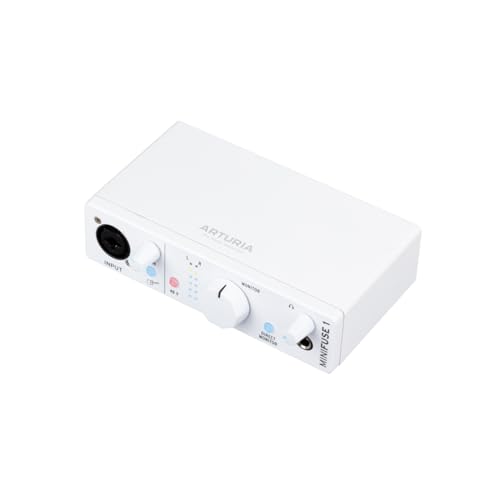
- 5-pin MIDI input and output
- 192 kHz recording with phantom power
- Five-year warranty and software bundle
Best For: Portable home recording with MIDI and audio
Best MIDI Distribution Hub

- Routes one MIDI input to five outputs
- Supports all MIDI channels and messages
- USB-C powered with reinforced housing
Best For: Expanding hardware MIDI rigs
Best for Basic Recording

- Air-mode mic preamp and Hi-Z input
- 24-bit/192 kHz recording
- Balanced outputs and bundled software
Best For: Solo vocals, guitar, and podcast recording
Best Controller-Sequencer Combo
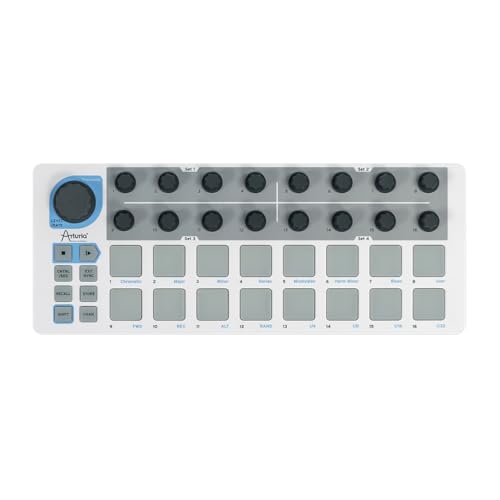
- 16 pads and 16 encoders
- MIDI, USB, and CV connectivity
- Controller and sequencer modes can run together
Best For: Hands-on beat making and hardware sequencing
Best Compact MIDI Router

- 3-in/3-out standalone MIDI routing
- USB-C works across major operating systems
- Supports filtering, merging, splitting, and MPE
Best For: Flexible hardware MIDI routing and computer integration
Best Compact Audio/MIDI Interface

- Records microphones, instruments, and synths
- Includes 5-pin MIDI input and output
- Comes with recording and music-production software
Best For: Home studios needing audio recording plus MIDI
Best Compact USB Host Interface

- Connects USB MIDI gear to 5-pin DIN hardware
- Expands to up to eight USB MIDI ports
- Stores up to four routing presets
Best For: Hybrid USB-and-DIN MIDI rigs and live setups
Best MIDI Splitter
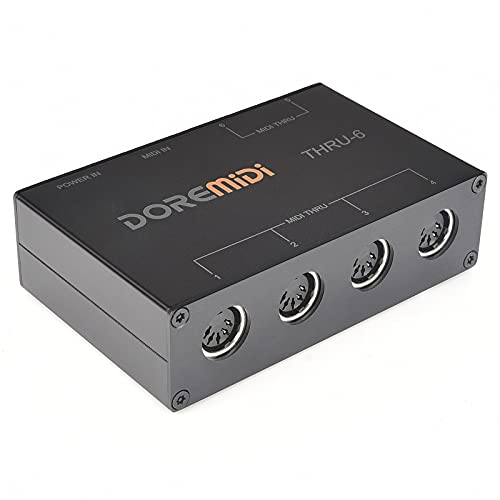
- Distributes one MIDI input to six outputs
- Standard 5-pin MIDI with 16 channels
- Compact, plug-and-play USB-powered design
Best For: Connecting one controller or synth to multiple MIDI devices
Best Heavy-Duty Pick

- Hosts up to eight USB MIDI devices
- Adds thru, split, merge, filter, and mapping tools
- Supports standalone USB or 9V DC power
Best For: Hybrid USB and traditional MIDI setups needing flexible routing
Best for Complex MIDI Rigs

- Six USB-C host and six-in/six-out TRS MIDI ports
- Advanced routing with up to six hardware presets
- Dual 5V USB-C and 9V DC power for portable rigs
Best For: Complex hybrid MIDI setups, pedalboards, and synth rigs
Best All-in-One Pick – MiniFuse 1
The Arturia MiniFuse 1 is a practical choice for shoppers seeking compact MIDI interfaces that can also handle microphones, instruments, and computer-based recording. It combines 5-pin MIDI input and output with a combo mic/instrument/line input, balanced outputs, headphone monitoring, USB connectivity, and loopback functionality in a small enclosure.
Best For: Home recording, portable vocal or guitar sessions, and beginners who want MIDI alongside audio recording.
Pros:
- Includes 5-pin MIDI input and output for synths, controllers, and drum machines.
- Supports recording at up to 192 kHz and includes 48V phantom power.
- Offers loopback for capturing voiceovers alongside in-app or in-game audio.
- Includes a five-year warranty and a broad software bundle.
Cons:
- Provides one main combo input, so it is less suited to recording several sources at once.
- The USB hub is limited to 250mA.
The MiniFuse 1 stands out when you want a compact MIDI interface that does not require a separate audio interface for basic recording. Its single-channel layout keeps it portable, while the MIDI I/O, phantom power, loopback, and included software make it a flexible starter setup.
Best MIDI Distribution Hub – MIDI Thru5 WC
CME MIDI Thru5 WC 1-in-5-out MIDI Thru | 5-pin DIN, High-speed, Optional Bluetooth
Check Price On AmazonThe CME MIDI Thru5 WC is a compact MIDI interface for expanding one MIDI source to as many as five connected devices. Its small, reinforced housing is designed for crowded studios, stage rigs, travel setups, and pedalboards, while USB-C power keeps the unit easy to integrate.
Best For: Musicians who need to distribute one MIDI signal reliably to multiple hardware devices.
Pros:
- One MIDI input feeds five standard 5-pin MIDI outputs.
- Supports all MIDI channels and messages, including clock, sysex, timecode, and MPE.
- High-speed optocoupling is designed to minimize errors, signal dropout, ground loops, and jitter.
- Compact, lightweight housing works well in space-constrained setups.
Cons:
- It is a MIDI Thru box, not an audio interface or USB MIDI data interface.
- The USB-C port is for power only.
- Requires standard 5-pin MIDI cables and an external 5V USB power source.
The MIDI Thru5 WC is a specialized option rather than a general-purpose compact MIDI interface. Choose it when dependable one-to-five MIDI routing is the priority; its focused design is less appropriate if you also need recording inputs, outputs, or computer MIDI connectivity.
Best for Basic Recording – Scarlett Solo 3rd Gen
The Focusrite Scarlett Solo 3rd Gen is a compact audio interface for recording a microphone or instrument, with a straightforward setup that also suits MIDI-based computer studios when paired with separate MIDI hardware. It offers a mic preamp with Air mode, a Hi-Z instrument input, headphone monitoring, balanced outputs, and USB-C connectivity.
Best For: Solo vocalists, guitarists, podcasters, and producers who need compact audio recording rather than built-in MIDI ports.
Pros:
- Mic preamp includes switchable Air mode for added clarity with acoustic instruments.
- Dedicated Hi-Z input accommodates guitar or bass.
- Records and mixes at up to 24-bit/192 kHz.
- Includes balanced outputs, headphone listening, and useful recording software.
Cons:
- No MIDI input or output is listed, so external MIDI hardware needs another interface.
- Its one mic preamp and one instrument input limit simultaneous recording options.
The Scarlett Solo is a strong pick if your compact MIDI interface search is really part of a broader small-studio setup and audio capture is the main requirement. However, users who need direct 5-pin MIDI connectivity should choose a model with dedicated MIDI I/O instead.
Best Controller-Sequencer Combo – BeatStep
The Arturia BeatStep is a compact MIDI controller and sequencer for hands-on control of software and hardware instruments. Its 16 velocity- and pressure-sensitive pads, 16 encoders, MIDI and USB connectivity, and CV/Gate output make it a creative alternative to traditional compact MIDI interfaces when performance control and sequencing matter most.
Best For: Beat makers, live performers, and hardware users who want pads, knobs, sequencing, and CV/Gate control in one portable unit.
Pros:
- Combines controller mode and step-sequencer mode, with both usable at the same time.
- Provides 16 velocity- and pressure-sensitive pads plus 16 encoders.
- Includes MIDI, USB, and CV connectivity for software and analog gear.
- Offers 16 pattern memories and supports MIDI clock master or slave operation.
Cons:
- It is a controller and sequencer, not an audio interface with microphone or line inputs.
- At two pounds, it is heavier than some minimal compact MIDI controllers.
- Its supplied details list Windows platforms, so operating-system compatibility should be checked before purchase.
The BeatStep is best understood as a performance-focused compact MIDI interface and sequencer rather than a recording device. It is especially appealing when tactile control, pattern recall, and connections to both software and analog equipment are more important than audio inputs.
Best Compact MIDI Router – CME U6MIDI Pro
The CME U6MIDI Pro is a strong choice for anyone comparing compact midi interfaces for a computer-based or standalone MIDI setup. Its 3-in/3-out design, USB-C connectivity, and built-in routing tools support flexible connections between keyboards, synths, drum machines, and other MIDI hardware.
Best For: Musicians who need detailed MIDI routing, filtering, merging, splitting, and broad operating-system compatibility in a small interface.
Pros:
- Supports 3-in/3-out standalone MIDI operation with routing and filtering.
- Works with macOS, iOS, Windows, Android, Linux, and Chrome OS.
- Handles notes, controllers, clock, SysEx, MIDI timecode, and MPE with low latency.
- Compact 3.49-ounce design with USB-C and 5-pin DIN connectivity.
Cons:
- Audio is not supported; this is a MIDI-only interface.
- Advanced configuration requires the UxMIDI Tools software.
Choose the U6MIDI Pro when routing flexibility matters more than audio recording. Its three MIDI inputs and outputs provide more expansion room than many small interfaces, while the standalone mode can reduce dependence on a computer.
Best Compact Audio/MIDI Interface – Arturia MiniFuse 2
The Arturia MiniFuse 2 combines audio recording and MIDI connectivity in a compact desktop unit, making it a practical option among compact midi interfaces for home studios and mobile production. It provides two combo inputs, balanced outputs, a headphone output, and traditional 5-pin MIDI connections.
Best For: Beginners, vocalists, guitarists, and producers who want one small interface for recording audio, connecting MIDI gear, and starting with included software.
Pros:
- Combines two audio inputs with 5-pin MIDI input and output.
- Includes 48V phantom power for compatible microphones.
- Offers loopback, a headphone output, balanced line outputs, and a USB hub.
- Includes Ableton Live Lite, Analog Lab Intro, effects, guitar software, and other creative tools.
Cons:
- Larger and heavier than the dedicated CME MIDI interfaces in this roundup.
- Its listed operating-system support is limited to Windows and macOS.
- It provides one MIDI input and one MIDI output rather than multi-port MIDI routing.
The MiniFuse 2 is the better fit if MIDI is only part of your setup. It sacrifices the specialized routing features and smaller footprint of dedicated MIDI boxes, but adds microphones, instruments, loopback, and recording capability.
Best Compact USB Host Interface – CME H2MIDI Pro
The CME H2MIDI Pro is designed for compact midi interfaces setups that mix modern USB MIDI equipment with traditional 5-pin DIN hardware. Its standalone USB host mode can connect class-compliant controllers and instruments without a computer, while USB-C client mode supports computer and mobile workflows.
Best For: Performers and producers connecting USB MIDI controllers, drum machines, pedals, or synths to legacy DIN MIDI equipment.
Pros:
- Connects USB MIDI devices directly to DIN MIDI hardware without a computer.
- Supports up to eight USB MIDI device ports through a standard USB hub.
- Provides routing, filtering, mapping, splitting, and four savable presets.
- Works with macOS, Windows, iOS, Android, Linux, and Chrome OS.
Cons:
- Its DIN connection is specified as one MIDI input and one MIDI output.
- USB host operation requires class-compliant MIDI devices.
- Advanced routing and preset configuration require HxMIDI Tools.
The H2MIDI Pro stands out when USB host functionality is the priority. Its 2.08-ounce body is especially portable, and the ability to save presets makes it useful for changing between performance or production configurations.
Best MIDI Splitter – 1-in/6-out MIDI Thru Box
For shoppers comparing compact midi interfaces, the MIDI Thru 6 Box is a focused solution for distributing one incoming MIDI signal to several devices. Its 1-in/6-out design, standard 5-pin connections, and plug-and-play setup suit straightforward studio and performance routing.
Best For: Connecting one MIDI controller or synth to up to six MIDI devices.
Pros:
- Sends incoming MIDI messages to all six outputs.
- Uses standard 5-pin MIDI and supports all 16 MIDI channels.
- Compact 4.53-by-2.87-by-1.3-inch design with USB power.
- Works with Windows, macOS, and Linux systems when used with compatible MIDI equipment.
Cons:
- Provides MIDI splitting rather than advanced routing, filtering, or mapping.
- Requires a 5V DC USB power supply.
- Offers one MIDI input, so it is not designed for merging multiple sources.
This is a practical choice when reliable one-to-many MIDI distribution matters more than computer-host features or elaborate configuration. It is especially suitable for a compact setup built around traditional 5-pin MIDI gear.
Best Heavy-Duty Pick – CME H4MIDI WC
The CME H4MIDI WC stands out among compact midi interfaces for flexible USB hosting and configurable MIDI routing. It can operate standalone or connect to a computer, while its small footprint works well in crowded studios, mobile rigs, and pedalboards.
Best For: Musicians who need USB MIDI hosting, computer connectivity, and programmable routing in a compact unit.
Pros:
- Hosts up to eight class-compliant USB MIDI devices through a standard USB hub.
- Provides MIDI thru, split, merge, mapper, and filter functions through HxMIDI Tools.
- Supports macOS, Windows, iOS, Android, Linux, and ChromeOS.
- Offers 5V USB or 9V DC standalone power and four savable presets.
Cons:
- Advanced routing setup depends on HxMIDI Tools.
- Optional WIDI Bluetooth MIDI requires the separate WIDI Core module.
- Its feature set may be more than needed for simple MIDI splitting.
Choose this model if your compact setup mixes USB MIDI hardware with traditional MIDI equipment and needs routing flexibility. Dual power and preset storage also make it useful for switching between studio and live configurations.
Best for Complex MIDI Rigs – CME H12MIDI Pro
For complex setups seeking compact midi interfaces, the CME H12MIDI Pro combines six USB-C host ports with six TRS MIDI inputs and six outputs. Its broad routing controls, computer interface, and dual-power design are aimed at pedalboards, synth rigs, and mobile production systems.
Best For: Large hybrid MIDI rigs using multiple USB-C and TRS MIDI devices.
Pros:
- Connects up to six USB-C MIDI host devices and supports expansion through hubs.
- Includes six-in/six-out TRS MIDI ports with selectable Type A/B operation.
- Provides thru, split, merge, filter, mapping, and up to six hardware presets.
- Works standalone on 5V USB-C or 9V DC and supplies up to 3A of USB host power.
Cons:
- TRS connections require compatible cables for integration with 5-pin DIN gear.
- Its extensive capabilities may be excessive for basic MIDI needs.
- Configuration relies on HxMIDI Tools for advanced routing and preset management.
The H12MIDI Pro is the strongest fit here for users who need substantial I/O in a still-portable enclosure. Its combination of USB-C hosting, TRS MIDI, computer connectivity, and flexible power supports elaborate live and studio workflows.
How We Picked the Best Compact Midi Interfaces
We selected these Compact Midi Interfaces based on connection options, portability, compatibility, ease of use, and usefulness in real-world setups. The lineup includes dedicated MIDI splitters, multi-port MIDI interfaces, USB host devices, compact controllers, and audio interfaces with MIDI functionality.
Because MIDI systems vary widely, there is no single best design for everyone. A small interface with one input and several outputs may be ideal for distributing a controller signal, while a USB host interface is better for connecting class-compliant USB MIDI gear to traditional DIN hardware. We also considered whether each product solves a clear connectivity problem without taking up unnecessary desk space.
Quick Comparison
| Best For | Look For |
|---|---|
| Basic MIDI splitting | One MIDI input and multiple outputs |
| Computer-based setups | USB MIDI support and dependable driver compatibility |
| Hardware-focused studios | Multiple DIN inputs and outputs |
| USB MIDI instruments without a computer | USB host functionality |
| Compact hybrid recording rigs | Audio inputs plus MIDI connectivity |
| Live sequencing and performance | Built-in pads, sequencing, and hands-on controls |
Key Buying Factors for Compact Midi Interfaces
Ports and Signal Direction
Start by counting the MIDI inputs and outputs your setup needs now, then allow room for one or two additions. An input receives data from a controller or instrument; an output sends data to another device. A MIDI Thru output copies incoming data, which is useful for sending one controller signal to several destinations.
USB Host Versus USB MIDI
A standard USB MIDI interface generally connects MIDI equipment to a computer or compatible host. A USB host interface can connect USB MIDI devices directly to hardware that uses traditional MIDI connections, often without a computer. Confirm the exact host and port requirements before buying, since USB-A, USB-B, USB-C, and DIN connections are not interchangeable without the right cables or adapters.
Audio Needs and Portability
If you also record microphones, instruments, or line-level sources, an audio interface with MIDI may be more practical than a dedicated MIDI box. Check input type, phantom power, monitoring, and headphone features. For mobile rigs, prioritize bus power, a compact enclosure, sturdy connectors, and a control layout that is easy to use under pressure.
Routing, Timing, and Compatibility
Dedicated hardware routing can reduce cable clutter and make a setup easier to operate. Look for reliable timing, clear status indicators, and any required editor or firmware support. Verify operating-system compatibility and whether the device needs external power, especially when connecting several MIDI instruments.
Who Should Buy Which Compact Midi Interfaces?
Choose a simple MIDI Thru box if you only need to duplicate one incoming signal across multiple instruments. Select a multi-port MIDI interface if you need independent two-way communication between a computer and several hardware devices. USB host models are the better choice for integrating USB-only controllers or instruments with DIN-based equipment.
Musicians who need recording and MIDI in one compact unit should consider an audio/MIDI interface. Producers who want hands-on sequencing and performance control may prefer a compact MIDI controller with built-in sequencing functions. Before ordering, map every device in your setup, identify whether each connection is USB or DIN, and check the required power and routing options.
