The best portable voice recorders make it easier to capture lectures, interviews, meetings, and everyday ideas without relying entirely on your phone. Today’s options range from simple USB dictation devices to AI recorders that transcribe and summarize conversations.
We compared these 10 models by storage, recording controls, portability, playback, transcription features, and practical value so you can choose the right recorder for your workflow.
Best 10 Portable Voice Recorders Picks for 2026
Reliable Classic

- Up to 57 hours of battery life
- Built-in USB for quick transfers
- 4GB MP3 recording storage
Best For: Simple lectures, meetings, and everyday voice notes
AI Productivity Pick

- Transcribes and summarizes recordings
- Ask questions across recorded conversations
- Up to four days of battery life
Best For: Meetings, calls, and organized smartphone-based note-taking
High-Capacity Workhorse

- 64GB storage for extended recording
- Voice activation with seven sensitivity levels
- WAV and MP3 recording with USB-C
Best For: Frequent lectures, interviews, meetings, and scheduled recordings
Professional AI Note-Taker
- Transcribes in 112 languages
- Captures calls and in-person conversations
- Ultra-slim body with AMOLED display
Best For: Professionals needing structured meeting notes and follow-ups
Long-Battery Pick

- PCM audio with automatic noise reduction
- Up to 68 hours of continuous recording
- Large storage with one-click recording
Best For: Students, journalists, and extended recording sessions
AI Note-Taking Pick

- Transcription in 113 languages
- Smart summaries and speaker identification
- Wired OTG transfer to the AI app
Best For: Students and professionals managing recorded notes
Maximum-Endurance Pick

- Up to 100 hours of continuous recording
- Triple intelligent noise reduction
- Includes microphone, headphones, and OTG adapters
Best For: Long meetings, lectures, interviews, and archival recording
Simple Everyday Recorder

- One-button recording and playback
- Up to 30 hours of recording time
- Voice activation and USB storage
Best For: Students and everyday note-taking
High-Capacity Choice

- 128GB storage capacity
- Up to 54 hours of continuous recording
- Folders, bookmarks, and password protection
Best For: Frequent recording and large file libraries
Flexible Learning Tool
8GB Voice Recorder with MP3 Player

- High-definition stereo recording
- A-B repeat and variable playback speed
- Up to 20 hours of continuous recording
Best For: Lecture review and study-focused recording
Reliable Classic – Sony ICD-PX370
Sony ICD-PX370 Mono Digital Voice Recorder with Built-In USB Voice Recorder,black
Check Price On AmazonThe Sony ICD-PX370 is a straightforward choice for shoppers comparing portable voice recorders for everyday lectures, interviews, notes, and meetings. It records MP3 audio, includes 4GB of storage, and connects directly to a computer through its built-in USB plug.
Best For: Buyers who want a familiar, simple recorder with long battery life and easy computer transfers.
Pros:
- Up to 57 hours of battery life
- Built-in USB connection for file transfer
- Records in MP3 format with mono and stereo microphone modes
- Compact design with included AA batteries
Cons:
- Only 4GB of internal storage
- Uses two AA batteries rather than a rechargeable battery
- Has a 2.5mm headphone jack
The ICD-PX370 favors dependable operation over advanced features. It is a practical pick when you need portable voice recorders for basic recording and straightforward file management.
AI Productivity Pick – Pocket AI Voice Recorder
The Pocket AI Voice Recorder takes portable voice recorders beyond basic audio capture by transcribing and summarizing recordings. With one-tap recording, 64GB of storage, MagSafe compatibility, and a battery rated for up to four days, it is designed for connected productivity.
Best For: Smartphone users who want recordings turned into summaries, action items, and searchable insights.
Pros:
- Automatically creates transcriptions, summaries, and action items
- Ask Pocket can answer questions using recorded conversations
- 64GB of storage and up to four days of battery life
- MagSafe-compatible design for hands-free attachment
Cons:
- Advanced features may require an optional subscription
- Designed around smartphone connectivity and Bluetooth
- Uses a nonstandard rechargeable battery
This is a more specialized option than a traditional recorder. Its value comes from reducing the work required after a meeting, call, or conversation rather than simply saving an audio file.
High-Capacity Workhorse – EVISTR L357 64GB Recorder
The EVISTR L357 is one of the more feature-rich portable voice recorders for lectures, interviews, meetings, and scheduled recording. It combines 64GB of storage with adjustable recording gain, voice activation, playback controls, and WAV or MP3 recording support.
Best For: Students, teachers, interviewers, and professionals who need substantial storage and flexible recording controls.
Pros:
- 64GB capacity can store up to 4,660 hours at 32Kbps
- Voice activation helps reduce silent sections
- Adjustable seven-level recording gain and noise reduction
- Up to 32 hours of continuous recording and USB-C file transfer
Cons:
- High-quality 1536Kbps recording uses storage more quickly
- Feature-rich menus may take longer to learn
- Playback and recording battery estimates vary by use
With its large capacity and practical controls, the L357 offers strong flexibility for frequent recording. It is especially useful when voice activation, scheduled recording, and adjustable playback matter as much as audio capture.
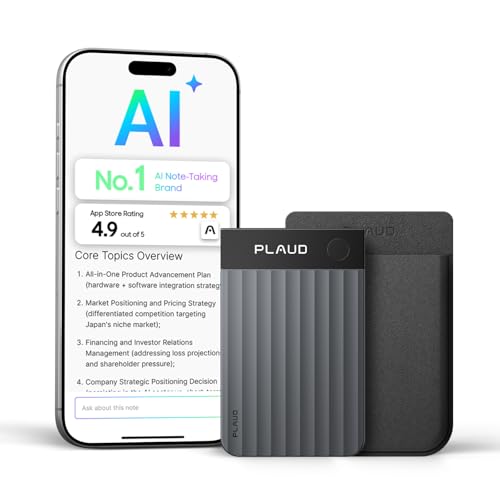
Professional AI Note-Taker – Plaud Note Pro AI Recorder
The Plaud Note Pro is a slim AI-focused option among portable voice recorders, built for in-person conversations, phone calls, and online meetings. Its microphone array, automatic dual-mode recording, and transcription tools are aimed at turning conversations into structured notes and follow-ups.
Best For: Professionals who want discreet hardware, cross-device access, and AI-generated meeting notes.
Pros:
- Four MEMS microphones and a VPU support AI beamforming
- Transcribes in 112 languages with speaker labels
- Creates action items, decisions, and follow-ups
- Credit-card-sized body with a 0.95-inch AMOLED display
Cons:
- 30-hour battery life is shorter than some basic recorders
- No headphone jack
- Higher transcription limits and additional features may require an upgrade
The Note Pro is best viewed as a connected AI workspace rather than a conventional standalone recorder. Its slim magnetic design and automated summaries are compelling for professional workflows, provided you are comfortable using its app and plan structure.
Long-Battery Pick – Tonfarb 136GB Voice Recorder
The Tonfarb A20 is a practical choice among portable voice recorders for lectures, interviews, meetings, and extended recording sessions. It combines PCM recording, automatic noise reduction, one-click operation, and a large claimed storage capacity in a lightweight metal-bodied design.
Best For: Students, journalists, and users who prioritize long battery life and simple controls.
Pros:
- Supports 1536 kbps PCM recording, voice activation, and automatic noise reduction.
- Includes 8GB built-in storage and a complimentary 128GB TF card, with up to 9,775 hours of MP3 recording claimed.
- Offers up to 68 hours of continuous recording and one-click recording from the powered-off state.
- Includes USB-C transfer, A-B repeat, password protection, and a 3.5mm headphone jack.
Cons:
- The 1.44-inch screen is relatively compact.
- Its advertised storage total depends on the included TF card and recording format.
Choose this model when recording endurance and straightforward operation matter more than app-based transcription. Its generous storage and long claimed runtime make it well suited to back-to-back sessions.
AI Note-Taking Pick – EVISTR L359 AI Voice Recorder
The EVISTR L359 stands out among portable voice recorders for buyers who want recording and post-processing in one workflow. Its AI DVR Link app supports transcription in 113 languages, smart summaries, mind maps, speaker identification, and Ask AI features when used with the supplied wired OTG accessories.
Best For: Students and professionals who want to turn recorded meetings, lectures, or interviews into organized notes.
Pros:
- Supports up to 3072Kbps HD recording, noise reduction, and voice-activated recording.
- AI features include transcription in 113 languages, summaries, mind maps, and speaker identification.
- 128GB storage provides a claimed capacity of up to 9,216 hours at 32kbps.
- Lightweight 65g body, one-touch controls, password encryption, HOLD switch, and wired OTG transfer.
Cons:
- Continuous recording is rated for up to 33 hours, shorter than some high-capacity alternatives.
- AI processing requires the AI DVR Link app and a wired OTG connection.
This is the most feature-focused option in the group for users who want more than audio files. Consider it when searchable, summarized, and organized content is part of your note-taking routine.
Maximum-Endurance Pick – Elasound 132G Voice Recorder
The Elasound NZ007 is a capacity-focused option among portable voice recorders, offering voice activation, triple intelligent noise reduction, and a claimed 100-hour continuous recording runtime. Its included accessories also make it flexible for transferring or reviewing recordings across computers and compatible mobile devices.
Best For: Professionals, journalists, and students who need very long recording sessions and extensive file storage.
Pros:
- Uses an AI DSP 4.0 chip and triple intelligent noise reduction to help clarify vocals.
- Includes a 128GB TF card and claims up to 9,800 hours of storage at 32kbps.
- Provides up to 100 hours of continuous recording and headphone playback.
- Includes a clip-on microphone, headphones, USB-C cable, and OTG-C and OTG-Lightning accessories.
Cons:
- The supplied details list MP3 as the recording format, without a WAV option.
- The listed dimensions are bulkier than those of the other models.
- Its highest storage and recording-hour claims depend on low-bitrate recording and the included card.
The NZ007 is a strong fit when recording duration and storage capacity are the main priorities. Its accessory bundle adds convenience, while voice activation can help reduce silent sections in long sessions.
Simple Everyday Recorder – Compact 16GB Voice Recorder
For shoppers comparing portable voice recorders, the Sunlan offers straightforward controls in a small, lightweight design. One-button recording, playback, voice activation, and built-in noise reduction make it practical for lectures, meetings, interviews, and everyday notes.
Best For: Students and users who want simple operation, 16GB storage, and a compact recorder for routine voice notes.
Pros:
- Simple REC, STOP, and PLAY controls support quick operation.
- 16GB storage and up to 30 hours of recording time provide useful capacity.
- Voice-activated recording can reduce blank sections and conserve power.
- Functions as an MP3 player and removable USB storage device.
Cons:
- Mono microphone operation may be less suitable for users seeking stereo recording.
- The 1-inch screen is relatively small for navigating files.
- Playback is rated for up to 7 hours.
This is a sensible pick when ease of use and portability matter more than advanced file-management features. Its 35-gram body and built-in speaker make it convenient to carry and review recordings on the go.
High-Capacity Choice – EVIDA 128GB Voice Recorder
Among portable voice recorders, the EVIDA stands out for its substantial 128GB capacity and flexible recording options. It supports PCM recording at 1536kbps, voice activation, password protection, and organized folder storage for lectures, meetings, interviews, and other recurring recordings.
Best For: Heavy users who need extensive storage, longer recording sessions, and features for organizing and protecting files.
Pros:
- 128GB capacity is specified for up to 9,296 hours of recording storage.
- Offers MP3 and WAV recording options, including 1536kbps PCM quality.
- Up to 54 hours of continuous recording on a full battery.
- Includes voice activation, four-folder file management, bookmarks, and password protection.
Cons:
- No headphone jack is listed in the specifications.
- Its feature set may require more setup than a basic recorder.
- The supplied details list a built-in mono microphone rather than stereo operation.
The EVIDA is the strongest option here for users who record frequently and want to avoid regularly clearing files. Its large storage, configurable formats, and organizational tools make it particularly practical for ongoing academic or professional use.
Flexible Learning Tool – 8GB Voice Recorder with MP3 Player
This HoTiyan model is one of the more versatile portable voice recorders for classroom and meeting use. It combines stereo recording, voice activation, A-B repeat, variable playback speed, password protection, and MP3 playback in a compact rechargeable device.
Best For: Students and meeting users who want repeat and playback controls for reviewing important sections.
Pros:
- Higher-sensitivity microphone and noise reduction support high-definition stereo recording.
- Voice activation can skip quiet sections and reduce unnecessary file content.
- A-B repeat and variable playback speed are useful for studying and reviewing interviews.
- Supports MP3 and WAV files and transfers recordings through the included Micro USB cable.
Cons:
- 8GB capacity is smaller than the 128GB option in this roundup.
- Continuous recording is specified at up to 20 hours.
- The three-button design is simple, but may offer less direct control than models with more dedicated buttons.
Choose this recorder if reviewing spoken material is as important as capturing it. Its stereo operation and study-focused playback tools give it a useful edge for lectures, language practice, and key meeting passages.
How We Picked the Best Portable Voice Recorders
We focused on features that matter during real-world recording rather than relying on storage numbers alone. Our comparison considered microphone performance, voice-activation options, battery and charging convenience, onboard playback, file transfer, recording capacity, and ease of use. We also separated traditional digital recorders from newer AI note-taking devices, since they serve different needs.
Models with transcription and summarization can reduce the time spent reviewing recordings, but they may require an app, account, subscription, or internet connection. Traditional recorders are often simpler, more private, and better suited to users who only need dependable audio files.
Quick Comparison
- Best for simple everyday recording: Sony’s compact digital recorder is a straightforward choice for notes, interviews, and general dictation.
- Best for AI-assisted notes: Pocket AI, Plaud Note Pro, and the EVISTR AI model are designed for transcription, summaries, and searchable meeting notes.
- Best for high-capacity storage: The 128GB and 136GB options suit users who record frequently and do not want to transfer files often.
- Best for lectures and meetings on a budget: The smaller-capacity EVISTR and USB-rechargeable models provide essential recording and playback controls.
Key Buying Factors for Portable Voice Recorders
Recording Quality and Microphone Design
Look for clear speech capture, useful noise reduction, and a microphone suited to your distance from the speaker. A voice-activated mode can reduce silent sections, but it may miss quiet words if sensitivity is poorly adjusted.
Storage and Battery Life
Storage needs depend on recording quality and frequency. Eight or 16GB is usually adequate for occasional notes, while 64GB or more is better for students, researchers, and professionals who keep recordings for long periods. Confirm how the device charges and whether it can record while charging.
Playback, File Transfer, and Privacy
Built-in playback is useful when you need to check a recording immediately. USB connectivity makes transferring files easier, while password protection can add a layer of privacy. If recordings contain confidential conversations, review where AI transcription data is processed before using cloud-based features.
AI Transcription and Summaries
AI tools are valuable for meetings, interviews, and study sessions, especially when you need searchable text or concise action items. Check supported languages, transcription accuracy, processing requirements, subscription costs, and whether phone-call recording is supported in your region and device setup.
Who Should Buy Which Portable Voice Recorders?
Choose a basic digital recorder if you want reliable audio capture, physical controls, and minimal setup. Students attending lectures may prefer voice activation, long battery life, ample storage, and easy playback. Interviewers and journalists should prioritize microphone clarity, dependable file transfer, and controls that can be operated quickly.
Professionals who spend significant time in meetings may benefit from an AI recorder that transcribes and summarizes automatically. High-capacity models are a better fit for frequent recording or archival use, while compact USB-rechargeable devices make sense for occasional dictation and travel. Before buying, match the recorder’s workflow to your habits: the most advanced model is not necessarily the best choice if you prefer local files and manual review.
