Finding the best laser engraver for beginners means balancing simple setup with useful power, reliable safety features, and enough workspace for the projects you actually want to make.
We compare 10 approachable machines, from compact enclosed models to larger DIY engravers, so you can choose with more confidence.
Best 10 Laser Engraver for Beginners Picks for 2026
Best Growth Pick

- Near-A4 workspace
- 10W diode with cutting capability
- Free software and optional IR upgrade
Best For: Beginners planning crafts, gifts, and small-business projects
Best Large-Workspace Pick

- 300 × 300 mm working area
- True 12W laser module
- Compatible with three software ecosystems
Best For: Beginners tackling larger signs, layered art, and expanding craft projects
Best for Easy Setup

- Tool-free modular setup
- 300 x 300mm work area
- Multiple safety and software options
Best For: Beginners wanting an easy-to-start, versatile desktop engraver
Best Compact Option

- 99% preassembled design
- Portable 2kg aluminum frame
- Supports AcmerStudio, LightBurn, and LaserGRBL
Best For: Small-format DIY projects and space-constrained work areas
Best for Larger Cuts
Creality Falcon 10W Laser Engraver

- 400 x 415mm working area
- Designed for thicker wood and black acrylic
- Supports LightBurn, LaserGRBL, and SD-card jobs
Best For: Larger crafts and beginners seeking stronger cutting capability
Balanced Beginner Pick

- 400 x 400mm workspace for varied DIY projects
- 10,000mm/min speed with 0.08mm laser spot
- USB, TF card, Wi-Fi, and app connectivity
Best For: Beginners wanting flexible controls and a spacious work area
Precision-Focused Choice
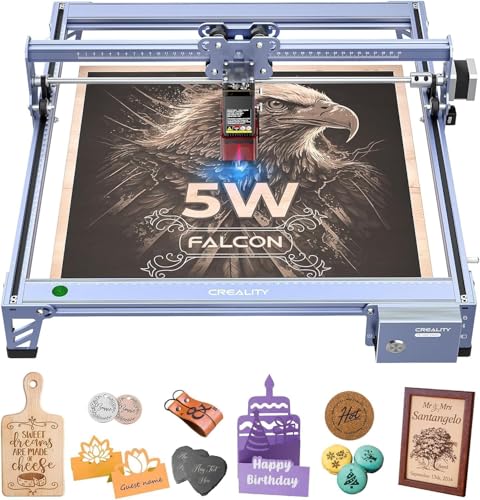
- 0.06mm compression spot for detailed engraving
- 400 x 415mm work area for larger pieces
- 10,000mm/min speed with eye-protective cover
Best For: Beginners prioritizing detail and repeatable results
Higher-Power Starter

- 10W output for stronger cutting capability
- 0.06mm spot and 10,000mm/min speed
- LightBurn, LaserGRBL, Wi-Fi, USB, and SD support
Best For: Beginners planning to cut thicker craft materials
Most Portable Pick – Pocket-Sized Laser Engraver
The LaserPecker LP1 Plus is a practical laser engraver for beginners who want a compact machine for simple projects at home or on the go. It starts quickly, works from a power bank, and uses a cross-platform app for importing photos or doodles. Keep in mind that the included ruler is used to set a 200 mm lens-to-material distance, and metal engraving is not supported.
Best For: Beginners making portable DIY projects on wood, leather, paper, acrylic, and other compatible non-metal materials.
Pros:
- Pocket-sized 2.4-pound design is easy to transport.
- Adjustable stand supports 360° multi-angle engraving.
- Simple app workflow and startup in under two minutes.
- Magnetic base helps secure small items.
Cons:
- Metal engraving is not supported.
- Requires careful 200 mm distance setup for the laser lens.
- The compact format is best suited to smaller projects.
The LP1 Plus emphasizes portability and ease of use rather than a large work area or broad material range. It is a sensible entry point for casual makers who value quick setup and mobile creativity.
Safest Compact Pick – Enclosed Mini Laser Engraver
The Twotrees TS1 Mini is a beginner-friendly laser engraver for beginners who prioritize an enclosed design and straightforward controls. Its acrylic cover contains light and debris, while Bluetooth smartphone control lets you upload images and adjust settings without a laptop. The small 80 × 80 mm work area makes it most suitable for detailed, compact projects.
Best For: Home workshops, classrooms, and makers who want enclosed operation and smartphone control for small items.
Pros:
- Fully enclosed design includes safety goggles.
- Plug-and-play setup requires no complex assembly.
- Bluetooth app control works with iOS and Android devices.
- 0.1 mm positioning accuracy and adjustable 3W laser support fine details.
Cons:
- 80 × 80 mm work area limits project size.
- Objects inside the machine must be no taller than 30 mm.
- Light cutting and engraving are intended for thin materials and small projects.
The TS1 Mini stands out for combining a compact footprint with an enclosed workspace and mobile controls. It is a strong choice for learning the basics, provided your projects fit its small work area.
Best Growth Pick – K15 Pro 10W Laser Engraver
The K15 Pro is a laser engraver for beginners who want room to progress from simple crafts into cutting and small-business projects. Its 10W diode module, near-A4 work area, free CutLabX software, wireless control, and three-minute assembly make the setup approachable. It also works with LightBurn and LaserGRBL and can run offline jobs from a TF card.
Best For: Beginners who want a versatile machine for wood signs, coasters, leather goods, coated metal, acrylic, gifts, and repeat projects.
Pros:
- Near-A4 11.8 × 7.9-inch workspace handles a broad range of everyday projects.
- 10W output supports engraving and cutting across more than 300 materials, according to the supplied notes.
- Free cross-platform software includes AI design tools and wireless control.
- One-touch focus, offline operation, warranty coverage, and lifetime technical support support long-term use.
Cons:
- The optional IR head is required for bare-metal engraving.
- Additional accessories such as a rotary roller or air purifier are optional.
- The supplied notes describe an expanded feature set that may take time for complete beginners to learn.
The K15 Pro offers a useful balance between beginner accessibility and upgrade potential. Its larger workspace and optional IR head make it more suitable than a mini engraver for users who expect their projects to grow.
Best Large-Workspace Pick – ACMER S2 12W Laser Engraver
The ACMER S2 is a laser engraver for beginners who want a larger working area and enough power for more ambitious DIY projects. Its true 12W module, 300 × 300 mm workspace, beginner-oriented assembly, and compatibility with ACMER Studio, LightBurn, and LaserGRBL provide a flexible starting point. Safety features include an anti-UV protective shield, goggles, and motion protection that pauses operation when abnormal movement is detected.
Best For: Beginners and growing makers creating signs, ornaments, layered artwork, personalized gifts, and small-business projects.
Pros:
- 300 × 300 mm workspace accommodates larger layouts and multi-piece projects.
- True 12W power supports engraving and cutting across more than 100 materials.
- Fine 0.08 × 0.08 mm spot and up to 0.01 mm positioning accuracy support detailed artwork.
- Windows, macOS, and Linux compatibility offers flexible software choices.
Cons:
- Optional rotary modules, risers, and air assist add to the system cost.
- Deeper cutting may require multiple passes.
- The larger workspace requires more room than the compact mini models.
The S2 is the most spacious option in this group and leaves more room for larger signs, layouts, and future accessories. It is a good fit for beginners who prefer buying a capable platform rather than starting with a highly restricted work area.
Best for Easy Setup – 5.5W Beginner Laser Engraver
If you want a laser engraver for beginners with minimal assembly, this 5.5W model is designed to get you engraving quickly. Its 300 x 300mm work area, 0.01mm focus, broad material support, and multiple connection options make it a flexible choice for home projects or a small workshop.
Best For: Beginners who prioritize simple setup, safety features, and a larger work area for wood, leather, acrylic, glass, or coated metal projects.
Pros:
- Modular five-piece design reportedly assembles without tools, with no belt tensioning or axis calibration.
- Includes a laser protection cover, flame sensor, emergency stop, safety lock, and tilt auto-pause.
- Supports LightBurn, LaserGRBL, and Cutlabx, with Wi-Fi, USB, mobile app, and offline TF-card options.
- Offers a 300 x 300mm work area and 0.01mm square-focus precision.
Cons:
- The rotary roller and air assist are optional add-ons rather than included features.
- Although it supports many materials, cutting and engraving results can vary by material and settings.
Its combination of beginner-friendly assembly, extensive safety measures, and software flexibility makes it a strong all-around starting point. Consider it if you want room to grow beyond basic wood engraving without replacing the machine soon.
Best Compact Option – ACMER S1 6W Laser Engraver
The ACMER S1 is a compact laser engraver for beginners that arrives 99% preassembled and needs only a quick laser-head installation. Its 6W diode laser, 130 x 130mm work area, and support for common engraving software make it a practical choice for small DIY projects and limited workspaces.
Best For: First-time users, hobbyists, and makers who need a lightweight, portable machine for detailed small-format engraving and light cutting.
Pros:
- Includes AcmerStudio software and also supports LightBurn and LaserGRBL.
- Uses a 0.04mm laser spot with up to 10,000mm/min speed and 0.01mm repeatable positioning accuracy.
- Works with materials including wood, bamboo, leather, plastic, PCB, ceramics, and aluminum oxide.
- Compact 2kg aluminum-alloy design supports Windows, macOS, and Linux.
Cons:
- The 130 x 130mm work area is substantially smaller than many desktop machines.
- Its Class 4 laser certification means users should take laser-safety precautions during operation.
The S1 emphasizes portability and a fast learning curve rather than a large production area. It is a sensible entry point for small crafts, personalized gifts, and detailed test projects, but larger signs or panels will require a bigger machine.
Best for Larger Cuts – Creality Falcon 10W Laser Engraver
For beginners who expect to work with larger pieces, the Creality Falcon offers a spacious 15.7 x 16.3-inch work area and a 10W laser module. Its 10,000mm/min speed, compatibility with popular software, and stated ability to cut thicker wood and black acrylic make it a more capable choice for ambitious projects.
Best For: Beginners and makers who want a larger work area for wood, leather, acrylic, fabric, and metal engraving, plus stronger cutting capability.
Pros:
- 400 x 415mm workspace accommodates larger materials in one pass.
- Rated to cut up to 12mm wood boards and 5mm black acrylic in one pass according to the supplied notes.
- Uses a 0.06 x 0.06mm compressed spot and lists repositioning accuracy below 0.007 inches.
- Supports LightBurn, LaserGRBL, and offline creation through an SD card.
Cons:
- Its larger footprint and approximately 10.93-pound weight make it less portable than compact beginner models.
- The supplied compatibility notes list specific operating-system support, so check your computer before purchasing.
The Falcon is a good fit when project size and cutting power matter more than the smallest possible footprint. Its larger workspace gives beginners more flexibility, while software and offline support provide several ways to manage jobs.
Balanced Beginner Pick – LONGER Ray5 5W
The LONGER Ray5 5W is a versatile laser engraver for beginners who want a generous work area, multiple connection options, and straightforward setup support. Its 400 x 400mm workspace and compatibility with LaserGRBL and LightBurn make it suitable for learning and varied DIY projects.
Best For: Beginners seeking flexible connectivity and a roomy work area for wood, leather, acrylic, glass, and metal projects.
Pros:
- 400 x 400mm working area accommodates larger projects.
- Up to 10,000mm/min engraving speed and a 0.08mm laser spot support detailed work.
- Supports USB, TF card, Wi-Fi, and app connections, including offline use.
- Includes emergency shutdown, motion protection, overheating detection, protective covers, and goggles.
Cons:
- The 5W output may be less suitable for demanding cutting than higher-output models.
- Protective equipment and safety features still require careful operating practices.
The Ray5 stands out as a well-rounded entry point, especially for users who value connectivity choices and a larger workspace over maximum cutting power.
Precision-Focused Choice – Creality Falcon 5W
The Creality Falcon 5W is a laser engraver for beginners who prioritize fine detail and repeatable results. It combines a 0.06mm compression spot, 10,000mm/min speed, and a 400 x 415mm work area for projects ranging from small designs to larger material pieces.
Best For: Detail-focused beginners working with wood, leather, acrylic, glass, and other supported materials.
Pros:
- 0.06 x 0.06mm spot supports fine engraving detail.
- 400 x 415mm working area handles larger projects in one go.
- Up to 10,000mm/min speed supports productive engraving.
- Eye-protective cover filters 97% of UV rays, and active stop functionality responds to detected movement.
Cons:
- Rotary roller and raisers for cylindrical or taller objects are sold separately.
- The product is listed as Laser Class 4, so careful safety procedures are essential.
With its fine spot and slightly larger listed work area, the Falcon 5W is a compelling choice for beginners who want precision without giving up project capacity.
Higher-Power Starter – Creality Falcon 10W
The Creality Falcon 10W is a laser engraver for beginners who want more output power for cutting as well as engraving. Its 10W output, 0.06mm spot, and compatibility with LaserGRBL and LightBurn provide a practical path from introductory projects to more capable material work.
Best For: Beginners who want stronger cutting performance for basswood, dark acrylic, paper, leather, and similar materials.
Pros:
- 10W output is specified to cut 5mm basswood or 3mm black acrylic in one pass.
- Up to 10,000mm/min speed supports efficient engraving and cutting.
- 0.06 x 0.06mm spot and stated repositioning accuracy support detailed designs.
- Supports LightBurn and LaserGRBL, with Wi-Fi, USB, and SD card data transfer.
Cons:
- The larger output may be more capability than needed for simple beginner engraving projects.
- Its listed dimensions indicate a substantial machine footprint.
The Falcon 10W is the strongest fit here for beginners who expect to cut thicker materials, while its focusing plate and multiple software options help keep operation approachable.
How We Picked the Best Laser Engraver for Beginners
We focused on the features that matter most when learning laser engraving: manageable setup, clear controls, practical power, work-area size, safety design, and material compatibility. We also considered whether each machine suits small personalized items, signs, craft projects, or more ambitious cutting and engraving work.
Power ratings are useful but are not the only measure of performance. Beam focus, air assistance, software support, frame stability, and the material being processed can affect results just as much. Enclosed models received special consideration for beginners who prioritize a contained workspace and added protection.
Quick Comparison
| Best for | What to prioritize | Recommended type |
|---|---|---|
| Small gifts and portable projects | Compact design, adjustable positioning | LaserPecker LP1 Plus |
| Added workspace protection | Fully enclosed construction | Twotrees TS1 Mini |
| General DIY engraving | Balanced power and a larger work area | 5.5W to 10W open-frame models |
| Faster cutting and thicker materials | Higher optical output and air assistance | 12W-class ACMER S2 |
| Offline operation | Touchscreen or onboard controls | LONGER Ray5 |
Key Buying Factors for a Laser Engraver for Beginners
Laser Power and Materials
Lower-power machines are well suited to engraving wood, leather, cardboard, coated items, and similar craft materials. Around 10W generally offers more cutting capability, while a 12W-class machine can handle demanding projects more efficiently. No diode engraver safely processes every material, so check the manufacturer’s compatibility guidance and never engrave PVC or unknown plastics.
Work Area and Machine Size
A compact engraver is easier to store and can be ideal for ornaments, tags, and small artwork. A roughly 300 × 300mm work area is more flexible for signs and larger panels, but it requires more table space and careful material alignment.
Safety Features
Look for an enclosure or protective shield, emergency stop, limit switches, flame detection, motion protection, and dependable ventilation. Open-frame machines should be used with appropriate laser-rated eye protection, supervision, and a controlled workspace. Vent smoke outdoors or through a properly designed filtration system.
Software and Controls
Beginner-friendly software support can matter more than a small difference in advertised precision. Confirm compatibility with your computer or phone, supported file formats, and whether the machine can pause, resume, or operate offline. Touchscreens and simple positioning controls can make repeat jobs easier.
Who Should Buy Which Laser Engraver for Beginners?
Choose the LaserPecker LP1 Plus if portability and small, creative projects matter most. The Twotrees TS1 Mini is a sensible option when an enclosed design is a priority. For a first full-size DIY machine, look at the 5.5W, ACMER S1, or LONGER Ray5 options. Choose a Creality Falcon or K15 Pro when you want a practical balance of workspace, accuracy, and material versatility. If cutting performance is the main goal, the higher-powered ACMER S2 is the strongest fit in this group.
Before ordering, measure your available workspace, confirm software compatibility, budget for ventilation and safety accessories, and decide whether you need engraving only or regular cutting. Those choices will narrow the field faster than headline wattage alone.
