Choosing among resin printers for small businesses means balancing print quality, build volume, speed, ease of use, and operating costs. The right machine can support prototypes, miniatures, jewelry models, dental-style patterns, and other detailed parts without overwhelming a small workspace or budget.
We compared ten current options across resolution, automation, capacity, workflow features, and business practicality. Use the guide below to narrow the list based on your production volume, preferred level of detail, and available workspace.
Best 10 Resin Printers for Small Businesses Picks for 2026
Best for High-Volume Production

- Large 18.3L build volume for batch production
- 14-inch 12K screen for fine detail
- Heated resin tank and automatic leveling
Best For: Oversized prototypes and dense production batches
Best for Automated Detail Work

- 16K resolution for intricate models
- Heated tank supports consistent resin flow
- AI camera, auto-leveling, and fast tilt release
Best For: Detailed production with reduced hands-on monitoring
Best for Dual-Material Creativity

- Dual-color and dual-material printing platform
- Wave release reduces demolding force
- AI checks for plate, resin, and residue issues
Best For: Small models and multicolor assembled creations
Best for Beginner-Friendly Workflows

- 16K detail with 14 × 19μm pixels
- Factory pre-leveling and smart resin handling
- Heating and remote monitoring for easier operation
Best For: Small teams wanting a streamlined resin-printing workflow
Best High-Precision Choice
Reflex RS Turbo Resin 3D Printer

- High-contrast amber screen for detailed, fast curing
- Automated slicing, supports, and auto-leveling
- Sensor-based failure detection and diagnostic reports
Best For: Small production workflows requiring precision and monitoring
Best Detail Value
Phrozen Sonic Mini 8K S Resin Printer

- 22-micron XY resolution for fine detail
- Compact 16.5 × 7.2 × 17 cm build volume
- Works with popular open-source slicers
Best For: Beginners and compact studios producing detailed small models
Best Connected Workflow
ELEGOO Mars 5 Ultra 9K Resin Printer

- Up to 150 mm/h stated printing speed
- AI camera and mechanical sensor for monitoring
- WiFi cluster printing and remote file transfer
Best For: Studios managing fast or multi-printer production
Best Overall Detail Value
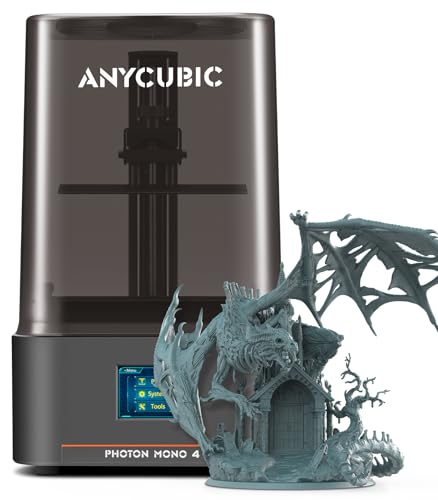
- 10K resolution with 17×17μm pixel precision
- Stable curing with 1.5-second exposures
- Assembled, calibrated, and power-loss recovery
Best For: Small businesses producing detailed prototypes and miniatures
Best for Speed-Focused Detail

- 10K detail with 17×17μm pixel size
- Up to 120 mm/h with High Speed Resin 2.0
- Self-check functions and multilingual touchscreen
Best For: Small teams needing detailed prints with faster turnaround
Best for High-Volume Production – ANYCUBIC Photon P1 Max
For small businesses needing resin printers for small businesses with substantial batch-production demands, the ANYCUBIC Photon P1 Max stands out for its unusually large build volume, heated resin tank, and automated setup features.
Best For: Small businesses producing oversized prototypes or densely packed batches.
Pros:
- Large 285.5 × 214 × 300mm build volume supports oversized parts and high-volume batch runs.
- 14-inch 12K monochrome screen and 24.8μm pixels support fine, smooth details.
- Heated 1900ml resin tank helps maintain resin flow in cooler workshop conditions.
- Auto-Leveling 3.0 and C7-grade ball-screw motion control simplify setup and support repeatable positioning.
Cons:
- Its 68.9-pound weight and large footprint require substantial workspace.
- The large resin tank and build volume may be unnecessary for low-volume operations.
The P1 Max is best suited to businesses that can take advantage of its capacity. It offers a practical combination of automation, temperature control, and precision for recurring production work, but its size makes it less appropriate for compact work areas.
Best for Automated Detail Work – ELEGOO Saturn 4 Ultra 16K
The ELEGOO Saturn 4 Ultra 16K is a strong option among resin printers for small businesses that prioritize highly detailed models, quick release, and monitoring features that can reduce hands-on oversight.
Best For: Businesses making detailed models while valuing speed and remote-style monitoring assistance.
Pros:
- 16K resolution is designed for smooth surfaces, fine textures, and precise models.
- Intelligent tank heating maintains resin at approximately 30°C to support fluidity and layer adhesion.
- AI camera monitoring can alert users to empty build plates and warped models, with built-in lighting and time-lapse support.
- Automatic leveling, tilt release technology, and speeds up to 150mm/h streamline production.
Cons:
- AI detection results may vary with the environment, model, and resin type.
- Its listed 24 × 17 × 15-inch dimensions still require dedicated workspace.
With automatic leveling, heated resin, and residue detection, the Saturn 4 Ultra is built around a low-intervention workflow. Its monitoring tools are useful for busy operators, though AI alerts should be treated as assistance rather than a guarantee against failed prints.
Best for Dual-Material Creativity – ANYCUBIC Photon P1
For small businesses seeking resin printers for small businesses that can handle distinctive multicolor or multimaterial creations, the ANYCUBIC Photon P1 combines a dual-color/-material platform with precision motion hardware and print-failure checks.
Best For: Small models and assembled designs requiring dual-color or dual-material printing.
Pros:
- Dual kits can reduce resin costs for small models and print complex assembled creations in one go.
- Industrial-grade ball screws, precision rails, and a build platform with under-80μm flatness tolerance support stable printing.
- Wave release technology reduces release force by more than 60% compared with smooth NFEP films.
- AI-assisted plate, bottom-layer, resin-level, and residue detection helps identify workflow issues.
Cons:
- The listed 33.07-inch length requires careful workspace planning.
- Dual-color/-material features may be more capability than a business needs for standard single-resin parts.
The Photon P1 is especially appealing when product appearance or integrated assembly matters. Its optical system, cooling, and motion components target consistent detail, while the detection features can help reduce wasted time on preventable problems.
Best for Beginner-Friendly Workflows – UniFormation GK3T
The UniFormation GK3T is a practical choice among resin printers for small businesses that want high-resolution output without a complicated setup. Factory pre-leveling, resin-handling features, heating, and remote monitoring are aimed at simplifying daily operation.
Best For: Teams that need detailed prints and a streamlined, easy-to-manage workflow.
Pros:
- 16K resolution with 14 × 19μm pixels supports sharp details and smooth surfaces.
- Factory pre-leveling, smart resin feeding, anti-drip platform, and quick-release plate simplify operation.
- Intelligent heating can maintain resin fluidity in temperatures as low as 0°C/32°F.
- Smartphone and slicing-software controls provide remote monitoring, progress updates, and time-lapse photography.
Cons:
- At 52.8 pounds, it is not especially lightweight for frequent relocation.
- Remote control and workflow integration depend on the dedicated app, slicing software, and compatible wash-and-cure equipment.
The GK3T emphasizes an all-in-one workflow rather than a single headline specification. Its combination of precision, temperature management, mess-reduction features, and remote visibility makes it a useful fit for small teams that want repeatable operation with less manual setup.
Best High-Precision Choice – Reflex RS Turbo Resin 3D Printer
For small businesses that need repeatable, detailed output, the Reflex RS Turbo is a resin printer for small businesses focused on speed, accuracy, and process monitoring. Its high-contrast amber screen, automated setup tools, and industrial-grade motion components are designed for demanding production workflows.
Best For: Small businesses producing detailed parts, prototypes, or batches where consistency and failure monitoring matter.
Pros:
- High-contrast amber screen is designed for crisp details, dimensional accuracy, and faster curing.
- One-click slicing can repair common model defects and generate supports automatically.
- Force sensors can detect resin residue, pause jobs, and create a diagnostic report after printing.
- C5 ball-screw Z-axis offers stated repeat positioning accuracy of up to 2 µm.
Cons:
- At 50.6 pounds, it is substantially heavier than the other listed options.
- Its advanced systems may be more than a very occasional user needs.
The Reflex RS Turbo stands out when production reliability and fine tolerances are priorities. Its automated calibration, adaptive process controls, and professional support make it a strong fit for businesses that want a more controlled resin-printing workflow.
Best Detail Value – Phrozen Sonic Mini 8K S Resin Printer
The Phrozen Sonic Mini 8K S is a compact resin printer for small businesses that need highly detailed models without moving to a larger machine. Its 22-micron XY resolution, monochrome 8K LCD, and compatibility with popular slicers make it practical for miniatures, action figures, and small design work.
Best For: Beginners and small studios making detailed miniatures, models, and action figures in a compact workspace.
Pros:
- 22-micron XY resolution is suited to fine model detail.
- Its 16.5 × 7.2 × 17 cm printing volume provides useful tabletop capacity.
- Supports open-source software and slicers including Lychee, Chitubox, and Tango.
- Precise Z-axis calibration supports even, accurate printing.
Cons:
- Its printing volume is smaller than what many batch-production workflows require.
- The supplied details do not mention built-in camera monitoring or network cluster printing.
This Phrozen model is an approachable option for businesses starting with resin printing or specializing in small, highly detailed pieces. Its compact footprint and broad slicer compatibility add flexibility, while the limited build volume favors smaller projects.
Best Connected Workflow – ELEGOO Mars 5 Ultra 9K Resin Printer
The ELEGOO Mars 5 Ultra is a resin printer for small businesses that want faster production, remote file transfer, and built-in print oversight. Its 150 mm/h stated speed, smart mechanical sensor, AI camera, and WiFi cluster printing features are especially useful for teams managing more than one printer.
Best For: Small businesses and print studios that value fast jobs, remote operation, and multi-printer workflows.
Pros:
- Tilt Release technology and speeds up to 150 mm/h are designed to reduce printing time.
- Smart mechanical sensing can identify low resin, foreign objects, and high light-board temperature.
- Built-in AI camera monitors issues such as empty build plates and model warping.
- WiFi supports remote transfers, OTA updates, and simultaneous printing across multiple printers on one LAN.
Cons:
- Its advanced networking and monitoring features may be unnecessary for a single occasional printer.
- The supplied information does not specify the printer’s build volume.
The Mars 5 Ultra is the most workflow-oriented choice in this group. With 9K imaging, automated issue detection, and cluster printing, it is well suited to small operations planning remote management or future expansion.
Best Overall Detail Value – ANYCUBIC Photon Mono 4
For small businesses seeking resin printers for small businesses, the ANYCUBIC Photon Mono 4 combines a compact footprint with high-resolution output and a straightforward setup. Its 10K screen, stabilized light source, and upgraded build plate support detailed prints while helping reduce common print failures.
Best For: Small businesses that need detailed prototypes, miniatures, or product samples without a complicated setup.
Pros:
- 10K resolution and 17×17μm pixel precision capture fine details.
- LighTurbo light source supports stable curing and 1.5-second exposures.
- Factory-assembled and calibrated for a quick start.
- Power failure recovery can resume interrupted prints.
Cons:
- Its compact build size is less suited to large objects or high-volume batch printing.
- Requires a four-point leveling check before use.
The Photon Mono 4 is a practical entry point for businesses prioritizing detail and ease of use. It is especially appealing when workspace and production needs are modest.
Best for Large-Scale Production – ELEGOO Jupiter 2 Large 16K
The ELEGOO Jupiter 2 is a strong option for small businesses that need resin printers for small businesses with substantially more capacity. Its large build volume supports bigger parts or multiple smaller pieces per job, while automated resin handling, heating, monitoring, and safety alerts simplify ongoing production.
Best For: Businesses making large models, grouped production runs, or parts that would require multiple prints on a smaller machine.
Pros:
- 302.4 × 161.98 × 300 mm build volume accommodates large or multiple objects.
- 16K resolution and a fully enclosed light source support detailed, uniform exposure.
- Auto leveling, smart tank heating, and automated resin replenishment streamline operation.
- Camera monitoring, Wi-Fi, power-loss recovery, and safety alarms support production oversight.
Cons:
- Its 63.8-pound weight and large dimensions require substantial workspace.
- The extensive feature set may be more than a low-volume business needs.
- Maintenance still involves occasional release-film replacement.
Choose the Jupiter 2 when throughput and part size matter more than a compact footprint. Its automation and monitoring features make it the most production-oriented option in this group.
Best for Speed-Focused Detail – ANYCUBIC Photon Mono 4 Ultra
For small businesses evaluating resin printers for small businesses, the ANYCUBIC Photon Mono 4 Ultra emphasizes detailed output and faster workflows. Its 10K LCD, COB light source, ACF film, and intelligent release algorithms are designed to preserve precision while reaching speeds up to 120 mm/h with High Speed Resin 2.0.
Best For: Small teams that want detailed models with a speed-oriented workflow and guided printer operation.
Pros:
- 10K resolution and 17×17μm pixels support fine model detail.
- COB light source with Fresnel lens provides at least 90% light uniformity.
- ACF film and release algorithms help shorten printing time.
- 360-degree self-check functions and an eight-language interface simplify operation.
Cons:
- The 120 mm/h maximum speed depends on using High Speed Resin 2.0.
- Its 7-inch screen and stated dimensions offer less capacity than the Jupiter 2.
The Mono 4 Ultra suits businesses balancing fine detail with faster turnaround. It is a compelling middle ground when a compact machine needs more speed-focused features than a basic model.
How We Picked the Best Resin Printers for Small Businesses
We evaluated these printers for the needs of small studios, product designers, makers, repair shops, educators, and other businesses that need dependable detailed parts. Our comparison emphasized resolution, build volume, leveling and monitoring features, print speed, resin-handling convenience, software workflow, and the amount of maintenance likely to be required.
We also considered whether a printer makes sense as a primary production machine, a specialized detail tool, or an affordable entry point. A higher-resolution screen can improve fine features, but it does not replace correct exposure settings, sound supports, suitable resin, and consistent post-processing.
Quick Comparison
| Best For | Recommended Direction | What to Prioritize |
|---|---|---|
| Large batches or oversized models | Large-format printers | Build volume, stability, resin capacity, and repeatability |
| Fine miniatures and display models | High-resolution 16K or 8K systems | XY resolution, exposure consistency, and detail retention |
| General business prototyping | Mid-size 10K–14K printers | Balanced speed, workspace, cost, and ease of use |
| New users or shared workspaces | Automated, sensor-equipped models | Leveling assistance, monitoring, and straightforward controls |
| Limited workspaces | Compact tabletop printers | Footprint, ventilation, cleanup, and accessible controls |
Key Buying Factors for Resin Printers for Small Businesses
Resolution and Real-World Detail
Screen resolution and XY pixel size indicate the smallest details a printer may reproduce, but print quality also depends on optics, calibration, resin, and model orientation. Choose higher resolution when your business sells intricate miniatures, small mechanical details, or jewelry-style patterns. For larger prototypes, build volume and reliable throughput may matter more.
Build Volume and Production Capacity
Measure the largest parts you expect to produce, then leave room for supports and efficient batch layouts. Large machines reduce the number of runs for multiple parts, while compact models can be easier to place, clean, and operate. Remember that larger vats usually increase resin consumption and cleanup requirements.
Automation and Reliability
Auto-leveling, mechanical sensors, print monitoring, dependable release mechanisms, and guided setup can reduce failed prints and save labor. These features are especially valuable when employees with different experience levels share the printer.
Operating Costs and Safety
Budget for resin, release films, build plates, gloves, filters, cleaning supplies, replacement screens, and a suitable wash-and-cure workflow. Resin printing requires ventilation, careful handling of uncured material, and proper disposal practices. A printer is not business-ready if the workspace cannot safely support it.
Who Should Buy Which Resin Printers for Small Businesses?
Choose a large-format option such as the ANYCUBIC Photon P1 Max or ELEGOO Jupiter 2 when batch size and oversized models are central to your business. The Saturn 4 Ultra and UniFormation GK3T are strong directions for users seeking a balance of detail, capacity, and production-oriented features.
For highly detailed work in a smaller footprint, consider the ELEGOO Saturn 4 Ultra, ANYCUBIC Photon P1, Reflex RS Turbo, or Phrozen Sonic Mini 8K S, depending on the required capacity and workflow. The ELEGOO Mars 5 Ultra and ANYCUBIC Photon Mono 4 are sensible choices for general prototyping and smaller operations. The Photon Mono 4 Ultra adds a higher-resolution option for users who want compact equipment with extra detail potential.
Before buying, confirm current pricing, replacement-part availability, compatible resins, software support, and the printer’s exterior dimensions. For most small businesses, the best choice is the model that delivers the needed detail and batch size with the least disruption to daily handling—not necessarily the printer with the highest headline resolution.
